
Author Archives: CharlieClaywell

Unknown's avatar

About CharlieClaywell

I have been a writer for years, mainly as a reporter, but I have always enjoyed history, especially non-mainstream stories buried inside old documents. My blog mostly centers around those stories. On occasion, though, I deviate and talk about my dog, vintage toys and what it's like to be middle-aged.

‘Evicted’ Describes What It’s Like To Be Poor, Vulnerable

As I recently posted, years ago I realized I live in a very impoverished county. Despite this reality, some local organizations are in denial. In a December, 2017 article, the Preble County Economic Development Director detailed job openings and business investments being funneled into the county painting a rosy picture of Preble County.

She said,

“There is no better marketing strategy than the demonstration of a successful and thriving business climate.”

According to the article, the County will gain about 200 jobs, but the cost for 109 of the positions was more than $500,000 in state tax breaks and another $135,000 in incentives from the cash-strapped City of Eaton. So, it’s a mixed bag at best, but regardless it’s about selling who we are and the Director does not shy away from that.

Later in the article, she says.

Preble County is the fifth largest ag county in the state and we pride ourselves in our strong workforce and strong work ethic. These traits make it easy to market Preble County.

Make The Bums Work

Despite the marketing spin, a help wanted sign has been on display for more than 90 days at one of the companies — suggesting a labor pool problem. The manufacturing firm needs less than 20 new workers. Freedom Caucus Members Warren Davidson and Jim Jordan (see below) are convinced the able-bodied people on welfare are causing the labor shortage in the United States, but there may be another reason we can’t fill the openings. Legislators may have unnecessarily created felons in their rush to feed the private prison industry. And as these nonviolent offenders return home, they meet their first barrier to reentering society — employers who refuse to hire them due to their felony conviction.

Today (Monday, Jan. 7), in Eaton (pop. 8,200) 125 cases are on tbe Eaton Municipal Court docket. Preble County Common Pleas has 24 items and the County Jail has filled 66 of its 70 beds.

On Sunday, Jan. 7 Congressman Warren Davidson re-upped the link to an op-ed co-written last summer with fellow Freedom Caucus member Jim Jordan. The dynamic due is convinced if able-bodied persons on welfare were forced to work our labor shortage would be solved.

I tend to dismiss the validity of local public relation stories because if life is as good as they say it is, I would not see empty buildings or infrastructure in need of repair. I would not see a slow crawl to expand the local jail. Nor would I see the ‘are you addicted’ signs as outside groups swoop in to financially benefit from our drug problem. In a great place to live we would not accept the exploitation.

Hard Times In The ‘Greatest Country On Earth’

When I read Evicted: Poverty and Profit in the American City by Matthew Desmond, which deals with poverty in Milwaukee, I noticed some of the same denial in the comments of Milwaukee’s gatekeepers and leaders. In Evicted, Desmond follows the lives of eight families as they ‘struggle to keep a roof over their heads.’ This engaging book received the Pulitzer Prize for nonfiction in 2017.

From my perspective the work accomplishes three things.

An Inside View Of Impoverished Life

Although there are eight families, Desmond does an excellent job balancing their stories. As their stories unfold, you can ‘see’ inside their homes and apartments, some quite filthy, and some filled with the aroma of marijuana. But, you can also see their attempts to pull out of their situation, only to be struck down by an unexpected bill, poor decision, or a landlord who arbitrarily decides to evict them for a late payment while letting a neighbor, who was also late, stay. You feel the loss of hope and insecurity as Desmond describes the ‘good, bad and ugly’ of their lives and communities.

Legal System All Messed Up

What I also enjoyed about the book was its balance. This is not a ‘poor renter’ book painting the landlord as an evil villain. Desmond creates a realistic image of the landlords’ plight as well. Although he does report a landlord’s willingness to kick out tenants, he also details the expense landlords incur in the process — destroyed or damaged property, court fees and inspections that can cost thousands. The reader quickly learns, though, that some landlords are better humans than their peers. Desmond helps uninformed readers, like myself, get a feel for how clunky, intrusive and ineffective the legal system is when dealing with the landlord-tenant relationship.

Lots of People ‘Just Doing My Job’

Those who have never faced evicted are probably unaware of the process. With just a few scenes Desmond brings it to life. The movers, including companies that specialize in evictions, invade a tenant’s home after they have been legally served by armed police officers. The movers, depending on legalities and landlord — and sometimes tenant wishes — sort through the belongings. Some of the stuff is sold, some stored, and a lot is ‘set on the curb.’ In one family’s story, the tenant hauls all her stuff to a neighboring house trailer because she knows the tenant is in the hospital. As the evictions occur, Desmond sprinkles in enough of the various comments from tenants, movers, and officers to show just how jaded they’ve become.

Don’t Skip The Ending

In some books, I skip epilogue-type content telling myself it’s nonessential. With this book the ‘after story’ is just as interesting as the book. Desmond goes into detail about the field work and his effort to not interfere with the subjects. He tried to keep the events naturally unfolding by staying in the background. I would also advise reading Amazon reviews — some of them come from people very close to the story — including Milwaukee Joe — who is critical of at least one of Desmond’s landlord depictions. However, Milwaukee Joe still gives the book a 4 out of 5 rating which, in my opinion, speaks to the book’s strength.

My Rating: 5 out of 5 stars. This subject could easily be a boring ‘just the facts’ story. It’s not. As a reader you become vested in the outcome. The book is also a strong indictment against how the United States treats its poor. For those interested in policies, Desmond also details techniques for improving tenant-landlord laws in the U.S.
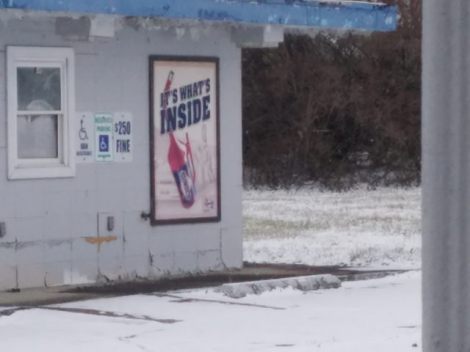
The gas station I used as a teenager has been abandoned for years. The empty building greets visitors as they enter the City of Eaton from the east.

Categories: 8th congressional district, Books I have read, Life In A Red State, My America, Preble County, Understanding Trump Counties

Heroin(e) Tells Story Of Three Outliers Making A Difference In Opioid Epidemic

If you do the same thing, you get the same results. In my part of the Greater Appalachian region this maxim applies to individuals, not systems.

In the short Netflix film Heroin(e) cameras examine the heroin epidemic ravaging Huntington, Va. — a once-proud industrial town that now has an overdose rate 10 times the national rate. The film’s website describes the documentary as follows:

Fire Chief Jan Rader spends the majority of her days reviving those who have overdosed; Judge Patricia Keller presides over drug court, handing down empathy along with orders; and Necia Freeman of Brown Bag Ministry feeds meals to the women selling their bodies for drugs.

In many ways, these women are combatting a male-centric view on how a society deals with a crisis. Rader, a firm believer in utilizing Narcan — medication that can reverse an opioid overdose, It is credited with saving 27,000 lives (2015 data) in the United States. She is met with resistance, though, with one male firefighter asking ‘but are we require to administer it.’

In Southwest Ohio we combat the same mindset.

The Butler County sheriff (directly to the south of Preble County) generated a news story in 2017 when he stated that his deputies would not administer Narcan, saying it doesn’t solve the problem — adding he was concerned for his officers’ safety. He cited the debunked theory that addicts receiving Narcan would ‘wake’ violently. The film shows several ‘coming out of their overdose.’ They are confused and docile, but the ‘violence’ myth is perpetuated by those who do not want to administer Narcan.

The dedication of the three women in the film is refreshing.

Besides the work done by Rader, the efforts by Keller and Freeman are reminders that some Americans still look out for their fellow citizens, regardless of the choices they’ve made or the situations they’re in. Films like this fill a much-needed vacuum in the ‘war on drugs’ which shows that compassion, coupled with individual responsibility, is a significantly more humane way to treat another human.

My Rating: Five out of five stars. The film is long enough to tell the story without belaboring the point. It shows the ‘good, bad and ugly’ of the epidemic without presenting the chemically-addicted in a condescending manner.

Categories: 8th congressional district, drug addiction, My America, Preble County, Understanding Trump Counties

What I Believe: Children Are Ruling The Playground And The Religious Right Is Wrong

Hiking at Ceasar Creek State Park during first snow of the season.

I believe it was Ben Franklin who said that most people die at 25 but aren’t buried until 75. I strive to make each year a time of growth, and I challenge my beliefs because truth can stand the scrutiny. Part of this process means that, for the past few years, I’ve reflected on what I know for sure. (Here are my thoughts on 2015 and 2016.)

As 2017 ends, here is what I believe:

1.) Children Are Running The Playground. I’ve seen this on the national level as the Orange Menace and Congress push a trickle-down economic plan. It didn’t work the first time around for Preble County — we enjoyed a 12 percent unemployment rate in its first year (1982). But I’ve grown tired of national politics and am more interested in the local children. The policies championed by local gatekeepers are failing — entrenching our poverty. In this crimson-red county, those who hold the purse strings, especially at the county level, have become less transparent and less willing to compromise for the good of our community. Emboldened, perhaps by 45*, these ineffective leaders need to face the scrutiny of a strong media presence and/or citizens so their behind-the-scenes actions can enjoy a little sunshine.

2.) The Drug Epidemic Is A Symptom Of Our Hopelessness. The drug epidemic claimed a family member’s life in November. He was my cousin, 32, a hard-working man employed in Montgomery County. He died of an apparent overdose, coincidentally, on the anniversary of my father’s death. His death is difficult to accept. It’s a painful reminder of our abysmal approach to drug use and abuse in southwest Ohio.

In Preble County those with addiction issues are often treated as sub-human. Our abandoned dogs receive more compassion than the chemically addicted. It is a top-down problem as the hypocrisy of our political leaders, especially those who have melded their fundamentalism with their political agenda, perpetuate long debunked myths about addiction. I have met my share of chemically-addicted individuals in the past five years and the most common thread, in the lives I see, is a disconnect with the community.

Many here believe it is the church’s place to ‘help these people find a cure.’ If churches believe that, the first thing they should do is befriend a chemically-addicted individual. The second thing they should do is be quiet. When they are silent they can hear, and in listening, they may learn where we failed our community members — as too many of the chemically addicted are victims of horrific events. Save their soul, if that’s important to you, but begin by saving their life. And, as compassionate people keep our neighbors alive, gatekeepers can work to bring livable wage jobs here to help us pull out of the epidemic. It would be infinitely more valuable to our community than planning the construction of (yet another) building at the fairgrounds.

3.) Justice Is Not Blind. If court records, police reports and the local jail roster have taught me anything in 2017, it’s that justice is not blind. It despises the poor and hates the chemically-addicted, but less so in December when the jail population falls by about 25-30 percent. Although it looks like a Christmas miracle, the reduction in inmates may be more closely linked to limited court openings during the holidays. (I wonder if that’s why reformers believe all defendants should request a trial.)

Versa reflects on the condition of her soul.

4.) The Religious Right Is Wrong. I was raised in a white, evangelical church so I have a thorough understanding of their interpretation of the Bible. I’m also aware of their obsession with the afterlife as they postpone a quality life here to ensure a spot in the Treehouse in the Sky — and just as importantly — avoid an apartment in the Eternal Lake of Fire. At my age, a warm fire doesn’t sound so bad, but if there is a Hell my biggest fear is my roommate. If Hell is meant to torture, I’m stuck with Franklin Graham or Jerry Falwell Jr. — men who scream out in fear on a daily basis as they use their pulpits to decry gays, Democrats and Muslims (not necessarily in that order). If I had to listen to their impish drivel for an eternity — well, I think you get my point.

The Religious Right should sell bumper stickers that say: Believe like us — or go to Hell. But if they want a heavenly afterlife, they need to read — then live — Matthew 25. It’s not complicated.

5.) David Thoreau Was Correct. In many ways, it seems to me, Thoreau lived in a time similar to ours. There was a significant portion of the country entrenched in anti-intellectualism with a religious force ‘proving’ that the immoral institution of slavery was, somehow, ‘God’s will.’ As the political dysfunction of Thoreau’s era eventually led to the Civil War, Thoreau found peace in the woods doing his work. When 2017 began I attended a Unitarian church in Eldorado — one that, unlike the fundamentalist/evangelicals, exemplifies the inclusivity of Jesus.

In January, the minister spoke about ‘Now what’ and, referencing a scripture, she said we needed to plant our gardens, tend to our fields — or, in other words, do our work. Her message, and Thoreau’s approach of being in nature, became a practice for me. Although I was not able to attend the Unitarian church as much as planned, I hiked a lot of Ohio’s forests — finding peace and contentment despite the political mayhem created by a deplorable dotard.

Looking forward to 2018….

Categories: 8th congressional district, Age of Discontent, Life In A Red State, maga, My America, Ohio