Author Archives: CharlieClaywell

Unknown's avatar

About CharlieClaywell

I have been a writer for years, mainly as a reporter, but I have always enjoyed history, especially non-mainstream stories buried inside old documents. My blog mostly centers around those stories. On occasion, though, I deviate and talk about my dog, vintage toys and what it's like to be middle-aged.

Dodge Ball, Dogs, And The Motivating Power of Praise

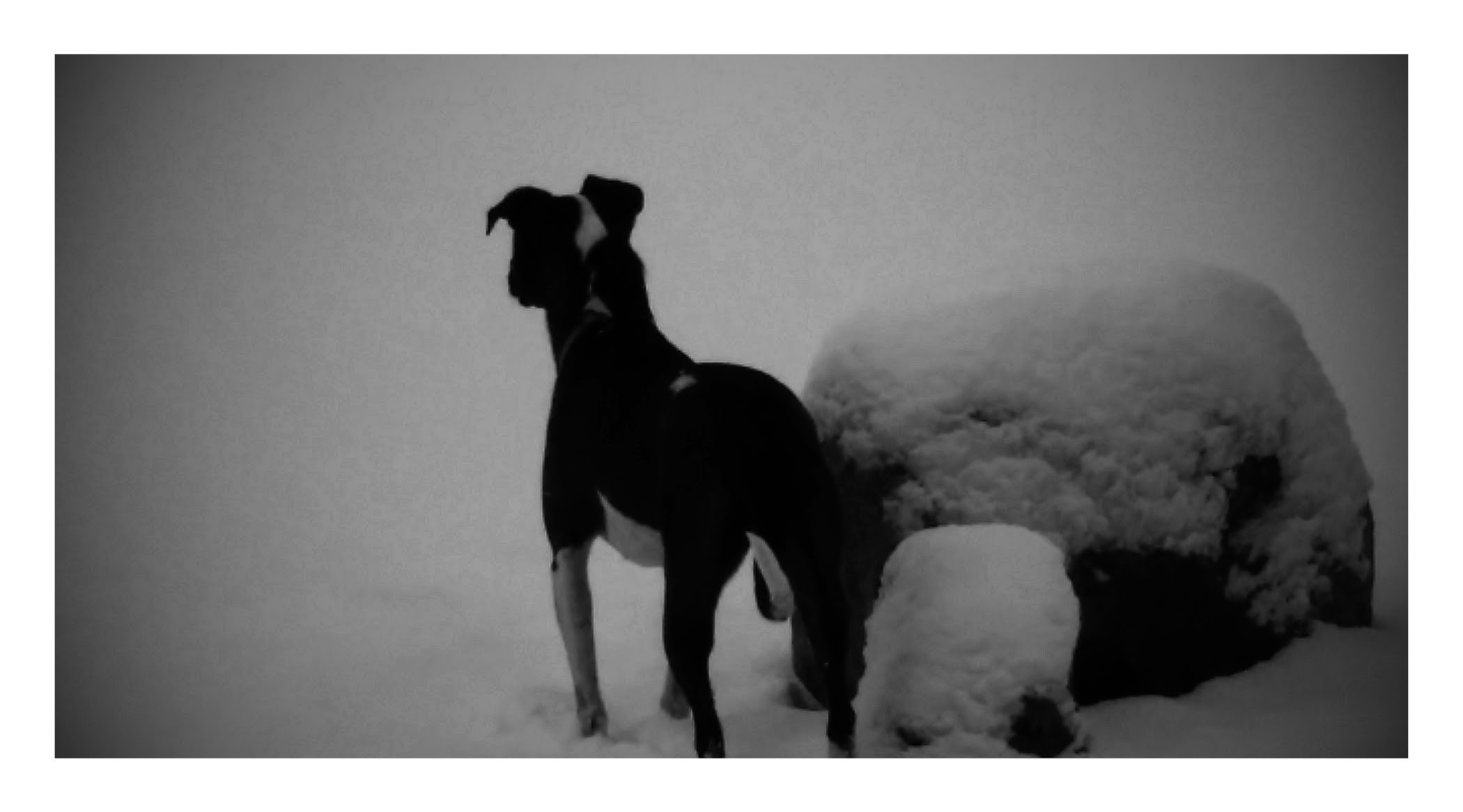
20160112_103030-EFFECTSI have a pound dog. And, like many shelter animals she suffers from fear aggression, which means she responds negatively to anything new or scary.

It can be a challenge when training her.

She does not respond to negative reinforcement. The other day when she grabbed my daughter’s unprotected sandwich and started to eat it, despite several firm commands to Drop it, she did not.

I knew she wouldn’t even as I utter the command.

Positive Reinforcement

She’s not a bad dog. In fact, Versa is normally well behaved (I know I’m bias). She will sit on command, lie down on command, fetch a ball and even catch a ball — all on command. She did not learn those skills with negative reinforcement. They were taught using the clicker training method. With this system a dog learns to associate the clicking sound with something positive — like a treat or praise.

And, Versa will do anything for a treat or praise. She will work hard. She will think and repeatedly try to master a new skill because she knows what is waiting for her. I even mix it up, giving her surprise jackpot treats which brings out the excitement even more.

I’m the same way. So are you.

One of the most positive experiences I had in grade school involved a not-so-fun game of dodge ball. As a small, underweight and athletically disadvantaged child, sports were not my place to shine. Unfortunately, then as now, even for the athletically challenged, sports are a huge part of the socialization process for children.

But, what I lacked physically I made up for in persistence. And, by the end of the day’s first dodge ball game, I found myself alone against five or six opponents, including the ‘toughest’ kid in the class.

As I dodged, threw, caught and played, my teammates were yelling — not words of encouragement, like ‘you got this’ or ‘you can do this’, but rather words like ‘give up’, ‘let them hit you’, and ‘get out so we can start a new game’. Of course, I didn’t give up and by some twist of fate, I outlasted my opponents and my team won.

But that wasn’t the end of the story.

Our gym teacher, Mr. Gilmore, (yes, I do remember his name), pulled the class aside, praising my hard work and perseverance.

That’s how you do it, he said.

One of the toughest battles bloggers and writers face, I believe, is the lack of positive feedback. Writing can be a vacuum with little to fill the void. We write, we post, and are often uncertain if our words touch anyone. The struggle is real. It is difficult to find your voice in the midst of the millions of other voices. It is hard to find the audience. As one talented writer notes,

I have my moments of doubt, when I wonder that I am talentless and all this education and practice and persistence means nothing because I just don’t have that mystical spark that makes a ‘real’ writer.

In those moments it’s definitely easier to quit. To throw in the towel — say I gave it my best shot — get a do-over and start a new game. Just like my fellow blogger, some days doubt fills the void. But, she doesn’t stop there. She offers these pearls of wisdom,

However, I also know that every person on the planet has these moments of angst, and I go on writing until the doubt dies down.

Thanks, Mr. Gilmore

When doubt creeps in, Mr. Gilmore resurfaces in my mind and I remember outlasting, outmaneuvering a more physically capable opponent. I did it then. I can do it now.

That’s what Mr. Gilmore said.

And I still believe him.
Categories: blogging university | Tags: , , , , ,

Andy Griffith Played Dark Role Before Mayberry & Matlock

It is Andy Griffith like you’ve never seen him. Released in 1957, A Face in the Crowd, follows the meteoric rise of a ‘country boy’ with a saleable skill — singing.

The movie opens with a local radio DJ heading to the county jail to spice up her A Face in the Crowd broadcast which interviews common, everyday people — hoping to find a rising star. Larry Rhodes (Andy Griffith), in jail for public intoxication, barters a deal with the DJ and sheriff in exchange for playing a song for the radio show. His bluesy, country sounds draws in the DJ who sees potential in the young miscreant.

After convincing her uncle, the owner of the radio station, to take a chance with Rhodes, the Lonesome Rhodes personality is unleashed on the public. What follows over the course of the two-hour film is a growing awareness by Rhodes that he can influence the public to do his bidding. At first it is benign — as he successfully attracts enough donations to help a woman rebuild her home destroyed by fire, but by the end, Rhodes has become the classic example of ‘power corrupts, absolute power corrupts absolutely.’ When he reaches the peak of his fame, he reminds his associates,

I’m not just an entertainer, I’m an influence, a wielder of opinion — a force.

Controlling the Masses

Although the film has a 1950s-era quality to the acting, it’s provocativeness comes from the dialogue — a significant portion delivered by a young Walter Matthau — and subject matter. In his drive for power, money and fame, Rhodes discards societal norms and values and lives by his own set of rules.

But what the nearly 60-year-old movie does, beside addressing the hypocrisy of the rising elite, is it successfully predicts the ease of influence  TV launched. Everything is a product and Rhodes is the salesman, hawking Viagra-like sugar pills and presidential candidates. Near the end of the film, Rhodes overhauls a Senator’s image with a new personality to make the Senator a more likeable presidential candidate.

Despite Rhodes constant line that he is just a ‘country boy,’ he is well-schooled in market percentages and knows, not only his share of the viewing audience, but what that means in political and financial power. It’s why he advises the Senator on proper facial expressions and a better delivery style when speaking on camera. Rhodes even launches a Hee-Haw type show (Cracker Barrel) — where he just sits around and ‘chews the fat’ with his ‘country’ co-stars — so he can have a vehicle to introduce America to the new, improved (and much more marketable) Senator.

Image Versus Reality

Of course, as in all cautionary tales, the rise to the top is only exceeded by the fall. Rhodes becomes too brash and, when what he really thinks about his audience(they are dumb) is leaked to them, his fans abandon him.

But all is not lost.

It is Matthau’s character that succinctly describes the short-term memory of the American public. In one of the final scenes Matthau admits Rhodes will be back on TV, but, Matthau tells Rhodes, it won’t be the same. When people talk about you, Matthau says, they will say:

Whatever happened to .. you know what’s his name .. the one who was so big a couple years ago… the number one fella… how could we forget a name like that, by the way have you seen the new fella….


White Trash

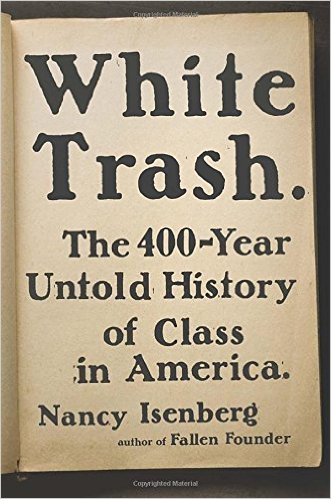
whitetrashI learned about A Face in the Crowd while reading White Trash: The 400-Year Untold History of Class in America by Nancy Isenberg. As Isenberg points out in the book, the film’s director used Griffith’s childhood upbringing as a motivational technique to draw more out of the actor.

The book, definitely a 5 out of 5 stars rating, addresses one of the oldest and most persistent myths in American culture: that we are a society with no class structure.

Isenberg begins in the colonial era, drawing off of the writings of the Founders, and builds a case that the people used to populate the colonies were, by and large, considered ‘waste’ people. They were expendable. She follows the theme of class up to the present time, showing, among other things, how political leaders exploit the class structure — often by pitting one class against another.

Despite being a more ‘scholarly’ book (with ample footnotes), White Trash is a very interesting, easy read. I highly recommend the book for anyone seeking a more in-depth understanding of America’s culture and history.

Categories: movies | Tags: , , , , , ,

Briggs & Stratton Dabbled In More Than Lawn Mowers

When I think of Briggs & Stratton, I think lawn mower. A 3-or 4-horsepower Briggs & Stratton was one of the first small engines I took apart as a kid. Those engines were known, then as now, for their simplicity, durability and reliability. Today I still prefer mowers with a Briggs and Stratton engine.

But, what I never knew about the company, was it manufactured go-kart type vehicles in the 1920s.

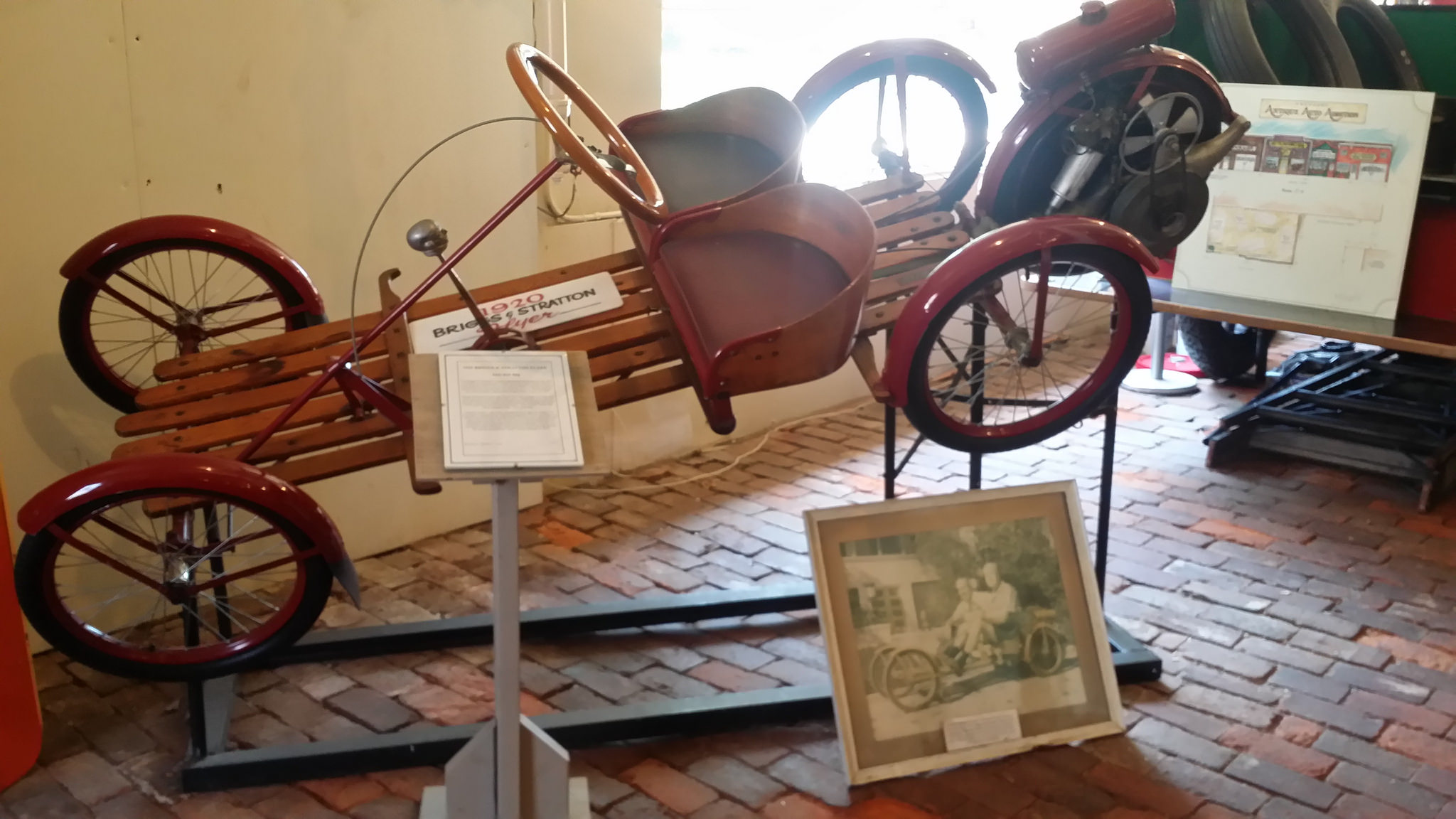
1920s-era Briggs and Stratton Flyer vehicle on display in the Wayne County Museum (Richmond, Ind.)

1920s-era Briggs and Stratton Flyer vehicle on display in the Wayne County Museum in Richmond, Ind.

Flyer Buckboard

I saw my first (and only) Flyer two-seat vehicle in the Wayne County Indiana Historical Museum in Richmond. The museum, which has an eclectic assortment of items — from a horse treadmill to a bona fide Egyptian mummy — houses about 15-20 early 20th century vehicles in a climate-controlled building behind the main exhibit area. This building alone is worth the $7 admission price. The building showcases vehicles, like the Davis automobile, that were manufactured in the region. They have two large electric vehicles from the early 1900s, but the gem for me is the first item you see when you walk in the door — the Briggs and Stratton Flyer Buckboard.

The vehicle has the look and feel of an old wooden sled with wheels. Two very small bucket seats sit on top of the wooden slats. The vehicle is barebones — no doors or windshields — just five wheels, two seats, a steering wheel and a gear stick (which is actually a lever to lower the fifth wheel).

Motor Wheel

When the automobile industry was in its infancy, lots of approaches were used to propel a vehicle forward. The one used by Briggs and Stratton was the Motor Wheel. Just like the name suggests, it was a wheel that included the motor. Sitting on top of the Motor Wheel was a half-gallon gas tank. Advertisements from that era said the vehicle could travel up to 25 mph and would get 80-100 mpg.

They accomplished those numbers with a 2hp motor. As Farm Collector notes,

At the peak of its popularity, the Motor Wheel was a versatile unit used to power bicycles, scooters, “flyers” (a small, two-seat, low-slung wooden buckboard with steering wheel and four wheels) and railway inspection cars. A photograph in the Briggs & Stratton archives even shows an ice skater using a Motor Wheel to tow her around the rink.

But, little did I know, that after a couple of failed ventures, it was the Motor Wheel that launched Briggs & Stratton into American history as the largest producer of small gasoline engines. The motor used in the Motor Wheel would eventually serve as the base model for their stationary gasoline engines.


And That’s Not All

Briggs & Stratton hybrid concept car.

Briggs & Stratton hybrid concept car.

When I began researching information about the vehicle, I stumbled upon another gem concerning Briggs and Stratton. They manufactured a hybrid vehicle — one that used an electric motor and a 18hp Briggs and Stratton engine in the late 1970s. Although the vehicle was not the first hybrid, it was ahead of its time.

But, unfortunately for the company, the prototype received poor reviews — mostly due to its lack of power. The vehicle could travel 300 miles on a tank of gas, had a fiberglass body and, (whether good or bad, you decide) looked a little like an AMC Pacer.

It also had six wheels. The extra wheels were a support feature — the car had 1000 pounds of batteries. Lithium Ion batteries were not invented until the 1990s so the vehicle used lead-acid batteries — like the ones used to start vehicles.

For a short history of Briggs & Stratton download the company’s publication (pdf).

Categories: American History | Tags: , , , ,