
Author Archives: CharlieClaywell

Unknown's avatar

About CharlieClaywell

I have been a writer for years, mainly as a reporter, but I have always enjoyed history, especially non-mainstream stories buried inside old documents. My blog mostly centers around those stories. On occasion, though, I deviate and talk about my dog, vintage toys and what it's like to be middle-aged.

Confirmation Bias Masquerading As The Voice Of God

28160056556_4e08e461dc_kI read an article by a preacher who attended the June New York meeting with GOP presidential candidate Donald Trump and evangelical leaders. The minister said that before the meeting began, he bowed his head and ask the Holy Spirit to guide him. The Holy Spirit led the minister to read Psalms 106. The passage, which he quotes in the article, is a condensed history of the sins of the Nation of Israel.

Of course, the minister interpreted David’s words by making a very, very long leap — Hillary Clinton must be stopped at all costs. It is what God wants, the minister asserts.

But, I wonder, how another person, say a Christian who is a Democrat, would interpret the same passage. Would God speak to them in the same way — declaring that Hillary is evil and Donald Trump is holy. Probably not. Not because of God’s apathy to the American dilemma — our two-Party, highly factionalize and divisive political system which keeps the masses agitated and uniformed — but because of a psychological concept known as confirmation bias.

As author David McRaney points out in You Are Not So Smart: Why You Have Too Many Friends on Facebook, Why Your Memory Is Mostly Fiction, and 46 Other Ways You’re Deluding Yourself, we tell ourselves that we read, research, and ponder over our position. We tell ourselves we weigh out all the choices, gather our information from a variety of sources, and make intelligent, logic-based decision.

But we don’t work that way. As McRaney writes,

Check any Amazon.com wish list, and you will find people rarely seek books which challenge their notions of how things are or should be. During the 2008 U.S. presidential election, Valdis Krebs at orgnet.com analyzed purchasing trends on Amazon. People who already supported Obama were the same people buying books which painted him in a positive light. People who already disliked Obama were the ones buying books painting him in a negative light. Just like with pundits, people weren’t buying books for the information, they were buying them for the confirmation.

Regardless if the subject is politics, religion or the breed of a dog, we start with our position and then find evidence to support it. In the current political climate, our highly predictable confirmation bias is used to push, prod and control us. As a 2013 article from CNN points out each like, share and post on Facebook paints an increasingly clear image of who you are, allowing marketers, advertisers — as well as ministers and politicians — to target you with information that confirms your bias. This data is so valuable one company is reportedly buying $40 billion worth of it.

But back to the minister. Did he interpret Psalms 106 accurately? Well, that depends on which presidential candidate you are backing. He concluded his piece by writing,

I couldn’t help but re-read Psalm 106, realizing that a spiritual cry of repentance is needed long before a strategic call to Republicans.

Of course, from his perspective, this spiritual awakening will be led by Trump, a man who revealed his level of godliness in two small, yet vital, ways: In his inability to name a favorite Bible verse and his mispronunciation of a New Testament text.

I know a lot of good Christians and two things I know for certain with everyone I have met. Not one of them, absolutely none, have ever said Two Corinthians and every single one has a favorite Bible verse. They never have to stop and ponder the question, What is your favorite Bible verse? Most, if not all, will even quote the verse to you.

So, even though some holy men are convinced Trump has the answers and they are ready to champion him — I think they are just hearing what they want to hear.

But, maybe my own confirmation bias is clogging my brain.

I doubt it, though.

Categories: Politics, Religion

WWII Museum In New Orleans Worth 2-Day Ticket

28090156122_434df13030_zI recently spent several days in New Orleans and one of the sites I visited was the WWII Museum. It was actually the first museum I have ever been in when a second-day pass would have been a good choice. It can be purchased for an additional $6 — when you buy a regular ticket. If you have the time, it’s worth the few extra dollars.

The reason I recommend it is the museum is divided into two floors: the European campaign and the Pacific Theatre. There is enough to read and see on each floor to easily take several hours.

One of the Best Museums

Two things make this museum one of the best. First, you are issued an interactive ‘dog tag’ with your ticket. Once you register your dog tag in a kiosk or by boarding a fake train (which is neat), you then follow the person — a real soldier — along their path through the war. They will most likely fight in one or the other campaigns — I do not know if any of the soldiers in the interactive piece fought in parts of both campaigns.

This brings the war to life in a more personal way since you get to hear their story as you make your way through the museum.

Since the museum is associated with some of Tom Hanks’ work it includes soldiers from Band of Brothers (the author was one of the museum  founders) and The Pacific (Eugene Sledge, for example), so if you have seen those series, you will recognize some names.

The other aspect of the museum that adds to its appeal is the 4D special effects movie — Beyond all Boundaries which highlights the war’s beginning. It’s worth the extra $5. The film is about 20 minutes long. We chose to watch it before walking through the museum. (you have to choose a film time when you buy your ticket).

My only criticism of the museum is there are not enough stations for listening to the soldiers’ stories and, even on a mildly crowded day like the day my daughter, her boyfriend and I went, you often have to wait too long to use a listening station. Since there are several stations to visit this can slow down your walk through the museum. They have offset this somewhat by making the content available at home by logging in with your email address.

The museum is open seven days a week, except for a handful of holidays.

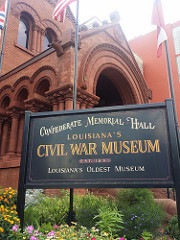
27913063470_10d5245318_mCivil War Museum

Just across the street from the WWII Museum is Louisiana’s oldest Civil War museum. The museum is a repository of Confederate items and includes artifacts owned and used by Robert E. Lee, Jefferson Davis and other Confederate leaders. Although the museum is small, everything is housed on one floor, what they have is authentic and interesting. You can probably view everything in an hour or so.

Categories: Civil War History, Things To Do, WWII | Tags: , , ,

Big Brother — The TV Show — Paints Picture Of Who We Are

We have a summer tradition in my house. Each year, my wife, daughter and I huddle around the TV three times a week to watch the CBS reality show, Big Brother. If you’ve never watched the show, it has a simple premise: 12-16 people are locked into a small house for the summer — competing for $500,000. All they have to do is be the last one standing. Two things are pushing them out of the house — their ability or inability to get along with others (called the social game) and their ability to win physical challenges. In some ways, the show mimics the workplace, where people often win or lose based on their skill set and their ability to get along with co-workers.

Unlike workplaces though, people are asked to leave by their peers. This is done once a week when house guests cast votes to evict a teammate. (The idea has never been implemented in the workplace due to a fear of increased turnover.)

But, what unfolds inside the house is too much free time — which often translates to boredom — and a lot of ‘mind games,’ as every move and word of each player is recorded. Soon, they forget the cameras are there and, even with a loss of privacy, they get a false sense of security.

It is this loss of privacy that shines a light on who we are.

In season after season, despite the varying cast of players, a very predictable pattern emerges. Players make poor choices. Players say the wrong thing at the wrong time to the wrong person. They trust someone who is lying. As viewers we can see their mistakes. In a small, godlike way, we see the whole picture of their life, but the players, they can only see and know what is immediately in front of them. They only know their own actions and conversations. They cannot see how it is all about to play out.

It’s why they mess up — they make decisions based on their extremely limited viewpoint.

Experience Alters The Course

This season four players are returning and they have adjusted their gameplay. One player, much more abrasive in her past performance, is only showcasing her abrasive side in the diary room — a private conversation with show producers that her peers cannot see or hear until after the season is over. She learned from life. She learned that, although she is funny and witty, not everyone gets her humor or even likes her — so she hams it up for the camera and then uses a more low-key approach when interacting with other players.

Some say this is manipulative — after all she is not being ‘real.’ I disagree. No one can be all things for all people. Our predictability is a liability. When people can push our buttons, they control our behavior. In the end, they know precisely how we will respond.

The wise players, both in the game and in life, step back, pause and think through their response before reacting. Observing life, and adjusting to its flow, is not a weakness. It can lead to peace and power.

And for one person it will mean $500,000 this fall.

Categories: Personal Essays, TV Shows | Tags: , , , ,