
Author Archives: CharlieClaywell

Unknown's avatar

About CharlieClaywell

I have been a writer for years, mainly as a reporter, but I have always enjoyed history, especially non-mainstream stories buried inside old documents. My blog mostly centers around those stories. On occasion, though, I deviate and talk about my dog, vintage toys and what it's like to be middle-aged.

Talk About A Bad Day — This 1960s Telephone Operator Tells All

16458827959_7573341640_mBad days at work — we’ve all had them. Most of us have heard tons of advice on how to deal with bad days. I remember hearing somewhere along the way, you can write down your feelings in a letter — and then destroy the letter.

This poor lady should’ve followed that advise.

Let me set the stage. I found the letter on microfilm from a 1960s edition of a community newspaper which means I can’t link to it since it doesn’t currently exist online — and I can’t reproduce it in its entirety since that probably violates some copyright laws — so I’ll just highlight the best parts.

The lady, let’s call her Maggie, is a telephone operator who has had her fill of, among other things, people who ‘cough, sneeze, and clear their throats in our ears,’ jumps right into her formal complaint against consumers at large — saying, in the second paragraph of her letter to the editor,

“Some say we are slow. Unfortunately, they don’t realize the main thing that slows us down is themselves. They seldom know the number they want and in the time it takes us to reach information, we could easily take three more calls, sometimes more. I feel they are just too lazy to write it down — it’s easier for them to let us do it.”

She continues a few paragraphs later by adding,

About half the time we answer a call, we have to painfully extract the needed information from them, for they are carrying on a running conversation with someone else and could care less that we are talking to them.

And don’t even get her started on area codes. Even though area codes were first introduced in 1947 — it apparently took a little longer for them to be integrated in small rural areas like Preble County. Maggie said,

They have no idea what an area code is for and they don’t use it. Without the area code you usually end up with a recording in Dayton.

But, even though Maggie is clearly frustrated with her customer base, she is pragmatic and offers a solution as she closes out her letter.

Those who complain so much should apply for a job here, for I’m sure they’d find it an enlightening experience.

Categories: Good News, Humor

1960s Propaganda Game Gets Hollywood Treatment

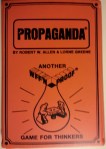
propaganda-game-coverWith a name like Propaganda — and with one of the game’s creators being Lorne Greene, the 60s western actor I had watched with my grandfather — I knew I had to purchase the game when I spotted it in the thrift store.

I’m glad I did, the game is like a time capsule from the mid-1960s.

Game’s Rules

The game is not one you just sit down and start playing. In the instruction booklet, which is 30-40 pages in length, players are advised,

“Since it is felt that an understanding of how one may deceive others is a prerequisite to an understanding of how one may be deceived by others, it is recommended that most players begin with Section A — Techniques of Self-Deception.”

the booklet further notes,

“A minimum understanding of each technique is necessary prior to the start of play; a more comprehensive understanding will develop as the players become involved in the game activities.”

propaganda-game

Game’s Origin

The game is based on the book: Thinking Straighter a college philosophy textbook written by Dr. George Henry Moulds. Moulds, a Waverly, Iowa high school graduate was a philosophy professor at Kent State in Ohio when the game was created.

In the Dec. 9, 1966 edition of the Daily Kent Stater — the college newspaper for Kent State college  — we learn the game is based on an “intriguing little brain-tickler of a course titled, ‘How To Think Straight,’ taught by Dr. Moulds.

The course, known simply as Philosophy 281, uses Moulds’ textbook and the article describes the book:

“It’s a witty book dealing with fallacies in language and methods of fooling people through the use of words. Dr. Moulds book has been gaining national attention lately because of a new propaganda game designed by Robert W. Allen, a former student of Dr. Moulds, and Lorne Greene, television star of “Bonanza.” What’s Greene doing fooling around with games? It seems that Allen and Greene, who are friends, were discussing philosophical topics one evening when Greene suggested that they design a game based on propaganda and its techniques.”

WWII Indirectly Inspires Game

After high school, Moulds graduated from Wheaton College with honors in 1938. He went on to become a high school teacher and principal before joining the Army in 1942. Moulds was assigned to the anti-aircraft division and would eventually participate in the D-Day attack.

According to the game booklet, as a result of his war experiences, Dr. Moulds turned to the study of philosophy. He received his PhD from the University of Chicago in 1959.

Value of Game

With such a specialized subject matter – and a game designed for thinking, instead of ‘fun’ — the game never really seemed to take off and it does not enjoy a significant collector’s market. The game was introduced in 1966 and came with a hard plastic shell. The version I have is the 1975 edition which has a soft plastic cover. Complete games in nice shape of the 1975 edition sell for around $10. The 1966 version — complete and in nice shape — sell for $25-$30.

When the game was released in 1966, it sold for $5.

Trivia

Known for his role as Ben Cartwright in Bonanza, Greene was an accomplished actor both before and after the hit TV show. But the show had a lasting impact on the Canadian-born actor — Greene’s personal residence in Arizona was a replica of the house used on the Bonanza set.

Categories: Vintage Toys

Wealthy Businessman Decries Tax System That Aids The Rich

I’ve always liked reading what Former Labor Secretary Robert Reich has to say about the economy. He is down to earth, practical and believes, quite simply, that people who work for a living — the Middle Class — has been getting the raw end of the deal for decades. In this 2013 documentary, he proves his point, by examining the data and explaining the government policies that created the stagnant wages workers have labored under since the early 1970s.

Categories: Family History