
Author Archives: CharlieClaywell

Unknown's avatar

About CharlieClaywell

I have been a writer for years, mainly as a reporter, but I have always enjoyed history, especially non-mainstream stories buried inside old documents. My blog mostly centers around those stories. On occasion, though, I deviate and talk about my dog, vintage toys and what it's like to be middle-aged.

Relax Kids — I Mean Parents — It’s Just A Game

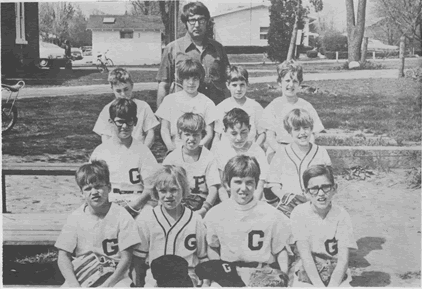
16025215106_e6df5834f4_o

I’m pictured bottom, right.

I try not to rant much  — in life or when I blog. I feel plenty of people are already ranting, but occasionally when I come across someone saying what I believe — I push it out for everyone to digest.

But, first let me set the record straight. I love baseball. Always have. I spent a considerable part of my youth playing catch, learning to field, hit and score. I followed the Big Red Machine religiously and relished in both of their World Series wins. I still think they are one of the greatest baseball teams ever assembled.

But something happened along the way between childhood and parenthood changing my view of youth sports.

I’ve attended youth sporting events in the past decade where I felt as if I had been transported to a Will Ferrell movie set. This is because some of the comments I’ve heard parents yell — sounded like Ferrell (think Stepbrothers).

I had even come to the conclusion that maybe it was me. Maybe I was old, cranky, tired and irritated. Maybe my inability to enjoy the incessant, juvenile heckling of the coaches and referees proved I was out of touch with how sports should be handled.

But I was wrong — it’s not me, it’s them.

In Sunday’s Parade magazine, St. Louis Cardinals Manager Mike Matheny, an Ohio native, is interviewed for his recent book, The Matheny Manifesto: A Young Manager’s Old-School Views on Success in Sports and Life where he expands on the idea of making youth sports all about the kids.

You say, “the biggest problem in youth sports is the parents.” “Yes. When you ask kids who play sports at different levels, ‘What do you want your parents to do?’ The overwhelming majority say, ‘Nothing.’ Parents need to be a silent source of encouragement.”

Silent source of encouragement?

His quote reminds me of another book every parent and coach should read — Until It Hurts: America’s Obsession with Youth Sports and How It Harms Our Kids by Mark Hyman. Hyman, a sports reporter, gives an inside look at the amount of money spent — and the volume of injuries — caused by the overly ambitious drive of parents who are banking on their child’s professional athletic future.

Hyman, though, does not just spout off numbers and stats, instead he takes you along for a more personal ride. The ride of his teenage son who has aspirations of becoming a professional baseball player — a son, who at the age of 18, has Tommy John surgery in the hopes of extending the life of his overused pitching arm.

Hyman, who had reported on the epidemic of Tommy John surgery at the high school level, writes,

..with my son in the doctor’s waiting room, I had become the overzealous parent and the accuser had become the accused.

A few pages later, Hyman further explains,

The bigger is better model of youth sports delights adults. We see our kids improve their skills and join highly competitive travel teams, a feat that impresses friends in the neighborhood and validates our superior parenting. The thousands of adults whose living depends on the billion dollar youth sports economy — selling gear, services, hotel rooms and such–are also happy…Only kids are losers here. Their voices are rarely heard…

Matheny, a Golden Glove winner who has led the Cardinals to the postseason each year since taking over as manager in 2012, was coaching Little League when the Cardinals approach him with a job offer.

In his book, Matheny dives into that youth coaching experience and argues that youth sports are about building character and concentrating on the 99 percent who will never make it to the next level of competition.

I couldn’t agree more.


Tommy JohnDodgers’ Pitcher Tommy John

I followed Tommy John’s pitching stats in my youth because he –and the Dodgers — were always standing in the way and trying to prevent the Reds from advancing to the postseason. He had the surgery named after him in September, 1974 and did not play in 1975. However, he was back in 1976 and was named the Comeback Player of the Year. He had three seasons with 20 wins or more after his surgery.

Long since retired from MLB, John operates a sports business designed to take aspiring young pitchers to the next level so they can make it in the big leagues. In Hyman’s book, John has this to say about parents.

What they don’t understand, and will never understand, unfortunately, is it makes no difference whether you start pitching at eight or eighteen. I can take a kid who has never pitched in his life until he’s seventeen. By the time he’s nineteen he’ll throw as well or better than the kid who’s been pitching since he was eight — and have less wear and tear on his arm.

John retired from MLB in 1989 after Mark McGuire got two hits off of him in a game. McGuire’s father was John’s dentist and the ole left-handed pitcher quipped,

When your dentist’s kid starts hitting you, it’s time to retire!

Categories: Baseball, Middle age

Mystery of Fatal Confederate Submarine Mission Closer To Being Solved

As Civil War Historian Bruce Catton points out in America Goes To War, the War Between The States forever altered modern warfare.

Neither side in the Civil War was prepared to stop anywhere short of complete victory. In the old days, wars had been formalized; two nations fought until it seemed to one side or the other that it would not be worth while to fight any longer, and then some sort of accommodation would be reached…But in the Civil War it was all or nothing.

Because of this new approach to war, after the first shot was fired there could be no compromise, no half-way point where the two sides could get together and agree on a truce. This all or nothing approach led to the invention of modern artillery, machine guns and the Civil War marked the introduction of submarine warfare.

By today’s standard the war’s submarines were very primitive.

But when the H.L. Hunley launched on the cold winter night, Feb. 17, 1864, from Charleston Harbor, and torpedoed the USS Housatonic, destroying the ship — the sub made history by becoming the first submarine to sink a war ship.

But it costs the Confederates more than the Federals as the submarine did not make it back to shore, costing the lives of all seven aboard. Before its fatal mission that night, 13 men had already lost there lives in the submarine project and as the History Channel reports,

For the third time, Hunley slipped to the bottom of Charleston Harbor, but exactly why remains a mystery. The undersea vessel could have been fatally damaged in the torpedo explosion, hit by a shot from Housatonic or sucked into the vortex of the sinking warship.

In 2000, the submarine was lifted from the water and for the past 15 years, scientists have been working to remove the gunk and sediment from the naval device. Recently, they uncovered the hull and one scientist admitted they are closing in on a theory as to why the hand-cranked sub sank.

Paul Mardikian, senior conservator on the Hunley project told the Associated Press that the exposed hull has revealed some things that may help solve the mystery — although he stopped short of revealing what those things were.

Last May, the submarine was placed inside a solution of sodium hydroxide to loosen the encrustation. In August, scientists began removing the loosen material with air powered chisels and dental tools. Approximately 70 percent of the hull is now exposed.


Learn More

Gold Coin found in H. L. HunleyIf you want to know more about the history of the submarine’s restoration project — or the history of its Civil War service — head over to the Friends of Hunley website. The site has a wealth of information including an intriguing story about a recovered gold coin belonging to the lieutenant in charge of the mission, George Dixon.

Categories: American History, Civil War History | Tags: , , , , , ,

Have Genealogy Stories To Tell? History Writing Challenge May Be The Answer

Gravestone for Bennie Lewis, located in Cumberland County, Ky. My family lineage is filled with lots of interesting stories. Stories of captured soldiers — one who worked with the enemy to survive. Stories of a 20-something-year-old man who wore the wrong coat and was shot by federal agents. Stories of survival, loss and hardship. The problem, though, is all the stories need to be committed to paper (or pixel) and that’s where a project I recently stumbled upon comes in. The Family History Writing Challenge is a 28-day challenge that starts February 1. It is designed to motivate and guide family historians and genealogists in a month-long effort to capture and record family stories. I’ve never attempted a challenge like this before, so I am curious to see where it leads. I have until Sunday to decide what exactly I want to zero in on (I am wavering between Civil War era Beatys and Shadrach Claywell’s children). Once I decide, though, there will be a couple entries about the stories I am trying to uncover. If you are interested in participating in the project, click here. The project is free — although donations are accepted. (Disclaimer: I am not compensated for this promotion, I’m just trying to pass along genealogy tips as I find them. Another recent tip for Kentucky researchers can be accessed here.)

Categories: Family History, Genealogy, Tools for historical search | Tags: