
Author Archives: CharlieClaywell

Unknown's avatar

About CharlieClaywell

I have been a writer for years, mainly as a reporter, but I have always enjoyed history, especially non-mainstream stories buried inside old documents. My blog mostly centers around those stories. On occasion, though, I deviate and talk about my dog, vintage toys and what it's like to be middle-aged.

Founding Father Reworked New Testament To Highlight Philosophy of Jesus

Thomas JeffersonThomas Jefferson was obviously one of the most influential men in early American history which is why I find this to be one of his most intriguing projects (besides, of course, the Constitution). It is a little book Jefferson pieced together commonly called The Jefferson Bible.

In a nutshell, the book is a succinct version of the first four books (the Gospels) of the New Testament. Jefferson splices together all four books and, by removing the redundancies, streamlines the story of Jesus and his philosophy into an easy-to-read 40 pages.

Since Jefferson was a Deist, besides splicing the story together, he removes quite a bit from the Gospels as well.

The Jefferson BibleThis is because Jefferson rejected the divinity of Jesus and did not believe all the miracles that had been attributed to him. In fact, in Jefferson’ words those passages belonged on the ‘dunghill.’ Since those passages are eliminated (the virgin birth, the resurrection, water to wine, etc.), what is left is the core of what Jesus said and taught.

Although Jefferson did not believe Jesus was divine, he did believe that the ethical system of Jesus was the ‘finest the world has ever seen.’

From a historical perspective, the book is also interesting simply because you get to read Jefferson’s handwritten notes in the margin of the book and you get a feel for how his mind worked. The Smithsonian version that I read, includes a couple chapters in the front that explain why Jefferson laid out the book as he did and its unique history — including how the Smithsonian finally acquired it. The Smithsonian version also explains the process of preserving the original book.

Regardless of your religious beliefs, it is an excellent book to read if you want a clearer understanding of what Jesus said. Besides the English passages, Jefferson also compiled the story of Jesus in Latin, Greek and French. All four translations exist inside the same book.

You can read the English-only, 1902 publication online for free here (pdf).
Categories: American History, American Revolutionary War

Ohio’s Presidential Legacy: William Harrison — America’s One-Month President

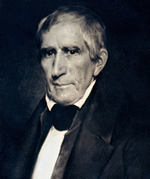
harrisonGrowing up in Ohio, I knew one thing for certain about the United States presidency — the state delivered eight men to serve in the White House. They were:

  1. William Harrison
  2. Ulysses S. Grant
  3. Rutherford B. Hayes
  4. James Garfield
  5. Benjamin Harrison
  6. William McKinley
  7. Howard Taft
  8. Warren Harding

What I did not learn in school was these eight men were involved in some of the weirdest stories in United States’ history. Of the eight men, two were assassinated, one died under suspicious circumstances, two lost the popular vote and were selected president (one in a scandal much larger than the 2000 Gore-Bush election) and one was the first president to die in office.

Here is a look at Ohio’s first offering for U.S. President.

William Harrison

Besides having the dubious honor of being the first president to die in office, Harrison also has the shortest presidential term: 30 days, 12 hours, and 30 minutes.

Most historians peg his death — ruled pneumonia by his doctors — as being caused by his two-hour long March 4 inaugural address which took place in rainy and cold weather.  He was 68 — and at the time — the oldest elected president. However, some disagree that the weather caused Harrison’s death because he did not become ill until nearly three weeks after the speech. These scientists theorize his death may have been associated with the human sewage that festered near the White House.

That field of human excrement would have been a breeding ground for two deadly bacteria, Salmonella typhi and S. paratyphi, the causes of typhoid and paratyphoid fever — also known as enteric fever, for their devastating effect on the gastrointestinal system.

Once he became ill, though, he died nine days later.

Despite such a short presidency, Harrison is credited with several ‘firsts,’ including:

  • Having the first modern presidential campaign. He successfully created the image of a common working class man (he was wealthy and his father was governor) during the 1840 presidential campaign — an image other politicians have successfully used and re-used.
  • Being the first sitting president to be photographed.
  • Being the first Whig to be elected president.

Upon Harrison’s death, the concept of how to deal with a vacancy in the office of president was tested. This was because neither the Constitution nor the 12th Amendment stated whether the vice president was named President or simply filled in as acting president until an election. Tyler took on the role of president establishing the precedent used today.

Trivia:

Harrison’s grandson Benjamin, also an Ohioan, was the 23rd U.S. president. Benjamin was elected to only one term.

-flagsBooks About Harrison
Of course, there is much more to Harrison’s life than his short-lived presidency. In fact, he was a successful military man and politician before deciding to become president. Several books have been written about Harrison and one that consistently garners good reviews on Goodreads is the 422 page Old Tippecanoe: William Henry Harrison and His Time by military historian Freeman Cleaves.
Another well-received book is: William Henry Harrison: The American Presidents Series: The 9th President,1841.
Categories: American History, Ohio History

Sutton, “American Apocalypse”

L&R Forum's avatarLAW AND RELIGION FORUM

This December, Harvard University Press will release “American Apocalypse: A History of Modern Evangelicalism” by Matthew Avery Sutton (Washington State University).  The publisher’s description follows:

American ApocalypseThe first comprehensive history of modern American evangelicalism to appear in a generation, American Apocalypse shows how a group of radical Protestants, anticipating the end of the world, paradoxically transformed it.

Matthew Avery Sutton draws on extensive archival research to document the ways an initially obscure network of charismatic preachers and their followers reshaped American religion, at home and abroad, for over a century. Perceiving the United States as besieged by Satanic forces—communism and secularism, family breakdown and government encroachment—Billy Sunday, Charles Fuller, Billy Graham, and others took to the pulpit and airwaves to explain how Biblical end-times prophecy made sense of a world ravaged by global wars, genocide, and the threat of nuclear extinction. Believing Armageddon was nigh, these preachers used what…

View original post 121 more words

Categories: Family History