I don’t know much about Americanism, but it’s a damn good word with which to carry an election – Warren Harding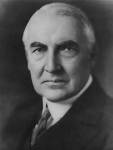
There is a reason few people can recall anything Ohio native and 29th president of the United States, Warren Harding did — he didn’t do much.
One of his greatest accomplishment came after he died — landing at the top of the Worst U.S. presidents list.
He has remained near the top ever since.
Born in a Small Town
The son of two doctors, Warren Gamaliel Harding, born in Corsica, Ohio, served as president from 1921-1923. At the age of 14 Harding was admitted to Ohio Central College and upon graduation his first business ventures were teacher and insurance salesman. In 1882, he and a couple of friends bought a small newspaper in Marion, Ohio and he spent the next decade or so managing and growing the paper.
It would be nine years later, when he married Florence Kling de Wolfe, a wealthy divorcée five years his senior — that Harding’s success would rally take off. De Wolfe, who had a keen business sense and plenty of money — started by helping the paper continue its successful run.
Political Career
In 1898, seven years after marrying de Wolfe, Harding entered politics at her bidding. He was elected twice to the Ohio legislature and became lieutenant governor in 1903, Even though two years later he returned home to his newspaper business, his political career had launched because, “Harding did favors for city bosses who, in turn, helped him advance in Ohio politics.”
In 1914 Harding became a member of Congress — elected as the Senator from Ohio. It is here we first get a hint of his work ethic with regards to the legislative process. Although he held strong views while in Congress, he didn’t back those views up with action since he “missed two-thirds of the votes held during his tenure as senator.”
Regardless, in 1920, political insider and close friend Harry Daugherty started pushing the idea of Harding for the Republican nomination for president. According to Daugherty, Harding was a great candidate because Harding had no significant political enemies, held the ‘right’ position on all the issues — and what may be the first instance in the 21st century of image over substance for a candidate — Harding ‘looked like a president,’ Daugherty said.
Running for Office
Harding’s campaign slogan, “return to normalcy,” hardly seems capable of inspiring voters to put him in office — but they did by an overwhelming majority. He carried 37 states and 60 percent of the vote.
He pulled this off despite the fact that he was not the first choice for the Republican Party that year — former president Theodore Roosevelt was. But when Roosevelt’s health declined drastically in 1918 (he died in 1919), the party made a strategic move — similar in design to the Democrats — by backing the little-known dark horse candidate from the electoral-vote-rich state of Ohio. The Democrats ran Ohio governor James Cox and Vice President candidate Franklin D. Roosevelt.
But the 1920 election, like today, was about spending power and getting the message out. With a 4-1 spending advantage over the Democrat candidate, Harding easily won.
So What Did He Do
One would think if elected and chosen by that many Americans, Harding would settle down and get to work on an agenda to bolster the post-war America. But that wasn’t the case. Aside from promoting political cronies to high-level positions, his only other accomplishments were cutting the income tax for the wealthy and raising tariffs — both high up on the Republican ‘to do list’ at the time.
While president, Harding deferred most decisions to Congress and confided to close friends and political allies that he wasn’t prepared for the role of president. Taking a page from his senatorial past — when his inactivity was reflected in his voting record — Harding assigned ‘the best man’ to the various roles of government. It would lead to several scandals including the Tea Dome scandal where government contracts were doled out to friends in return for guaranteed loans. His friend Daugherty would be indicted twice and eventually forced to resign his appointment of Attorney General during Calvin Coolidge’s administration.
But He Loves The Ladies
Harding was a ladies’ man. His first extra-marital affair began in his hometown of Marion when a local department store owner and wife lost a child. It was 1904 — the department store owner was a close friend of Harding, and Harding felt compelled to comfort the man’s strawberry-blonde wife during their time of grief. Harding would comfort Carrie Phillips, nine years his junior, for the next 15 years.
Then, in 1917, Harding discovered Nan Briton another Marion resident. Briton, who was 31 years younger than Harding, was infatuated with the good-looking politician. After her graduation from secretary school she requested a letter of reference from Harding. After the pair’s cordial meeting in May, Harding and Briton took it to the next level and by July were intimate.
Briton’s relationship with Harding would continue while he was Senator and they allegedly conceived a child inside a closet of the Capitol building. In 1919, Briton gave birth to a girl which she claimed was Harding’s child. (the official record says Harding has no children).
Both affairs proved expensive to Harding.
Harding reportedly paid the Phillips (Carrie’s husband learned of the 15-year affair when it ended in 1919) $20,000, plus $2,000 a month while he was president and a free trip to the Orient. But, the jilted lover, Carrie, had the last laugh. When she died in 1963, love letters from Harding were found in her estate. The often bawdy letters were released to the public in 2014.
Harding’s Anti-Climatic Death
Allegations of an illegitimate child coupled with the pressures from the Tea Dome scandal is probably what did him in. Harding died in a San Francisco hotel in 1923 where, most historians believe, he died of a heart attack. But even his death was tainted. Some theorize the heart attack was caused by a doctor’s faulty use of purgatives and after his death a book surfaced saying Harding was murdered.
Trivia
During a poker game, Harding once gambled away a White House china set dating back to Benjamin Harrison’s presidency.
Quote
“I have no trouble with my enemies. I can take care of my enemies all right. But my damn friends, my god-damned friends, White, they’re the ones who keep me walking the floor at nights!” — Warren G. Harding.
Ohio’s Presidential Legacy
Read more from the series:
 When many people think of the first English colonies in North America, Jamestown, or maybe Plymouth Rock, comes to mind. Few, if any, recall the Roanoke Colony in present day North Carolina.



 Charlie R. Claywell