
Author Archives: CharlieClaywell

Unknown's avatar

About CharlieClaywell

I have been a writer for years, mainly as a reporter, but I have always enjoyed history, especially non-mainstream stories buried inside old documents. My blog mostly centers around those stories. On occasion, though, I deviate and talk about my dog, vintage toys and what it's like to be middle-aged.

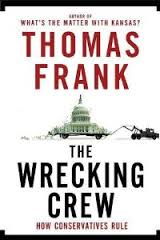
Books I’ve Read: The Wrecking Crew Shines Spotlight On Republican Not-So-Hidden Agenda

The Wrecking CrewBefore I started reading books by Thomas Frank, I thought maybe I had slept through the 80s and 90s, especially as I listened to the Republican rhetoric in this ‘Ronald Reagan was the greatest president’ era. I thought I remembered, Reagan — and both of the Bush presidents for that matter — driving up the national debt, increasing the federal deficit and being unable to balance a budget.

Turns out I remembered correctly.

In The Wrecking Crew: How Conservatives Ruined Government, Enriched Themselves, and Beggared the Nation, Frank takes a hard, uncompromising look at the cronyism that came to define the conservatism movement and how government became inept because of it. In example and example, Frank views historical moments — current events that most of us remember — and shows what occurred on stage and behind the scenes.

Disasters like Hurricane Katrina and the fumbling government response by the head of FEMA — and George W. Bush’s crony  — Joe Allbaugh. Allbaugh was appointed to the position despite the fact that he had no experience in anything remotely akin to responding to a disaster.

But, examples like that are old news, so it’s Frank’s piecing together of some of the lesser-known events and persons that makes the book such an interesting read.

Frank devotes an entire chapter to one of America’s most powerful groups — lobbyists, showing what they have accomplished in Washington D.C. since the early 1990s. Embarking on the time period filled with the righteous indignation of Newt Gingrich and the Freshmen Class of 1994, Frank unveils the agenda of Indiana freshman Republican David McIntosh. McIntosh is ready to face this lobbying problem head-on, well sort of, by trying to get a bill passed to ban lobbying — at least by certain groups.

In his trademark, biting wit, Frank writes,

“This was a form of idealism in the way that poison ivy is a tasty and nutritious salad green. McIntosh’s antilobbyist bill, as it turned out, would have applied solely to organizations that received federal funding and would thus have damaged only advocacy lobbyists like environmentalist and good government types; in Republican circles his proposal was commonly referred to as a ‘defund the left’ bill. Instead of staving off government-by-money, McIntosh’s measures would have only eliminated the competition for corporate lobbyists.”

Of course, as the book points out, the idealistic, anti-lobbyist McIntosh became a lobbyist the year he left Congress.

What I like about Frank is the amount of research he does for his books — the breadth and scope of his reading must be enormous — as can be seen by the somewhat obscure examples he uses, including this one which he uses early on in the book.

He opens a scene with an example from a 1945 children’s book. The book explains all the good that can come from a single dime when coupled with a benevolent government. The 1945 dime was all about service, so Frank modernizes the story, showing how a privatized and outsourced government creates a dime that is all about profit.

And as Frank shows — with plenty of footnotes for the doubters —  this new model of selling off government to the highest bidder has cost the American worker more than just the equity in their homes — or a  Great Recession.

It costs them their voice in government.

Rated 4.5 out of 5. The only reason I don’t give this book 5 stars is because it is so fact-dense (which is a good thing) that the notes and footnotes tend to slow the reader down.


Categories: 8th congressional district, American History, Books I have read

Why You May Want To Try Walmart’s Savings Catcher

krogerEven if you do not use coupons to cut your weekly household and grocery expense, you may want to consider using Wal-Mart’s Savings Catcher program because you can get store credit with just a few minutes of your time.

How it Works

When  you receive your receipt at Wal-Mart you have two options for using Savings Catcher. The easiest is with a smartphone (once you download the app). You simply scan in the QR Code (small square at bottom of the receipt) and the app will begin the 3-4 day process of checking your receipt against local competitor’s ads. In my case, it is 37-38 ads.

If you do not have a smartphone, or prefer to do it online, go to Savings Catcher and enter the receipt number from the bottom of your receipt.

What You Get

Once Savings Catcher is finished checking all the local competitor ads, you will be advised whether or not any lower deals were found. In the first 10 receipts I submitted, all but three found lower prices. You can let the savings accumulate — or move them over to a eGift card. Once you are ready to cash in the eGift card, you can either print it out and use it at your local Wal-Mart — or use it for online purchases.

Either way, it’s money back in your pocket.

Other Ways To Save

You can cut your costs even more with these coupon-based apps.

Categories: Family History, saving money

Confederate Ruse Led To Capture of Beaty Men

ransomMary Polly (Hull) Beaty, my grandmother of the Civil War era, understood firsthand the pains of War. In less than a decade, she watched as her life went from being a farmer’s wife with a healthy family to a widow who lost not only her husband, but two sons, a son-in-law, a nephew and a grandchild. Her husband and grandson were the only two not killed by the war. The other four men died, not in battle or from battle wounds, but instead they died of starvation and disease inside a Confederate prisoner of war camp.

Several situations had to increase Mary’s pain. One, her sons were buried away from home is a military graveyard and second, the way her sons and family members were captured.

These seasoned soldiers were victims of a well-planned ruse by Confederate sympathizers. The ruse would eventually cost two of her sons, Thomas and Andrew Jackson, their lives. Her oldest boy, Jonathon would survive the ordeal, but his brother-in-law Andrew Owens and cousin Morgan Hull would not.

We learn more about how the Beatys, members of Company B, were captured on Nov. 6, 1863 near Rogersville, TN in a book written by a fellow soldier. Twenty years after the capture, in 1883, John Ransom, published a book based on a diary he kept (but later destroyed) as a prisoner of war with Company B. In John Ransom’s Andersonville Diary: Life Inside the Civil War’s Most Infamous Prison, he describes the way company was captured.

The rebel citizens got up a dance at one of the public houses in the village, and invited all the Union officers. This was the evening of Nov. 5th. Nearly all of the officers attended and were away from their command nearly all night and many were away all night. 

At dawn, with many of the Union officers missing or incapacitated from the previous night, the Rebel Calvary attacked Company B.

[The] Rebels had us completely surrounded and soon began to fire volley after volley into our disorganized ranks. Not one in five officers were present.

According to Ransom, the battle lasted 10 hours and when the unit finally surrendered 100 men were dead and another 400 were wounded. Once captured, it became apparent that the Confederate Army had no intention of treating the capture men humanely. The first order of business was to take personal belongings (blankets, etc) from all the Union soldiers.

Then the Army executed several soldiers accused of deserting the Rebel cause.

It set the expectations for what the captured men could expect. Within six months, the last of the four captured family members, Thomas, was dead.

Based on pension records filed by Mary in 1868, we further discover Mary was dealt one more hard blow — she lost her source of livelihood.

Thomas supported his mother both financially and physically, during the War. Each month, Thomas gave his mother all — or nearly all — of his Army stipend –and since his father, Alexander, was crippled with rheumatoid arthritis, Thomas planted and harvested the crops.

Categories: Appalachia, Civil War History, Cumberland Plateau, Family History | Tags: , ,