
One local Facebook user said there were 300 currently available jobs in Preble County. The user based the claim on a Indeed job search, but the user did not take the time to look at the listed jobs — or their location. An October 7 Indeed search revealed there are 101 jobs currently advertised in Eaton (the county seat), 96 of those jobs had an annual salary estimate of $15,000. But even the 101 number is incorrect because included in that list are Border Patrol jobs for the federal government, a Chief of Police job for Sylvania Township, Ohio and a flight attendant for Delta Airlines, to name just a few inaccuracies. Also, some of the listing are repeated (for example the same Water Meter Installer ad appears on the first three pages of listings and three positions at Henny Penny are duplicated).
Framing Issues Just Like In The 80s
I’m amazed at the slanted information that filters onto social media.
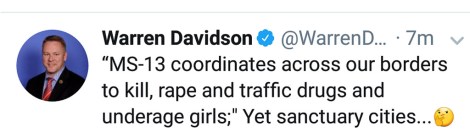
Although Sanctuary Cities aren’t much of an issue in Ohio’s 8th Congressional District they were Warren Davidson’s pressing concern this week. His Tweet, with its xenophobic and racist undertones, implies the need to protect our (white) girls from darker-skinned gang members.
Davidson is correct in one aspect, though, Ohio has a rape problem.
He’s just framing it immorally.
Selling Fear
The day before Davidson’s Tweet, in my hometown newspaper, a rape was reported with a story line that is significantly more common in Ohio. Victims are raped by someone they know.
The suspect, who was convicted and is scheduled to be sentenced next month, was a resident of a small, rural town on the southern end of Preble County — a county that is 97 percent white. The 49-year-old man was convicted of raping his daughter’s friend — a 20-something who, after a night of drinking, decided to ‘crash on the couch’ at the friend’s house where the father also lived.
No gangs. Just a 49-year-old man with predatory behavior — a demographic and behavior that is much harder to politicize.
Just a few weeks earlier, in Eaton, another man — about the same age — tied up a 90-something-year-old female relative, stealing her vehicle, just a few blocks from my home. After being apprehended by the Eaton Police Department, the suspect escaped the cruiser while handcuffed — and within 24 hours was accused in the stabbing of another Preble County resident.
Again, no gangs — just a white American male.
What Would Ted Nugent Do?
The Tweet — with its nod to the infamous Willie Horton ad from the 80s — is troubling on many levels, but it comes in a week where the GOP has attacked women’s reproductive rights while intentionally ignoring action on gun violence. After the horrific incident in Las Vegas where roughly 600 people were shot by a high-powered assault rifle from the 32nd floor of a hotel — negating the possibility of a CCW-armed individual neutralizing the situation — the GOP proved its political approach is woefully out of whack with the leadership the country needs.
But some of their fans are egging them on.
I see this on Facebook since I live in a Red Zone. We love our guns more than liberty, and Facebook lit up with people justifying their 2nd Amendment right to arm themselves. They quoted Teddy Nugent and Pat Robertson to justify their position — all the while ignoring the context that the 3rd Amendment brings to the debate.
God Help Us
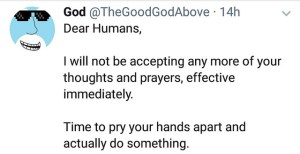 Part of our inability to stave off nefarious Tweets or solve problems like gun violence is an exploitation of social conservative beliefs. Many good, church-attending people in my community are convinced that only God can solve our problems — effectively removing human accountability. One Preble County resident, commenting on the Las Vegas shooter, said,
‘There is no way to figure out who these people are until it’s too late.”
Besides shutting down public discourse (since there ‘are no solutions’), as Redneck Liberal Trea Crowder points out, there is a level of hypocrisy in the statement. Crowder says, this is not the response white people have when a person of color fires the weapon. It is not the response they have when non-Christians fire the weapons. And, as Crowder also points out, other countries have found workable solutions.
For some, though, none of this matters. It’s easier to do nothing. It’s the reason ‘thoughts and prayers’ resonates with many here and throughout the country — a naïve belief that God’s will usurps authority over intellect — and we just need to trust Him to solve our problems.
Passive Americans

Preble County church.
After mentioning a local church’s response to Colin Kaepernick’s protest in a recent post, I listened to the minister’s argument. It boils down to: how would it look to children if we disrespect the flag/anthem? It’s a weak argument coming from an organization (Southern Baptist) that supported a man who bragged about sexual assault and called Kaepernick a son of a bitch. Besides, Southern Baptists may not be a moral authority on race relations since they owe their inception to slavery.
But, more importantly, Kaepernick’s protest could teach children that people have an obligation to denounce systemic racism or that the First Amendment was penned for situations like police accountability.
It is the story of Elijah the minister references, though, in his ‘kneel or stand’ sermon that offers a stronger clue to why communities like mine lack the skills to problem solve.
In the story, a destitute and hungry prophet Elijah, survives because God instructs birds to daily deliver food to him. This is accepted as a literal act of God — not a Aesop-type fable — but real birds delivering real food to a real man. Elijah does not solve his hunger problem, the solution exists outside of him.




 When it comes to vintage books, Goodwill is my go-to source. I recently purchased a handful of early 20th century books and will be posting excerpts, from time to time, from them.



 Charlie R. Claywell