
Author Archives: CharlieClaywell

Unknown's avatar

About CharlieClaywell

I have been a writer for years, mainly as a reporter, but I have always enjoyed history, especially non-mainstream stories buried inside old documents. My blog mostly centers around those stories. On occasion, though, I deviate and talk about my dog, vintage toys and what it's like to be middle-aged.

‘American Nations’ Explains Country’s Cultural, Ethnic Beginnings

American-NationsWhen I read Albion’s Seed, it sparked a paradigm shift — for the first time I finally understood why the definition of ‘real American’ is vastly different depending on where a person lives. Albion’s Seed also sparked my appreciation for the fact that the colonists and the Founding Fathers were not some coherent group that mirrored each other’s beliefs. (i.e. all were — fill in the blank)

So when I hear someone say — in the beginning America was (fill in the blank) — I know this person has chosen to view history in a way that is convenient for them. For example, some say America was founding on the ideals of religious freedom. If they are talking about the colony of Pennsylvania they are largely correct. However, if they mean New England, they are wrong since the Puritans persecuted, and even executed, Quakers, Baptists and Methodists.

Whereas Albion’s Seed concentrated on four British-American colonies, in American Nations: A History of the Eleven Rival Regional Cultures of North America, Colin Woodward looks at the whole of the United States.

One Nation Comprised Of Many

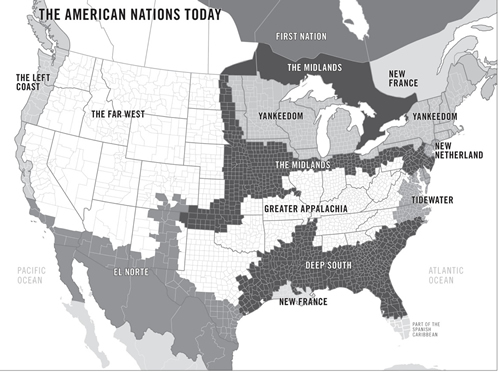
The basic premise of Woodward’s book is the country is really 11 nations — each with distinctive cultural, political and religous beliefs. Of course, I — like many — grew up learning the traditional story of American history. In this historical accounting, the eastern colonies fought for independence and then marched westward to conquer the land from ‘sea to shining sea.’

But, as Woodward points outs, this narrative overlooks historical data which really begins in the 16th century in the middle of the continent.

The 11 Nations

Instead of reviewing the book (which I highly recommend if you are interested in the country’s historical beginnings), I will list the 11 nations Woodward explores. These nations obviously cross state boundaries (he explains how/why in his book). Woodward successfully argues that these 11 nations are, in many ways still intact, and they continue to drive America’s politics. In chronological order the nations are:

  1. El Norte. It turns out the mid-section of the country was the first section settled by colonists — not the east coast. By 1595, twelve years before Jamestown, Spanish Americans were living and thriving in present-day north New Mexico and southern Colorado. Nation’s key traits: overwhelmingly Hispanic — a hybrid between Anglo- and Spanish America.
  2. New France. As Woodward point out, 16 years before the Mayflower’s voyage, it was a group of Frenchmen who were the first Europeans to face a New England winter. Nation’s key traits: multiculturalism and negotiated consensus among its inhabitants.
  3. Tidewater. This is the region where my paternal line — the Claywells — entered North America. It is basically Jamestown and the land owned and developed by the Virginia Company. To some this is ‘real America,’ where the ‘bold, scrappy individualist,’ was born. It was populated with ‘haughty gentlemen-adventurers, the rest beggars and vagrants,’ prompting the Virginia Company president to say, ..’a more damned crew, Hell never vomited.’
  4. Yankeedom. Founded on the eastern shores of the continent by the Massachusetts Bay Company, the colony was founded by educated, Puritan families. The colony was created as a effort of the Puritans to create a ‘city on a hill,’ and to give them the ability to pursue their mission of purifying the church. Core beliefs: emphasis on education, local political control and pursuit of the ‘greater good’ for the community.
  5. New Netherland. Founded by the Dutch in present-day New York City it was ‘from the start a global commercial trading society: multi-ethnic, multi-religious, speculative, materialistic, mercantile, and free trading, a raucous, not entirely democratic city-state where no ethnic or religious group has ever truly been in charge.’
  6. Deep South. Founded by Barbados slave lords as a West-Indies styled slave society, for most of American history this region has ‘been the bastion of white supremacy, aristocratic privilege, and a version of classical Republicanism modeled on the slave states of the ancient world, were democracy was a privilege of the few and enslavement was the natural lot of the many.’
  7. The Midlands. Founded by English Quakers, this region gave birth to the culture of Middle America and the Heartland. It was the only British American colony in 1775 that had a non-British majority. In this nation, ‘ethnic and ideological purity have never been a priority, government has been seen as an unwelcome intrusion, and political opinion has been moderate, even apathetic.’
  8. Greater Appalachia. Woodward’s boundaries for this region comprises a significantly larger chunk of the country than traditional Appalachian maps. As a southwest Ohio resident, I live inside this nation. According to Woodward, this nation, while in the British Isles, ‘formed a state of near-constant war and upheaval, fostering a warrior ethic and a deep commitment to individual liberty and personal sovereignty.’ It is also the region my maternal line, the Beatys, settled in when they arrived in North America.
  9. Left Coast. This nation extends from a strip in Monterey, California to Juneau, Alaska and was founded by two other groups, Woodward says. Merchants, missionaries and woodmen from New England — who arrived by sea — and farmers, prospectors and fur traders from Greater Appalachia who arrived by wagon. The first group controlled the towns while the latter controlled the countryside.
  10. Far West. This region in the only place, Woodward contends, where environmental factors outweighed ethnic ones. It was colonized in large part through the efforts of large, private corporations and federal government programs (like railroads). It’s political class tends to ‘revile the federal government for interfering in its affairs…while demanding it continue to receive federal largesse.’
  11. First Nation. Comprised of indigenous people to the north, the inhabitants of this nation never surrendered their land through treaties and still ‘retain cultural practices and knowledge that allow them to survive in the region on their own terms.’

Final Thought

One of the most interesting aspects of the book for me, is it simplifies how politics work in America. I subscribe to the belief that the ‘apple doesn’t fall far from the tree,’ and now I can see the country based on its various  ‘segments’. This makes it easier to understand why certain national politicians fail or succeed in their marketing campaigns for the presidential office. Articles by Woodward | Podcast with author

Categories: American History, Colonial Era, Colonial Period

Insane American Killer Plays Integral Role in Publication of British Dictionary

professorandthemadmanYou can file this story under the truth is stranger than fiction.

In The Professor and The Madman, Simon Winchester tells the story behind the creation of the Oxford English Dictionary which was first published (in part) in 1884 and has long been hailed as the standard upon which all dictionaries are measured.

Winchester’s book is two stories in one. It is about vastness of the dictionary project undertaken by Oxford Professor James Murray – when he and others set out to catalogue all the known English words of the era. But it is also the story of Yale-educated and former surgeon, William Minor.

A story about a dictionary, in and of itself, is not necessarily interesting reading unless you’re a wordsmith, but when it is coupled with Minor’s story it is quite intriguing.

The Murder

The book opens at the crime scene, shortly after 2 a.m. when the father of seven with an 8th child on the way – is pursued, shot and killed by Civil War Union veteran Minor in the community of Lambeth (near London, England). The deceased, who had agreed to pick up a shift for a co-worker, was murdered on his way to work. An editorial in Lambeth’s weekly newspaper commented somewhat smugly on the 1872 crime by noting,

Happily, we in this country have no experience of the crime of ‘shooting down,’ so common in the United States.

Incarceration

The crime part of the story moves fairly quickly into Minor’s trial, where he is found not guilty by reason of insanity. Minor, who receives a military pension, is then given a two-room suite at an asylum and in his own disillusioned world, he comes to believe the staff are his servants.

He seems resolved to make the best of his situation.

Then the author fills us in on the problems leading to Minor’s mental breakdown. We uncover his illness mental mainly through observations written by his attendants. We come to realize that Minor is paranoid, especially at night, when he is convinced people are attacking and molesting him.

He was also terribly frightened of Irishmen, we learn, because of a War incident. As surgeon, Minor was given the gruesome task of branding a Irishman deserter during the U.S. Civil War. Minor applied a hot iron to brand the letter D in the young man’s face.

The brutality of the act plants the seeds of Minor’s mental illness.

Oxford English Dictionary

So, what does all of this have to do with the dictionary?

To construct the Oxford English Dictionary, Professor Murray sent out a request for volunteers to read books dating back to around Shakespeare’s time. These volunteers would meticulously write down words for inclusion in the dictionary as well as when the word first appeared in the English language. The volunteers would also locate quotes from original materials to provide a ‘real world’ definition of the term. The sheer volume of this labor-intensive project caused many of the volunteers quit. And, it also delayed the final product by decades — the final version was not finished until 1928.

But one man, Minor, kept submitting high quality work and pushing the project forward. In fact, the original books include dedications to Minor because of his efforts. What Murray did not know, when mentioning Minor in the dedications, was the American veteran was living in an asylum and he had killed an innocent man.

This all changes when Minor is not present at a book publishing party. Many in attendance wanted to meet him, so Murray took it upon himself to find Minor. And it is in the asylum where Murray first learns Minor is not in an esteemed position, but is instead a patient. What unfolds over time is something akin to a friendship. When Minor is eventually (after more than 40 years) returned to the United States to the custody of his brother (with the condition he be placed in an asylum), it is Murray and his wife that see him off.

Rated 4 out of 5:
Writing a book about publishing a dictionary is tough to keep entertaining. At times the book moves a little too slowly for my tastes, but the author does deliver an intriguing look at Minor’s mental issues. The author does this while also weaving in Murray’s ambitious project. The book is worth reading just to get a glimpse at how mental illness was treated in Britain at the end of the 19th and beginning of the 20th centuries.

Categories: American History, Books I have read | Tags: , , , , ,

Lighten Up Your Day With These Entertaining, Educational History Podcasts

By Source, <a href=" https://en.wikipedia.org/w/index.php?curid=21257376">Fair use</a>

By Source, Fair use

One of the defining attributes of the modern era is the abundance of high quality information that can be easily – and freely – accessed over the Web. Regardless of what you are interested in, there is a source to supply high-quality information.

This is especially true with history.

Here are five podcasts to consider. I chose these based on brevity (only the final podcast in the list is longer that 15 minutes) and subject matter — the more obscure or intriguing, the better.

  1. Ted-Ed: Lessons Worth Sharing. Plenty of topics and most of the podcasts are about 4-minutes long. Subjects range from whimsical (Why Is Ketchup So Hard To Pour), scientific (What Percentage Of Your Brain Do You Use) to the complicated (Big Data). These fast-paced episodes are packed with information and are usually presented by industry or subject experts.
  2. Past and Present The Colonial Williamsburg History Podcast. These presentations tend to run about 15 minutes in length and the format is kind of like old-time radio where an expert is interviewed. This leads to a wide range of topics from — Colonial Marriage Customs to Skill and Science in Historic Trades.
  3. Today In History. Fast and to the point, these three-to-five minute podcasts tell the interesting back story behind a specific event or object on this day in history. You can learn everything from the history of the Barbie doll (March 9), the Frisbee (January 23) or more about when Elvis Presley was drafted into the Armed Forces (December 20). Adding to the intrigue of this podcast is the 60s style robotic sounding voice of the narrator.
  4. History in Five Minutes. Although the episodes are slightly longer than five minutes, usually around seven, they cover some of the more intriguing and obscure stories from history. The podcast includes series about History’s Greatest Spies, Explorers that Pushed the Boundaries, and Examples of Unintended Consequences (like rabbits in Australia).
  5. Grownups Read Things They Wrote As Kids. Technically this one is not about history, per se, except it is about personal history. But, it is quite funny. The premise of the show is simple — adults share journals, diaries, poems and other musings written in their youth. Some of the journals were written as young as second grade. Needless to say, the ideas, beliefs and comments are entertaining including a 13-year-old’s letter to her future self and a young man’s ranting after getting fired. (episode 213). Episodes are 20-30 minutes in length.

Unfamiliar With The Medium?

If you are new to podcasts, they are essentially radio shows for the Web. They remind me of the old shows we used to listen to on the Oxford (OH) radio station in my youth — shows like Lum and Abner.

There are two ways to listen to podcasts: download them to your phone or mobile device — or stream them live over a website. I tend to stream (and only listen when I am on Wi-Fi) because I don’t want to clutter up the limited amount of memory on my phone. However, regardless of which method you choose, to begin listening to podcasts, you need to download an app by visiting iTunes (if you have an iPhone) or the Google Play Store for Android phones.

Several apps exists. You can learn about Android apps here (I use Podcast and Podcast Addict — both are free) and iTunes apps here.

Categories: American History, How To Learn History, Podcasts | Tags: ,