Author Archives: CharlieClaywell

Unknown's avatar

About CharlieClaywell

I have been a writer for years, mainly as a reporter, but I have always enjoyed history, especially non-mainstream stories buried inside old documents. My blog mostly centers around those stories. On occasion, though, I deviate and talk about my dog, vintage toys and what it's like to be middle-aged.

Family History: Bennie Lewis’ Locker Sheds Light On What Was Important To Him

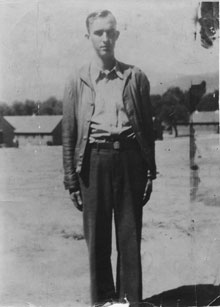
Bennie Lewis, a younger brother of my paternal grandmother. He died at the age of 25 in a logging accident.

Bennie Lewis, a younger brother of my paternal grandmother. He died at the age of 25 in a logging accident.

I have previously posted about Bennie Lewis, my paternal grandmother’s brother, and wrote about how his life was tragically cut short while working in a Civilian Conservation Camp in Idaho. The post includes the letter Bennie wrote his mother one week before his death.

But to learn more about Bennie’s accident, I contacted the National Archives Records Administration in St. Louis and purchased a copy of his file. Contents of the file offer additional information about the accident because it contains the eyewitness accounts.

Bennie’s main duty in the camp at the time of his death was Kitchen Police — or KP duty as it’s often called, but he was also a truck driver. On the Friday when Bennie died, he was working with two other men, felling trees. They had been asked by their supervisor to cut dry lumber into four to eight foot sections — load the lumber into a truck and haul it back to the main camp a couple miles away.

The three men sawed in pairs. That is, two men would saw while the third man would mark the trees — rotating the roles so no one was stuck with only sawing. At the time of the accident — around 2:50 that Friday afternoon — it was Bennie’s turn to mark the trees. A witnesses who was sitting about 200 feet away — taking a break and talking with some other members of the camp — describes what he saw.

“…I happened to look up where the boys were cutting the last tree and just then the tree fell on Bennie. After it fell I could not move for about half a minute and then I ran up to see if I could do anything about it.”

Another witness reported hearing a man yell ‘look out’ as he saw the dead tree falling. The men sawing the tree were able to jump back out of the way, Bennie, unfortunately, was not.

In the follow-up reports that were filed after his death, the tree that killed Bennie was described as a dead 8-inch diameter Red Fir — about 40 foot long that uprooted as it fell.

Bennie’s Foot Locker:

In less than two hours of his death, all of Bennie’s personal effects were locked up and inventoried so the items could be sent to his family. This is what was found in his foot locker:

  • 1 box of old letters
  • 1 box containing two horned toads
  • 1 box containing souvenirs and a New Testament
  • A baseball cap
  • 1 suit of blue clothes — 3 pieces
  • 1 blue dress shirt with a neck tie
  • 1 pair of black oxfords
  • 1 briar pipe

Bennie, who had only been with the program about eight months when he died, received high marks for his work ethic and personality while in the CCC — being described by his supervisor in an earlier evaluation as ‘courteous and willing to work.’

Gravestone for Bennie Lewis, located in Cumberland County, Ky.

Gravestone for Bennie Lewis, located in Cumberland County, Ky.

Red Tape
After Bennie death, his parents were awarded a monthly settlement of $8.40 to be paid for a period of eight years — or just a little over $800. For those who believe excessive red tape is a modern invention of the government — apparently not. In order to receive the monthly payment (which was actually sent in a bi-monthly $4.20 check), his parents were required to resubmit the claim four times a year (on the first day of January, April, July and October) and the claim had to be ‘acknowledged’ before the local postmaster and then forwarded to the Commission.

My Family Tree

Bennie was the second member of his family to die at a young age. When Bennie was around 12 or 13, his youngest brother, Earl, died about a week after his 10th birthday.

Children of Granville Hunter Lewis (1877-1962) and Delila Florence Surratt (1875-1948)

  1. Martin M. Lewis (1897 – 1974)
  2. Fannie Lola Lewis Cash (1900 – 1993)
  3. Mary D. Lewis Claywell (1903 – 1993) — my grandmother
  4. Claude L. Lewis (1905 – 1991)
  5. Clyde Lewis (1907 – 2003)
  6. James Logan Lewis (1909 – 1980)
  7. Bennie P. Lewis (1910 – 1935)
  8. Earl Lewis (1913 – 1923)
Categories: Cumberland Plateau, Family History

Larry Doby: The Second Player Across Baseball’s Color Line

Here is an interesting entry from theolballgame about MLB’s second player to cross the color line in the 1940s.

michaellecompte's avatartheolballgame

By Michael LeCompte

A sometimes unfortunate aspect of history is that the second person to do something is often forgotten. Eleven weeks after Jackie Robinson broke the color barrier in Major League baseball, Larry Doby joined the Cleveland Indians.

Although largely overlooked in 1947 as the national media followed the trials and feats of Robinson with the Dodgers in the National League, Doby was the first black player in the American League.

Larry Doby was born in Camden, South Carolina in 1923 and grew up in New Jersey. Like Robinson, Doby was also a three sport star in high school. According to teammates and coaches he had professional level talent in football and baseball.

However, Doby initially harbored professional aspirations of a different kind. Hoping to follow the example of an influential high school coach, he planned to go to college, with the ultimate goal of becoming a P.E. teacher.

View original post 306 more words

Categories: Family History

1800s Wild West Lynching Claims Life Of Claywell Man

WildhorsesowyheeIn Lynchings in Kansas, 1850s-1932 by Harriet C. Frazier, the author tells of a 1858 lynching of Warren Claywell in Coffey County, Kansas — and describes his family as ‘notorious for its thieving ways.’ According to the book Warren and a brother, were hung — Warren until he was dead, but his brother was spared after he gave a full confession and supplied the names of others in the Territory engaged in stealing horses.
One of the news articles that covered the lynching reads like a public notice. In the July 6, 1858 edition of The Freeman’s Champion, the paper reports:

We have in our possession the affidavit or confession of Warren Claywell, who was executed in a summary manner at Leroy, for horse stealing, &c, which implicates a number of persons who have for months past lingered in this vicinity. An eye will be kept on their proceedings, and if they do not mend their ways, the people will do it for them, after the manner of The People vs.Claywell, at Leroy.

It is the New York Tribune, though, that offers a more complete version of the story.

The June 14, 1858 Leroy, Kansas Territory dateline clues us in on when and where the story unfolded — the eastern border of Kansas. Even though Warren is lynched, it is in an orderly fashion — as orderly as these things are — and he is actually in the custody of the Sheriff when everything goes bad — mainly because Warren talks too much.

While in custody, Warren is confronted by a victim and Warren confesses he stole the man’s horse. As the reporter notes, though, the sheriff warns Warren against making a confession. Once the confession is obtained, word spread fast and the townfolk and those in outlying areas gather in town and by 10 a.m. the following morning, more than 400 people are on hand demanding justice.

By 11 o’clock, 12 men are selected from the crowd to serve as jury. Warren, based largely on his confession, is found guilty. He is sentenced to be hanged when the 400 or so people vote. Thirty-seven vote for Warren to be sentenced to jail while 100 vote for him to be hanged until dead (another account says 300 voted for him to be hanged).

While all this is unfolding, Warren’s mother, siblings and the local Methodist preacher, Mr. White, ‘implore’ the crowd to show mercy and not execute Warren — all to no avail. The reporter further writes,

…He was then asked if he had any thing to say; he said he had not.They led him up on to the wagon, and tied a silk hankkerchief over his face, and proceeded to adjust the rope. This was, indeed, a strange and touching moment. Claywell’s four brothers and mother were shrieking at the top of their voices continuously, making the grove vibrate with their wailing. There was not a dry eye in the crowd…

After he is executed, we are learn of his family’s fate. The crowd,

…unanimously resolved that all the Claywell family, except James, the oldest brother (and who was not present during the excitement), should leave the Territory within six days; and. if found within its bounds after that time, they sould be dealt with is the same manner. This step was deemed necessary from the threats that had been made and the character of the family.


Gravesite

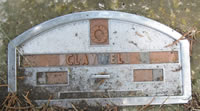
57699083_128277628289Although his first name is not on the tombstone, this appears to be the grave of Warren Claywell. He is buried in the Leroy Cemetery, in Coffey County, Kansas. You can view his gravesite on the Find A Grave website.


Bleeding Kansas

51HlD0wfQUL__SL250_The Kansas Territory was established by an Act of Congress in 1854 — and was embroiled in the slavery issue — because Congress, instead of dealing head-on with slavery — pushed it downhill to the people. The Act said that the inhabitants of the area would determine through popular sovereignty whether or not the region endorsed or opposed slavery. This created a violent and unstable situation and the region would eventually be the site of one of the bloodiest massacres of the Civil War in Lawrence, Kansas — about 80 miles north of Leroy.


Is Warren Part of My Family Tree?

Short answer. I don’t know.

It is difficult to prove my connection to Warren for several reasons:

  • I do not know the name of his parents — and only know the names of his brothers James and Frank.
  • I cannot find him in the 1840 Census. Most of the Claywells associated with my tree are still in North Carolina, Kentucky or Illinois in 1840.
  • I cannot determine where his surviving family moved to after being ordered to leave the region (although one article does say they headed back to Missouri)

If he is related, based on where all this happened — about 100 miles southwest of Kansas City — it would lead me to believe, that Warren is from a branch of Claywells living in either Missouri or Illinois. Since the incident occurs close to the Missouri border (and one article says the family went back to Missouri) and because there was an increase of Missourians in Kansas (trying to ensure the state was pro-slavery) during the 1850s — I believe Warren migrated from Missouri.

It is the June 26, 1858 edition of The Kansas Herald of Freedom that offers the most clues into where Warren is from, though — and the article gives us the name of the brother that was also hanged — Frank. In this front page story, we learn that,

Mrs. Claywell, with five sons, well-known thieves, have resided near Burlington, about 10 miles from here (Leroy, Kansas). One one occasion, last winter, they broke open and robbed a store at that place, and also stole various articles of clothing from the ballroom, on the same night, for which they were arrested by the citizens, and threatened with summary punishment.

The article tells how Frank was hanged prior to Warren (by a day or so it appears), but only to extort a confession out of him. The approach — although barbaric — worked exceedingly well as Frank — in exchange for his life — names accomplices and goes into detail about previous crimes, including how he escaped jail by paying a guard $20 and a horse saddle.

Frank’s Life of Crime?

In the 1860 Census a 24-year-old Frank Claywell appears in the Cole County (Jefferson City, MO) penitentiary. Based on other information in the Kansas Herald article it appears this is Warren’s brother.

Seven years later we meet up with Frank again in Springfield, Ill, and although, I cannot verify it is still Warren’s brother, geographically, it is the right location.  According to the Monday, April 15, 1867 edition of the Milwaukee Daily Sentinel,

A Mr. Henry Bunn, of Springfield, Ill. was shot dead in the street of that city while walking with a lady, by a man named Frank Claywell.

So, until I can find documents that verify Frank and Warren Claywell are family members associated with the Springfield, Illinois Claywells, I can only presume there is a connection.

My Family Tree In Springfield, Illinois

Job Claywell, who was born in 1800, is the son of Shadrach Sr. — my grandfather of the Revolutionary War era. Job left Cumberland County, Ky. and settled in Scott County, Illinois. According to the 1860 Census, Job was 60 and his oldest child — in his household anyway — was 22. Since this child (Joel) was born in Illinois one can deduct that Job probably left Kentucky by the time he was 38 — or by 1838 — the year his father, Shadrach, died.

Categories: Family History, Genealogy