
8th congressional district

Preble County Church Plays Role In Underground Railroad

Historic Hopewell Church, founded in 1808 in Preble County, Ohio.

Historic Hopewell Church, founded in 1808 in Preble County, Ohio.

If you visit the Preble County Library website, you will find a list of more than 50 churches in this county of about 40,000 — and at least one of these churches has been here for 200 hundred years.

It is possibly the most recognized historical church in Preble County — the Hopewell Church — near Hueston Woods. In 2008 the church celebrated its bicentennial. One of the defining marks of the church was its position on slavery — the church was established by some of Preble County’s first settlers, families from Kentucky and South Carolina, because of their opposition to slavery and the church openly encouraged worship by African Americans.

It was also part of the Underground Railroad network that operated in the southwest region of Ohio.

Bunker Hill HouseOne of its member, a free black man Gabriel Smith, known as ‘Old Gabe,’ lived in nearby Fairhaven in the Bunker Hill House. Gabe’s room at the Bunker Hill House was a small closet built underneath a stairwell in the summer kitchen. As a conductor on the route, Old Gabe would lead runaway slaves along Four Mile Creek until they reached Bunker Hill House where they would receive refuge until they could continue their journey north to Canada.

The Hopewell Church, which spawned four daughter churches, closed its doors in 1915, although it held annual meetings in the church building until 1958. When talks of demolition began in the mid-1960s, former members created an organization to save the building and started having services in the church. In 2000, the church was restored to its current condition.

Historic Hopewell Inc. the non-profit organization that maintains the church has posted several online photo albums showcases the church and the restoration project.

If you visit the area during the summer months, you can attend a Sunday morning church service.

The church also has a special Christmas service in December.

Underground Railroad

freedom-centerYou can learn more about the Underground Railroad by reading the words of the slaves that escaped in The Underground Railroad: Authentic Narratives and First-Hand Accounts (African American). If you are in the Cincinnati area, you can also visit the National Underground Railroad Museum Center to learn more about the region’s impact on freeing slaves.

Preble County Churches

>>View images of more churches throughout the county
Categories: 8th congressional district, American History, Preble County | Tags: ,

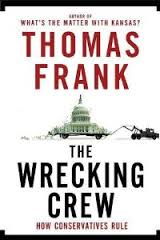
Books I’ve Read: The Wrecking Crew Shines Spotlight On Republican Not-So-Hidden Agenda

The Wrecking CrewBefore I started reading books by Thomas Frank, I thought maybe I had slept through the 80s and 90s, especially as I listened to the Republican rhetoric in this ‘Ronald Reagan was the greatest president’ era. I thought I remembered, Reagan — and both of the Bush presidents for that matter — driving up the national debt, increasing the federal deficit and being unable to balance a budget.

Turns out I remembered correctly.

In The Wrecking Crew: How Conservatives Ruined Government, Enriched Themselves, and Beggared the Nation, Frank takes a hard, uncompromising look at the cronyism that came to define the conservatism movement and how government became inept because of it. In example and example, Frank views historical moments — current events that most of us remember — and shows what occurred on stage and behind the scenes.

Disasters like Hurricane Katrina and the fumbling government response by the head of FEMA — and George W. Bush’s crony  — Joe Allbaugh. Allbaugh was appointed to the position despite the fact that he had no experience in anything remotely akin to responding to a disaster.

But, examples like that are old news, so it’s Frank’s piecing together of some of the lesser-known events and persons that makes the book such an interesting read.

Frank devotes an entire chapter to one of America’s most powerful groups — lobbyists, showing what they have accomplished in Washington D.C. since the early 1990s. Embarking on the time period filled with the righteous indignation of Newt Gingrich and the Freshmen Class of 1994, Frank unveils the agenda of Indiana freshman Republican David McIntosh. McIntosh is ready to face this lobbying problem head-on, well sort of, by trying to get a bill passed to ban lobbying — at least by certain groups.

In his trademark, biting wit, Frank writes,

“This was a form of idealism in the way that poison ivy is a tasty and nutritious salad green. McIntosh’s antilobbyist bill, as it turned out, would have applied solely to organizations that received federal funding and would thus have damaged only advocacy lobbyists like environmentalist and good government types; in Republican circles his proposal was commonly referred to as a ‘defund the left’ bill. Instead of staving off government-by-money, McIntosh’s measures would have only eliminated the competition for corporate lobbyists.”

Of course, as the book points out, the idealistic, anti-lobbyist McIntosh became a lobbyist the year he left Congress.

What I like about Frank is the amount of research he does for his books — the breadth and scope of his reading must be enormous — as can be seen by the somewhat obscure examples he uses, including this one which he uses early on in the book.

He opens a scene with an example from a 1945 children’s book. The book explains all the good that can come from a single dime when coupled with a benevolent government. The 1945 dime was all about service, so Frank modernizes the story, showing how a privatized and outsourced government creates a dime that is all about profit.

And as Frank shows — with plenty of footnotes for the doubters —  this new model of selling off government to the highest bidder has cost the American worker more than just the equity in their homes — or a  Great Recession.

It costs them their voice in government.

Rated 4.5 out of 5. The only reason I don’t give this book 5 stars is because it is so fact-dense (which is a good thing) that the notes and footnotes tend to slow the reader down.


Categories: 8th congressional district, American History, Books I have read

How 10 Percent Of The Voters Made A Choice Everyone Has To Deal With

-flagsI know this is sacred territory. Some Americans equate voting with the only civil right that matters.

But does every vote matter — or is it possible the system is flawed?

Growing up I heard a lot of folklore about the ‘one vote that mattered’ in elections, but as far as a I can tell, there have been very few, if any, significant elections altered by a single vote. The only one that comes to mind for me is the 1876 Presidential election, which was in fact decided by one vote. But the election is hardly an example of how well the system works. It is just the opposite and the election is a black spot on America’s past.

I write about this because I live in Ohio’s 8th Congressional District. House Speaker John Boehner, just two steps away from presidential power, has represented this region for decades — ever since he was first elected in 1990.  Since 1990, besides running unopposed several times, he has never faced any serious competition.

But, the region is hardly prosperous. Parts of the gerrymandered district  are under-employed, impoverished and in decline. Although not responsible for all the woes that have beset this area, Boehner seems to have done little to stem the economic fallout.

Which goes back to the original question, does every vote really matter.

In Ohio, we use a closed primary system. What this means, in a nutshell, is every May (sometimes March), when it is time for voters to decide who will appear on the November ballot, not everyone has a say. FairVote.org offers this explanation of closed primaries,

In a closed primary, only voters registered with a given party can vote in that party’s primary. Parties may have the option to invite unaffiliated voters to participate, but such independent voters usually are left out of the primary unless they decide to give up their independent status.

So during the primary, a large percentage of voters in Boehner’s home county of Butler and in Preble County, where I live, do not cast a vote for their potential Congressmen — instead being required to wait until November.

In fact, in the 2014 May primary, 83 percent of the 234,320 Butler County voters (193,833) had no say. In Preble County, a region which is small enough that its voting base has no sway on national politics, 65 percent — or 17,800 voters had no say in who would be on the November ballot as their potential representative in Congress.

Or to put it another way, only a small number of voters in the 8th District do decide which candidates end up on the ballot.

In Butler County, 19,900 voters chose Boehner as their party’s candidate for the 8th Congressional District while 3,631 chose Tom Poetter as the Democrat candidate — but all of the county’s 234,320 voters have to accept it — and then choose between them come November.

Which, one could argue, doesn’t really reflect the will of all the people.

Categories: 8th congressional district, American History