
American History

‘Muscle Shoals’ Looks At Man Behind Musical Sound, Hits


Documentary Muscle Shoals is an enjoyable walk down memory lane — showcasing some of the greatest music ever produced in the United States.

But, it is also a story of survival — of persevering through a life of setbacks and emotional pain.

The movie details the life of Rick Hall, founder of the Fame music studio located in Muscle Shoals, an Alabama town (population 13,600) near the Tennessee River. Although, the studio is far removed from the typical hustle and bustle of the large city studios in New York City and Los Angeles, it still produced hit after hit beginning in the 1960s.

Despite its ‘off the beaten path’ location, in time big-name bands and artists flocked in to record their music.

Rolling Stones & Company

Footage of the Stones’ recording sessions, including the production of hits like Wild Horses, is more than nostalgic meandering, it moves the story forward. But the movie is not just old clips, current interviews with Mick Jagger and Keith Richards offer reflection as they, and other artists, try to explain the appeal and magic of the region.

But, while these interviews and clips round out the story, make no mistake, Hall is the star of the film.

Hall’s story is a tale of triumph and loss. I won’t retell his story here because it would ruin an initial viewing of the film, but his life is proof that hard times make some people stronger — and, for people like Hall, something good can be created out of the aftermath of hard times.

Down A Long Hard Road

Hall, and the studio musicians featured in the film were, in many ways, just ‘good ole boys’ from down the road. However, that certainly did not equate to untalented. They were all extremely skilled. The studio musicians, The Swampers, even toured with The Who before returning to their Alabama roots, where they eventually split from Hall opening their own music studio. This only seemed to up the magic as the hits kept coming — ranging from Bob Seger’s Old Time Rock and Roll to Percy Faith’s When a Man Loves a Woman.

Missed Opportunities

Two musical incidents I found interesting, though, demonstrate the hit, miss and competitive nature of the business. Duane Allman — who would eventually helped form the Allman Brothers Band — camped out near Hall’s Fame studio trying to land a job as a session musician. In time, Hall hires him. Allman, being the creative guitarist he was, attempts to convince Hall to record, what is now known as southern rock. Hall, not interested in that style of music, nonchalantly admits on screen, ‘yeah I missed the boat on that one.’

The other story involves the best rock song ever recorded — Free Bird by Lynyrd Skynyrd (I know some will argue that distinction goes to Welcome to The Jungle by Guns N Roses, but they’re wrong). When the studio version of Free Bird was recorded in Muscle Shoals, it was over nine minutes long (the live version is about 15 minutes — as it should be). The record company wanted the studio version shortened to less than four minutes. The recording studio refused saying it would destroy the integrity of the song.

The decision eventually cost them the contract.

Rated 5 out of 5

If you enjoy music, and the stories behind some of the biggest names in music, the documentary is a perfect blend of music, interviews and story. Be forewarned though, it may inspire you to dust off some old albums or to download some classic songs from iTunes.


My Interest In The Movie

Bob_Dylan_-_Slow_Train_ComingBefore watching the film, I knew nothing about Rick Hall, but I did know that Bob Dylan recorded Slow Train Coming in Muscle Shoals — his best work in my opinion. The 1979 Christian Rock album features bluesy cuts like Gotta Serve Somebody and Precious Angel as well as a somewhat humorous take on the Garden of Eden — Man Gave Names To All the Animals. Dylan also recorded the follow-up album Saved in Muscle Shoals.



Categories: American History, Americans Who Got It Right, movies | Tags: , , , , , ,

‘Inventing A Christian Nation’ Tackles Narrative Of Religious Founding

christian-americaAs an amateur student of American history, my reading and research has upended three previously held beliefs.

These are, in no particular order, the belief in upward social mobility, the belief we are a society without a class structure, and the belief we were founded as a Christian nation. A book I recently read, White Trash: The 400-Year Untold History of Class in America, addresses the first two. Author Nancy Isenberg dismantles the myths about class and mobility in a fairly straightforward — and at times a very direct — manner.

The approach of author Steven K. Green in Inventing A Christian America: The Myth of the Religious Founding, feels a little more lowkey. Like White Trash, Green’s book is very detailed and highly readable although some may find Christian America controversial since Green does not believe the country was founded as a Christian nation.

But, for the most part, Green takes a very non-confrontational approach as he slowly and methodically disassembles the Christian Nation Narrative. (Note: This book is not dealing with whether the population was or was not mostly Christian, but rather if the Declaration of Independence, the Constitution and other founding documents were written in a way to create a government built on Christian principles.)

Diverse Beginning

By reading other historians, like David Hackett Fischer and Colin Woodard, I had already come to the conclusion that the country’s founding was significantly more complicated than the simple narrative I had learned about the Pilgrims. In Albion’s Seed, Fischer highlights the differences in the four British American colonies. Woodward’s American Nations builds on this idea by looking at the 11 nations that eventually became the United States.

In Christian America, Green opens by developing a backdrop of the country’s early years. He dips into the writings, laws, practices and religious beliefs of that time period. By unwinding how the Christian Nation Narrative began, Green gives the reader a stronger understanding of just how complicated — and diverse — society was in the years leading up to 1776 and beyond.

And his approach is fair.

Dissecting The Arguments

Green does not shy away from the various Christian influences in early American history — like early Supreme Court rulings or the decision of Congress to hire a chaplain to open sessions with prayer. Nor does Green bypass the only religious reference in the Constitution — the clause prohibiting religious tests for office (i.e. I believe Jesus is the Son of God).

He fearlessly broaches both sides of the argument, painting a detailed picture of the thought-process and precedents behind the Constitution, the Declaration of Independence and other founding documents. He does not cherry-pick statements, quotes or arguments to prove his position. Instead he lays it all out — both sides of the argument — while explaining why and how he arrived at his conclusion. He most certainly does not come across as anti-Christian. He comes across as an historian on a quest to understand how and when the Christian Nation narrative began.

In some ways, the book reminds me of a well-crafted Sherlock Holmes story, because Green embraces a wide body of evidence, and then he whittles it down to his well-defended, and well-thought out position. Reading the book, I felt a like bit like Watson, wondering why I had not made the connections before reading the book (in my defense, though, I am not as knowledgeable on all of the early historical documents as Green is).

When The Myth Began

In Green’s estimation, the Christian Nation myth started during the 1830s when the young nation, undergoing a spiritual renewal and a generation removed from the Founders, was seeking to understand why its republic and revolution succeeded when France’s did not. This prompted many writers, historians and clergymen to simplify the story of the country’s beginning. It also led to a desire of these writers to link God’s Guiding Hand to the Founding — largely in an effort to broaden the philosophical and political divide between the revolutions of the United States and France.

Both revolutions were based on Enlightenment ideas, but the French revolution led to the persecution, and massacre, of Christians and culminated in the eventual dictatorship of Napoleon. In contrast, the American revolution led to religious freedom (at least for Protestant Christians) and a (mostly) democratically-elected republic form of government.

So, to explain the divergent paths the revolutions took, writers in the 1830s deified the Founding Fathers while dismissing their Enlightenment beliefs. The words and works of the Founding Fathers were minimized as new stories — like the famous myth of George Washington cutting down a cherry tree — were invented to elevate the men into the role of conduits of God’s will.

Imposing Modern Beliefs on History

As Green points out, when the Christian Nation Narrative was created, the religious inklings of the population had shifted. The Second Great Awakening introduced a new strain of Christianity — evangelical Protestant — with a heavy emphasis on being born again and personal revelation. Being born again, though, would have been a foreign idea to the Founding Fathers, including many of the Christian Founders. As a whole, these men did not believe in revelations of a personal nature. Unlike some modern fundamentalist, the Founders easily combined science, rationalism and natural law with the spiritual teachings of Jesus.

In many cases, Founders (even Christian ones) chose reason and science over miracles. Some of the Founding Fathers Founders saw no moral conflict in dismissing biblical miracles despite being a Christian. (The concept of the inerrant Word of God evolved after most of the Founding Fathers had died. It was not until the late 1800s that it became, for many, an issue of faith. During the late 1800s, the belief of inerrancy was strongly, and famously, defended by Benjamin Warfield and Charles Briggs.)

When the Constitution was ratified, many political leaders — including the Founding Fathers — were criticized for the creation of a non-religious Constitution that omitted the role Jesus/God had played in the country’s creation. Clergy and newspaper editors reviled the politicians for their ‘reckless’ behavior.

Rating: 5 out of 5 stars

If you are interested in learning more about whether the country was founded as a Christian nation — and can open your mind to the evolution of laws in society, it can be an enlightening book. The book is technical at times, dealing with concepts like higher law, natural law, covenants and compacts, but Green explains them in laymen terms.

The book is filled with plenty of examples, anecdotes, footnotes and familiar figures to give the reader an appreciation for our country’s complicated beginning — a beginning that is significantly more interesting than the Christian Nation myth.

Categories: American History, Books I have read, Religion | Tags: , ,

Briggs & Stratton Dabbled In More Than Lawn Mowers

When I think of Briggs & Stratton, I think lawn mower. A 3-or 4-horsepower Briggs & Stratton was one of the first small engines I took apart as a kid. Those engines were known, then as now, for their simplicity, durability and reliability. Today I still prefer mowers with a Briggs and Stratton engine.

But, what I never knew about the company, was it manufactured go-kart type vehicles in the 1920s.

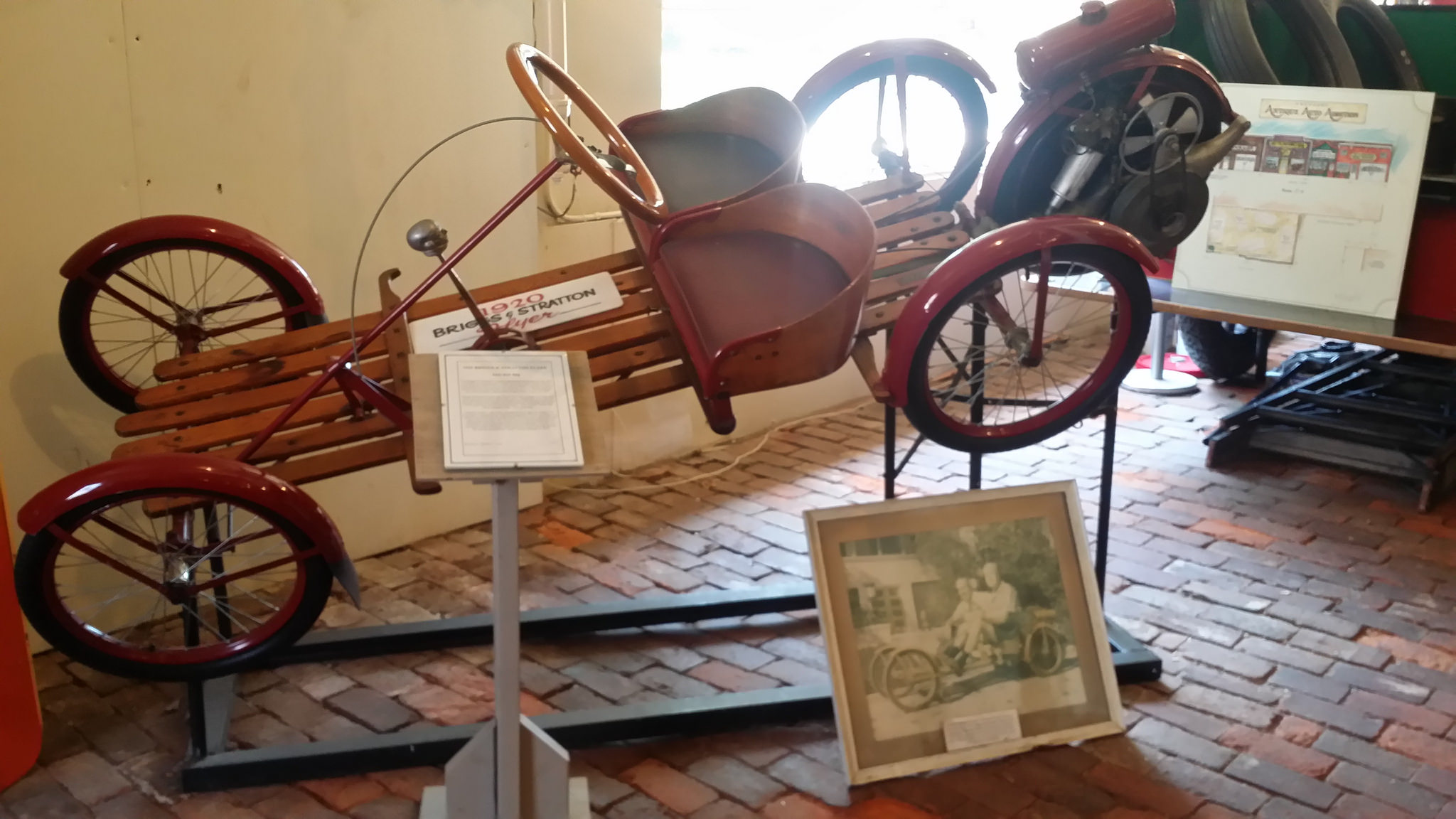
1920s-era Briggs and Stratton Flyer vehicle on display in the Wayne County Museum (Richmond, Ind.)

1920s-era Briggs and Stratton Flyer vehicle on display in the Wayne County Museum in Richmond, Ind.

Flyer Buckboard

I saw my first (and only) Flyer two-seat vehicle in the Wayne County Indiana Historical Museum in Richmond. The museum, which has an eclectic assortment of items — from a horse treadmill to a bona fide Egyptian mummy — houses about 15-20 early 20th century vehicles in a climate-controlled building behind the main exhibit area. This building alone is worth the $7 admission price. The building showcases vehicles, like the Davis automobile, that were manufactured in the region. They have two large electric vehicles from the early 1900s, but the gem for me is the first item you see when you walk in the door — the Briggs and Stratton Flyer Buckboard.

The vehicle has the look and feel of an old wooden sled with wheels. Two very small bucket seats sit on top of the wooden slats. The vehicle is barebones — no doors or windshields — just five wheels, two seats, a steering wheel and a gear stick (which is actually a lever to lower the fifth wheel).

Motor Wheel

When the automobile industry was in its infancy, lots of approaches were used to propel a vehicle forward. The one used by Briggs and Stratton was the Motor Wheel. Just like the name suggests, it was a wheel that included the motor. Sitting on top of the Motor Wheel was a half-gallon gas tank. Advertisements from that era said the vehicle could travel up to 25 mph and would get 80-100 mpg.

They accomplished those numbers with a 2hp motor. As Farm Collector notes,

At the peak of its popularity, the Motor Wheel was a versatile unit used to power bicycles, scooters, “flyers” (a small, two-seat, low-slung wooden buckboard with steering wheel and four wheels) and railway inspection cars. A photograph in the Briggs & Stratton archives even shows an ice skater using a Motor Wheel to tow her around the rink.

But, little did I know, that after a couple of failed ventures, it was the Motor Wheel that launched Briggs & Stratton into American history as the largest producer of small gasoline engines. The motor used in the Motor Wheel would eventually serve as the base model for their stationary gasoline engines.


And That’s Not All

Briggs & Stratton hybrid concept car.

Briggs & Stratton hybrid concept car.

When I began researching information about the vehicle, I stumbled upon another gem concerning Briggs and Stratton. They manufactured a hybrid vehicle — one that used an electric motor and a 18hp Briggs and Stratton engine in the late 1970s. Although the vehicle was not the first hybrid, it was ahead of its time.

But, unfortunately for the company, the prototype received poor reviews — mostly due to its lack of power. The vehicle could travel 300 miles on a tank of gas, had a fiberglass body and, (whether good or bad, you decide) looked a little like an AMC Pacer.

It also had six wheels. The extra wheels were a support feature — the car had 1000 pounds of batteries. Lithium Ion batteries were not invented until the 1990s so the vehicle used lead-acid batteries — like the ones used to start vehicles.

For a short history of Briggs & Stratton download the company’s publication (pdf).

Categories: American History | Tags: , , , ,