American History

President James Garfield: Angry Diplomat Cuts Presidency Short

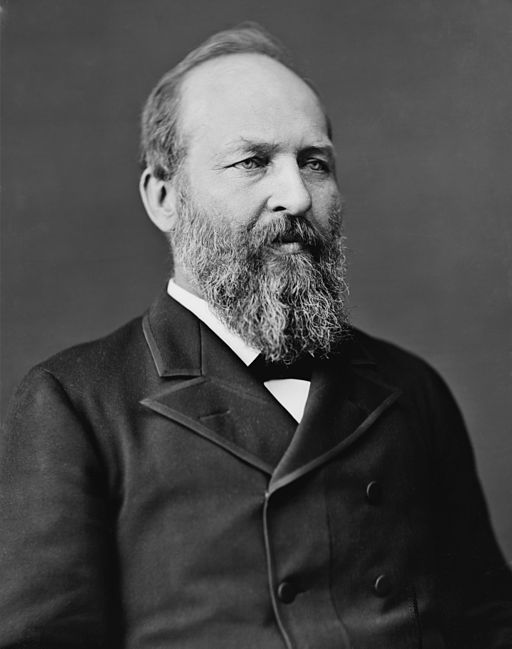
garfieldUnlike the image portrayed by Ohio’s first president — William Harrison — James Garfield actually was poor in his youth. He was the youngest of five children and his parents were devout followers of the then relatively new denomination — the Disciples of Christ.

During college he supported himself as a part-time teacher, a carpenter and even as a janitor. After earning a reputation during the Civil War as a war hero, Garfield became a member of Congress. As a member of Congress he supported the Compromise of 1877, which ended the military occupation of the South.

Garfield was born in Cuyahoga County, Ohio, in 1831 and fatherless by the age of two. Garfield would later drive canal boat teams to earn enough money for an education. He graduated from Williams College in Massachusetts in 1856, and returned to Ohio to teach, employed as a classics professor at the Western Reserve Electric Institute (later Hiram College).

Within a year he would be the Institute’s president.

When he ran for president — after 17 years in Congress — Garfield was not the Republican Party’s first — or even its second choice for president so just like Rutherford B. Hayes before him his election was a tight race. But, Garfield did win both the electoral and the popular vote — Garfield received 10,000 more votes than his opponent.

His presidency only lasted 200 days.

On July 2, 1881 Garfield was shot by a man who was angry that Garfield had not appointed him to a diplomatic post. Garfield died 11 weeks later on September 19.


Victim of the Curse?

256px-Appletons'_TecumsehIs Garfield a victim of Tecumseh’s Curse? According to legend after questionable tactics were used by U.S. President William Harrison in the defeat and surrender of the Shawnee Indian tribe, a curse was placed upon the White House so that every 20 years, the president would die in office. The theory became more popular in the 1930s after a Ripley’s Believe It or Not book promoted the idea of Tecumseh’s Curse which stated that death would prevent any president elected in an year ending in zero — to fulfill his term in office.

Beginning with Harrison, a U.S. president died in office every 20 years until Ronald Reagan survived an assassination attempt. Four of the presidents on the list are from Ohio.

  • 1840: William Harrison
  • 1860: Abraham Lincoln
  • 1880: James Garfield
  • 1900: William McKinley
  • 1920: Warren Harding
  • 1940: Franklin D. Roosevelt
  • 1960: John F. Kennedy

Ohio’s Presidential Legacy

Read more from the series:


Categories: American History, Politics

Mystery of Fatal Confederate Submarine Mission Closer To Being Solved

As Civil War Historian Bruce Catton points out in America Goes To War, the War Between The States forever altered modern warfare.

Neither side in the Civil War was prepared to stop anywhere short of complete victory. In the old days, wars had been formalized; two nations fought until it seemed to one side or the other that it would not be worth while to fight any longer, and then some sort of accommodation would be reached…But in the Civil War it was all or nothing.

Because of this new approach to war, after the first shot was fired there could be no compromise, no half-way point where the two sides could get together and agree on a truce. This all or nothing approach led to the invention of modern artillery, machine guns and the Civil War marked the introduction of submarine warfare.

By today’s standard the war’s submarines were very primitive.

But when the H.L. Hunley launched on the cold winter night, Feb. 17, 1864, from Charleston Harbor, and torpedoed the USS Housatonic, destroying the ship — the sub made history by becoming the first submarine to sink a war ship.

But it costs the Confederates more than the Federals as the submarine did not make it back to shore, costing the lives of all seven aboard. Before its fatal mission that night, 13 men had already lost there lives in the submarine project and as the History Channel reports,

For the third time, Hunley slipped to the bottom of Charleston Harbor, but exactly why remains a mystery. The undersea vessel could have been fatally damaged in the torpedo explosion, hit by a shot from Housatonic or sucked into the vortex of the sinking warship.

In 2000, the submarine was lifted from the water and for the past 15 years, scientists have been working to remove the gunk and sediment from the naval device. Recently, they uncovered the hull and one scientist admitted they are closing in on a theory as to why the hand-cranked sub sank.

Paul Mardikian, senior conservator on the Hunley project told the Associated Press that the exposed hull has revealed some things that may help solve the mystery — although he stopped short of revealing what those things were.

Last May, the submarine was placed inside a solution of sodium hydroxide to loosen the encrustation. In August, scientists began removing the loosen material with air powered chisels and dental tools. Approximately 70 percent of the hull is now exposed.


Learn More

Gold Coin found in H. L. HunleyIf you want to know more about the history of the submarine’s restoration project — or the history of its Civil War service — head over to the Friends of Hunley website. The site has a wealth of information including an intriguing story about a recovered gold coin belonging to the lieutenant in charge of the mission, George Dixon.

Categories: American History, Civil War History | Tags: , , , , , ,

American Sniper Explores Murkiness of War

am-sniperI’ll admit all the hype about the movie, American Sniper, made me reluctant to watch it. I had read the comments from Michael Moore, Kid Rock and a handful of others on social media and when the posturing on the subject was reduced to conversation-blocking words like idiot, coward and moron — well, I’ve just grown tired of the mentality.

But my daughter and a friend of hers wanted to see the movie, so I went and was impressed by what I saw.

The film, about the life of U.S. Navy SEAL and sniper Chris Kyle, is based largely on the book, American Sniper, written by Kyle. As I watched the movie I did not presumed it would be one-hundred percent accurate (Time Magazine has separated the movie’s fact and fiction) or that it would be completely true to the book (which I have not read).

The movie is a story of what war does to the human psyche.

As you watch Kyle make excruciating decisions time and time again (to kill or not kill) — and then watch him try to readjust in civilian society at the end of each tour, you have a stronger appreciation for what American soldiers fighting these endless wars go through.

You also come to understand the dichotomy of his mind. He seems drawn back to the war zone — he does four tours of duty — because war, he understands. Despite how gruesome the scene, the job — although extremely hard — is simple. Kill the bad guy (or woman or child) before they kill your comrades.

After his final tour, Kyle is forced to re-entry a civil society that he has not been a part of for nearly a decade. His Post-Traumatic Stress Disorder comes to a climax when he nearly kills the family dog because he mistook the pet’s playfulness with a child as an attack. At this point he seeks professional help and starts volunteering at the local VA — working with the veterans of the Iraqi War whose bodies are marred and dismembered by the conflict.

In some ways, the movie is a modern-day Platoon in that the innocence of why a soldier fights (to protect his country) gets blurred by the atrocities seen and committed. Kyle is American through and through. He struggles with the mental aftermath of war, but his conscious is clear because every kill, he says, was to protect his comrades.

It was a duty he volunteered for and he never shirked from it.

Rated: 5 out of 5. Definitely a film worth watching as it explores the concept of war and what it does to the victors and the victims.

Categories: American History, movies