

American History

Christmas — in September?

Christmas timeIn the early 70s Larry Norman penned the song, Christmastime, in which he sang,

Santa Claus is coming and the kids are getting greedy — It’s Christmas time

but maybe it’s really the store owners that are greedy. Toys R Us, the national chain that supplies children everywhere with toys at retail prices, announced on Wednesday, Sept. 10, it is already stocking up for the holidays.

“We’re deploying capital both in-store and online to improve the customer experience,” said Hank Mullany, the chain’s president, noting that the company has cut its checkout transaction time by 16% and increased the frequency of shipments to stores to help keep shelves fully stocked. In addition to new signs, Toys R Us will feature gift-idea stations within its fleet of 877 U.S. stores, and is introducing an online layaway program.

While September may be early, and it may feel as if stores are pushing holiday sales earlier and earlier — it’s actually not a new trend. An article from Slate magazine — which showcases newspaper ads from as early as 1912 — reveals stores were starting the Christmas push as early as October in the early 1900s. The push to shop by Thanksgiving goes back even more — to the late 1880s.

The trend to start earlier and earlier, though, may have faded away if not for the well-intentioned goal of a woman bent on abolishing child labor and reducing the work week to 40 hours. In 1903, Florence Kelley, wrote a widely distributed pamphlet, The Travesty of Christmas, where she urged consumers to think about the children working in the stores. The Slate article adds,

The employment of messenger and delivery boys especially appalled her, as these were the “many children for whom the cruel exposure attending their holiday work is followed by nervous prostration, or pneumonia, too often ending in tuberculosis.”

By 1918, the United States Council of National Defense joined the bandwagon — running an full page ad stating, “If You Really Want Us To Win The War Do Your Christmas Shop[ping] Early.”

The rest, as they say, is history.
Categories: American History

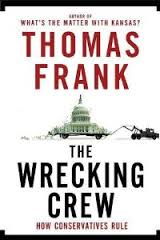
Books I’ve Read: The Wrecking Crew Shines Spotlight On Republican Not-So-Hidden Agenda

The Wrecking CrewBefore I started reading books by Thomas Frank, I thought maybe I had slept through the 80s and 90s, especially as I listened to the Republican rhetoric in this ‘Ronald Reagan was the greatest president’ era. I thought I remembered, Reagan — and both of the Bush presidents for that matter — driving up the national debt, increasing the federal deficit and being unable to balance a budget.

Turns out I remembered correctly.

In The Wrecking Crew: How Conservatives Ruined Government, Enriched Themselves, and Beggared the Nation, Frank takes a hard, uncompromising look at the cronyism that came to define the conservatism movement and how government became inept because of it. In example and example, Frank views historical moments — current events that most of us remember — and shows what occurred on stage and behind the scenes.

Disasters like Hurricane Katrina and the fumbling government response by the head of FEMA — and George W. Bush’s crony  — Joe Allbaugh. Allbaugh was appointed to the position despite the fact that he had no experience in anything remotely akin to responding to a disaster.

But, examples like that are old news, so it’s Frank’s piecing together of some of the lesser-known events and persons that makes the book such an interesting read.

Frank devotes an entire chapter to one of America’s most powerful groups — lobbyists, showing what they have accomplished in Washington D.C. since the early 1990s. Embarking on the time period filled with the righteous indignation of Newt Gingrich and the Freshmen Class of 1994, Frank unveils the agenda of Indiana freshman Republican David McIntosh. McIntosh is ready to face this lobbying problem head-on, well sort of, by trying to get a bill passed to ban lobbying — at least by certain groups.

In his trademark, biting wit, Frank writes,

“This was a form of idealism in the way that poison ivy is a tasty and nutritious salad green. McIntosh’s antilobbyist bill, as it turned out, would have applied solely to organizations that received federal funding and would thus have damaged only advocacy lobbyists like environmentalist and good government types; in Republican circles his proposal was commonly referred to as a ‘defund the left’ bill. Instead of staving off government-by-money, McIntosh’s measures would have only eliminated the competition for corporate lobbyists.”

Of course, as the book points out, the idealistic, anti-lobbyist McIntosh became a lobbyist the year he left Congress.

What I like about Frank is the amount of research he does for his books — the breadth and scope of his reading must be enormous — as can be seen by the somewhat obscure examples he uses, including this one which he uses early on in the book.

He opens a scene with an example from a 1945 children’s book. The book explains all the good that can come from a single dime when coupled with a benevolent government. The 1945 dime was all about service, so Frank modernizes the story, showing how a privatized and outsourced government creates a dime that is all about profit.

And as Frank shows — with plenty of footnotes for the doubters —  this new model of selling off government to the highest bidder has cost the American worker more than just the equity in their homes — or a  Great Recession.

It costs them their voice in government.

Rated 4.5 out of 5. The only reason I don’t give this book 5 stars is because it is so fact-dense (which is a good thing) that the notes and footnotes tend to slow the reader down.


Categories: 8th congressional district, American History, Books I have read

MLB.com Writers Share Their Favorite Baseball Books

Came across this on Freshly Pressed…

Mark Newman's avatarBaseball Books

Time for some summer reading? You’re in luck. We invited our esteemed writing colleagues at MLB.com to suggest at least one favorite baseball book. Ball Four tops Moneyball, 8-6, for most mentions. David Halberstam has the most suggested works with three. Some titles will surprise you. These 47 folks write about baseball for a living, in some cases books as well, so take their advice and happy reading.

Jordan Bastian: Fifty-nine in ’84 By Edward Achorn.

Mike Bauman: Eight Men Out by Eliot Asinof.

Summer of '49Jason Beck: I read Summer of ’49 while in college, and for me it’s still the standard. Really good individual storytelling woven into the bigger context of a pennant race and its place in the larger culture.

Barry Bloom:The Iowa Baseball Confederacy by W.P. Kinsella. Shoeless Joe was turned into a cliche by the movie “Field of Dreams.” Iowa stands on its own as…

View original post 1,216 more words

Categories: American History