American History

Confederate Families Exit The U.S. To Colonize Brazil

-flagsThe United States Civil War has always fascinated me especially once I discovered the high price my maternal family paid in the conflict. Living in the borderland region of Tennessee and Kentucky, my family line suffered death as well as the exploits of renegades like Tinker Dave Beaty and Champ Ferguson and overall, a general breakdown in law and order.

Another part of the War that I find interesting are the stories that have, for the most part, been removed from the history of the conflict –like this one about Americana, Brazil.

Shortly after the War ended, as many as 20,000 Confederates left the United States and an estimated 5,000-10,000 headed to Brazil (which still practiced slavery) where they hoped to create a plantation system based on a life that had left behind in the South. For nearly the first 100 years, the descendant spoke only English (with a southern drawl) before becoming more assimilated into the Brazilian society.

Historians say theirs was the only political exodus of American citizens in the history of the United States, though it is rarely mentioned in history books. In the latter half of the 1800s, thousands of Americans from all over the South left their homes and families in search of new lives in Mexico, Cuba and Brazil.

The Confederate families that chose Brazil found cheap land and the opportunity to colonize. The South American country welcomed the families because Brazil hoped to establish itself as the leader in worldwide cotton production by capitalizing on American farming techniques.

In the case of the ones that landed near present day Americana, Brazil — they maintain a connection to the Confederate South even to this day — holding an annual festival to honor their heritage.

Casa_dos_Norris

First Confederate home in Brazil.

Learn More

Wikipedia has a nice article on the history of the Confederate colonies in Brazil, but for a more in-depth article read The Confederados by Ron Soodalter originally published in America’s Civil War magazine.

I also found a few book titles (which I’ve added to my reading list).

Categories: American History, Civil War History

Free Revolutionary War records until end of July

Yohn_Battle_of_Kings_MountainIf you are interested in the United States Revolutionary War, then head over to Fold3 and view records free until the end of July. This is a great deal. Years ago, I purchased the Revolutionary War records for my grandfather of that era Shadrach Claywell and paid about $40 for the documents (not sure what the fee is now).

Based on Shadrach’s records, the documents have quite a bit of information in them. In the case of Shadrach, I learned in 1778 he served three months under Capt. Robert Adams as a private — and that, when he enlisted, he lived in Bedford County, Virginia. The file contained about 20-30 pages so I was able to learn about his other tour of duties — including his capture at the Battle of Guilford Courthouse.

An email from Fold3 describes the collection as:

  • Revolutionary War pension files
  • Service records
  • War rolls,
  • Payment vouchers and,
  • The Revolutionary War Manuscript File

The email further states:

If you’re interested in the historical aspects of the war, you can explore the captured vessels prize cases, Revolutionary War milestone documents, Pennsylvania Archives, Constitutional Convention records, and the papers and letters of the Continental Congress, among others.

You can access the free records here until July 31.

Categories: American History, American Revolutionary War, Family History, Tools for historical search | Tags: , ,

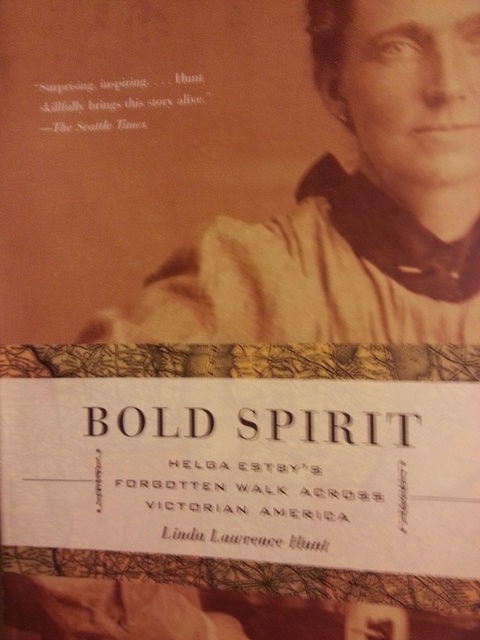
Books I’ve Read: ‘Bold Spirit’ Delves Into a Woman’s Role As Mother, Provider in 1896

Bold SpiritThis is another one of my thrift store finds and it was the subtitle that caught my eye. Bold Spirit: Helga Estby’s Forgotten Walk Across Victorian America by Linda Lawrence Hunt is a story about grit, hope, despair, betrayal and loss. It is a story that would be forever lost if a 8th grade student had not written an essay about his great-great-grandmother’s walk across the United States. When historian Linda Hunt read the boy’s essay, she tracks down articles and pieces the story together.

Helga Estby, a 36-year-old mother of nine, and her 19-year-old daughter, Clara, leave Spokane, Washington on a quest to be in New York City by December in exchange for $10,000. Helga leaves behind her seven children (a 12-year-old son died just five months earlier) and her injured husband in an effort to save the family farm.

As a reader, the money — offered by an unnamed sponsor (who required a contract be signed)  — seems sketchy from the outset, but it also gives a hint of the desperation Helga must have felt after the death of her son and her husband’s inability to work combined with unpaid taxes and a looming foreclosure. So even though the wager has the feel of a lottery (albeit one that requires a 3,500 mile walk) it is understandable why she would undertake the journey.

Some of the rules stipulated by the contract included:

  • the type of dress to wear (a bicycle skirt)
  • earn enough money along the way to pay for food and board (they left Washington with $5 a piece)
  • visit state capitals in the West
  • acquire signature of governors and other ‘important’ people along the way.

Helga and Clara keep their end of the deal and overcome wild animals, hunger, harsh weather, thugs and miscreants — protecting themselves with a small revolver and a pepper spray mechanism. Along the way, they become famous and well known as newspapers report their progress. They even spend the night at the home of president-elect William McKinley and eat dinner with the wife of president hopeful William Jennings Bryan (he was out of town campaigning).

But, the journey alienates Helga from her family.

The alienation begins when she arrives in New York and the sponsor does not honor the contract, leaving Helga and Clara broke and stranded. While in New York, one of Helga’s children contracts diphtheria and dies. Shortly after she finally secures train passage home a second child dies.

By the time she reaches Spokane, Helga is more of a villain than a heroine and so her story is silenced. So much so, that when she dies more than 40 years later, her children burn the manuscript she had written.

Rated 5 out of 5. The book is about so much more than the walk. Hunt successfully captures the mood and mores of the late 1800’s in the United States. She does an excellent job recreating the hardships of daily life faced by immigrants like Helga as they try to create a better life for their children.

Categories: American History, Books I have read