American History

The Great Gatsby: Skip the book, watch the movie

The Great Gatsby was one of those books on my to-read list that I never read, so I cannot say if the movie follows the novel’s story line, but I can say, the movie is well executed with great performances by Leonardo DiCaprio (Jay Gatsby), his friend and Daisy’s cousin Nick Carraway (Tobey Maguire), Daisy (Carey Mulligan), Daisy’s husband (Joel Edgerton ) and the mistress (Isla Fisher).

Simply put, the story is a love triangle. Gatsby loves Daisy, but Daisy is married to Tom. The story’s narrator, Nick, just happens to be Daisy’s cousin and Gatsby’s neighbor — so he is pulled into the plot to solve the problem.

From the onset, you figure out that at the very least, Gatsby is a troubled soul. He is mysterious and aloof, throws outlandish parties and has fabricated a personal history that enthralls everyone — although no one really knows him. The story is told through the eyes of his neighbor Nick, a midwestern war veteran who find a servant home nestled among all the Long Island mansions of the newly rich. When Nick receives a personal invitation to one of Gatsby’s party — their friendship blossoms.

Gatsby’s pain — and parties — are centered around the ever elusive Daisy Buchanan — the young love he met as a soldier, but was unable to wed because of Gatsby’s overwhelming need to be wealthy. Gatsby asks Daisy to wait while he created his wealth, but Daisy does not and marries Tom Buchanan — with ‘old money’ instead. Unfortunately for Daisy, her husband is involved with many women, including a mistress he rents an apartment with in the city.

When Gatsby finally arranges a meeting with Daisy and woos her back, he has only one — albeit — odd request. Daisy need to tell her husband that she never loved him — something Daisy cannot do. Because, although they have fallen out of love, she cannot change the past — the time when she did love Tom.

Gatsby spirals out of control with Daisy refusal to tell her husband (at the forced meeting arranged for Gatsby). In the ensuing drive home — in which Daisy’s husband asks Gatsby to drive Daisy home — Daisy accidently strike’s her husband’s mistress with the vehicle killing her. Stories are revised and lies are told — and the accident is eventually blamed on an unknowing Gatsby.

But it is not the police or the crime that seals his fate — it is a misguided and grieving lover.

Rating: 5 out of 5

Great performances, excellent sound track, intriguing story filmed in a compelling way.

Categories: American History, movies

Guns turned on families of American workers in 1913 debacle

History is written by the victorsWinston Churchill

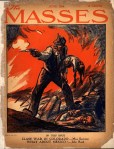
Cover of the June, 1914 issue of The Masses by John French Sloan, depicting the Ludlow Massacre.

Cover of the June, 1914 issue of The Masses by John French Sloan, depicting the Ludlow Massacre.

It is amazing what is minimalized or deleted from American history books. For example, we read about the Trail of Tears, but fail to learn that a significant number of Cherokee had already assimiliated into western society — adopting the clothing styles, building schools and farming European style — before they were uprooted from their homes and driven west by the Andrew Jackson administration.

History books tend to show the Native Americans in a more ‘savage’ manner with the ‘Great White Father’ Andrew Jackson needing to guide, counsel and control them.

Textbooks have also sanitized or omitted the Labor issues that plagued America between 1880-1920. Workers often are villified as violent agitators unthankful for America’s great bounty.

This is especially true in a strike that occured in 1913 at the Rockefeller-owned Colorado Fuel and Iron Corporation mine. The violence would claim the life of up to 200 people (according to a Rockefeller-financed investigation — the state report pegged it at 69) before it ended — and would show that justice favors the powerful.

Just the Facts

On September 23, 1913 miners went on strike for the following reasons:

  • Wages — they earned $1.68 per day. When paid, they received scrip instead of U.S. currency.
  • Unsafe working conditions. The mine fatality rate was twice the national average due, in large part, unenforced state safety laws.
  • Brutality against union organizers. The murder of a union organizer prompted the strike.

The company responded by:

  • Evicting miners and their families from company-owned homes.
  • Hiring strikebreakers and replacement workers
  • Petitioning the state of Colorado for National Guard assistance

Move and Countermove

Once the strikers were evicted from their homes, with the assistance of the United Mine Workers of America, miners created  ‘tent towns’ (for workers and their families) by renting land near canyon entrances, so they would be visible to replacement workers and prevent their jobs from being taken. Miners also presented this list of demands to the company:

  • Recognition of the United Mineworkers of America as the miners’ union
  • A fair, effective checkweighmen system of checkweighmen
  • Pay for digging coal at a ton-rate based on 2,000 pounds
  • Wages paid twice a month in U.S. currency
  • Abolition of scrip and the truck system
  • End to discrimination against union members
  • Strict enforcement of state safety laws by supplying miners with timbers, rails, and other required materials

The demands outraged Rockefeller who launched a campaign to destroy the strike.

Resistance meets Brute Force

Rockefeller hired armed guards to harass and intimidate the strikers. One of the agencies hired by Rockefeller built an aptly named Death Special — an armored vehicle with a machine mounted on top.  Less than a month after the strike began, on October 17, the vehicle was used in an attack on the Forbes tent colony resulting in the death of one miner and two wounded children. A boy’s legs were riddled with machine gun fire while a girl suffered a gun shot wound to the face.

The union fought back — and the back and forth loss of life continued through March. It escalated to the breaking point when, on March 10 the body of a strikebreaker was found near railroad tracks at the Forbes tent colony. When this occured National Guard’s General John Chase ordered families in the tent colonies evicted.

The Battlefield
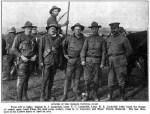
Karl Linderfelt, center, accused in death of miner Louis Tikas.

Karl Linderfelt, center, accused in death of miner Louis Tikas.

Ludlow was the largest of the tent colonies and on April 20 (the day after Easter), troops fired into the civilian-occupied colony. Anyone moving was fair game and a 14-hour gun battle ensued. During the battle, the tent colonies main organizer 30-year-old Louis Tikas met with National Guard Lieutenant Karl Linderfelt (the officer in charge of the assault on the Ludlow camp) to arrange a truce. But instead of working out a cease-fire, Linderfelt struck Tikas with the butt of his rifle and National Guard soldiers fired multiple times into Tikas’ back as he lay on the ground — killing him.

After dark, with Tikas dead, Guardsmen enter the camp and set fire to the tents killing two women and 11 children in addition to the estimated 40 people killed during the gun battle.

Backlash

In the aftermath, sympathy strikes occured across the country in support of the miners. However, none of the miners’ demands were met.
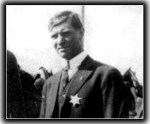
Louis Tikas killed by Colorado National Guard during conflict at Ludlow mines.

Louis Tikas killed by Colorado National Guard during conflict at Ludlow mines.

In 1918 a monument was erected with the following names and ages:

Louis Tikas, 30
James Fyler, 43
John Bartolotti, 45
Charlie Costa, 31
Fedelina Costas, 27
Onafrio Costa, 4
Frank Rubino, 23
Patria Valdez, 37
Eulala Valdez, 8
Mary Valdez, 7
Elvira Valdez, 3 months
Joe Petrucci, 4 ½
Lucy Petrucci, 2 ½
Frank Petrucci, 4 months
William Snyder Jr, 11
Rodgerlo Pedregone, 6
Cloriva Pedregone, 4

Categories: American History, Labor History | Tags: ,

How a poor managerial decision blew up a space shuttle

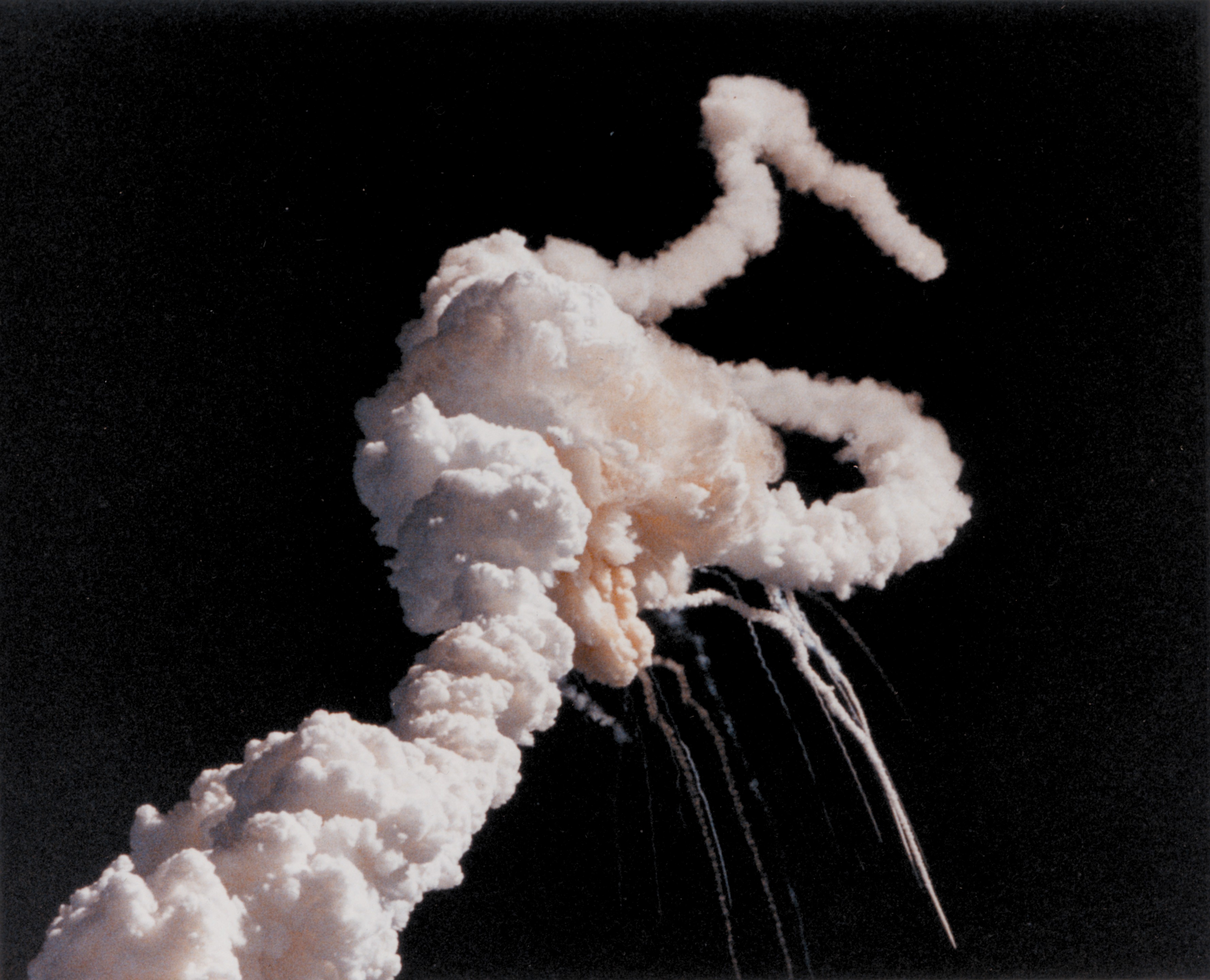
Challenger Eplosion

“If we launch tomorrow we will kill those seven astronauts,” Roger Boisjoly.

It was the first time a civilian was included in a space flight and Americans watched with anticipation as the Challenger launched — only to see it explode 73 seconds later. If you were alive in 1986 when it happened, you probably remember two things: Where you were and that o-rings were to blame.

But what received limited news coverage was the teleconference call the night before the launch where, despite objections from engineering expert Roger Boisjoly who presented his team with images of damaged o-rings from previous flights, NASA was given the go ahead for the launch.

It has been described as one of the worst ‘the customer is always right’ decision-making examples in history.

But, to get a historical perspective on why the go-ahead was given you need to understand three factors at play: an expiring $710 billion contract, waning public interest in space travel — and a president hoping to capitalize on a teacher traveling into space.

The Looming Contract

Space flight was a very expensive venture which meant it was highly profitable for those in the business. One of those companies was Morton Thiokol International — part of the family of companies that supply table salt. They were no stranger to government-funded projects — Thiokol was a major supplier of liquid polymer sealants in WWII.

With regards to space travel they designed the solid rocket boosters used to lift the shuttle off the launch pad. Even though they did not submit the low bid, they were able to win the initial SRB contract, possibly due to political connections between the Utah-based NASA administrator and the Utah-based Morton Thiokol. That first contract was worth $710 billion and Morton Thiokol was still in the process of securing the second contract on the eve of the disaster.

Reviving Interest in Space Travel

NASA, on the other hand was dealing with a different type of problem: waning public support. The public’s enthusiam of the 60s and 70s for the program had been replaced by a ‘been there, done that’ feeling. To offset this and revive interest, NASA embarked on a massive public relations campaign with its Teacher in Space project. The program was announced by President Ronald Reagan in 1984 and proved quite popular with more than 11,000 teachers applying for a seat on the shuttle. In 1985 NASA chose Christa McAuliffe with Barbara Morgan as her backup.

Political Aspirations

Last, but not least, President Ronald Reagan wanted to include the event in his State of the Union address to be delivered on January 28. Once the tragedy occured, Reagain became the first and only president to delay a State of the Union address. Reagan declared January 28 a day of mourning and delivered his address on February 4.

The Phone Call

When Morton Thiokol management initially engaged in the January 27 teleconference with NASA, they stuck to their guns saying they could not recommend a launch below 53 degrees since that was what the data supported. This was met by opposition from NASA and at one point in the conversation, Larry Mulloy, the SRB Program Manager for NASA said,

“My God, Thiokol. When do you want us to launch? Next April? The eve of a launch is a hell of a time to be generating new Launch Commit Criteria.”

Thiokol found itself in a new position. It was accustomed to giving evidence supporting a decision to launch, but now it had to supply evidence why it should not launch — a much different task. This led to their downfall. Since they did not have data to conclusively prove a launch would be catastrophic, they would have to rely on an opinion. It became a case of management not valuing or trusting the opinion of the person closest to the problem. Engineering expert Boisjoly (and others) had been deeply immersed in the o-ring issue for months so they had intimate knowledge, but their knowledge was bypassed as managers above them sought to appease a dissatisfied customer.

Boisjoly, who on the night of the call vehemently opposed the launch, six months earlier, sent a memo to the vice president of engineering stating,

It is my honest and very real fear that if we do not take immediate action to dedicate a team to solve the [o-ring] problem…we stand in jeopardy of losing a flight along with all the launch pad facilities.

His opinion was ignored.

They Get The Contract Anyway

In a final odd twist to the story, despite their role in the catastrophe, Morton Thiokol was awarded the new SRB contract, receiving less than a ‘slap on the wrist,’ in the opinion of one editorial.

What About The Teacher Who Trained As McAuliffe’s Back Up?
Barbara Morgan trained as the backup astronaut for Christa McAuliffe, the teacher who died in the 1986 Challenger explosion. Morgan went on to become the first teacher in space more than 20 years after her colleague’s death — and she did it with little fanfare.

In 2007, she was load master on an 11-day mission to the International Space Station on the space shuttle Endeavour. In a nod to McAuliffe, during the mission, she answered students questions via satellite. Learn more about Morgan in the PBS special Barbara Morgan: No Limits.

Resources

Quite a bit has been written about the Challenger explosion. The decision-making process has been written about in ethic, engineering and other publications. Several books have been written as well, here are a few:

Categories: American History | Tags: ,