American History

Books I’ve Read — Shot All to Hell: Jesse James, the Northfield Raid, and the Wild West’s Greatest Escape

It is true, we are robbers, but we always rob in the glare of the day and in the teeth of the multitude. — Jesse James

There is just something about Frank and Jesse James that attracts interest. Immortalized into American lore, stories of the pair often are romantized to the point that it is hard to tell fact from fiction. Fortunately, there are writers who dig deep and try to research a story before committing it to paper.

That is definitely the case with Mark Lee Gardner, who has dug out the complete story of a botched Minnesota bank robbery conducted by the James-Younger gang. The book retraces the steps the men took to rob the bank and the fumbling way authorities worked as they tried to captured the six surviving members as the gang made its way through unfamiliar terrain and territory.

As the story of near captures, wrongly captured men, hysteria and admiration unfolds, it is amazing how the Younger part of the gang is eventually captured — because of a teen age boy Oscar Sorbel. For his efforts, Oscar will eventually be awarded $56. When the surviving Younger men are captured and taken to jail a new type of show unfolds as people want a glimpse of the famous outlaws.

Frank and Jesse elude capture for years. Jesse will eventually be shot and killed by Robert Ford. Frank, seeing the writing on the wall, eventually seeks out a clemency deal with the governor of Missouri — becoming the only one who truly escapes, despite the fact he was guilty of murdering a bank employee in the Minnesota robbery.

Book is written at a nice pace, has enough detail to keep it interesting, but not so much to bog it down. I would give it a 4.5 out of 5 rating. Excellent read.

I guess, if I had it all to do over, and had the choice, and had to make the choice as a young man, I’d rather have all the pain and danger and trouble than to be just a plain farmer. If I had an old man’s head, I would choose different. … — Frank James late in life.

Categories: American History, Books I have read | Tags: , , ,

U.S. President with previous experience as hangman? Absolutely.

rope

Growing up in Ohio I knew seven U.S. presidents were born here and I knew from high school history class that Grover Cleveland was the only president to serve two non-consecutive terms. But, what I didn’t learn in history class was The Buffalo Hangman performed two executions during his three years as sheriff — apparently to save $20.

In 1870, Cleveland was elected sheriff of Erie County, New York. One of the responsibilities he had as sheriff was to make sure death sentences were carried out. Although not required to physically do the execution, (he could pay a deputy $10 to perform the task) for whatever reason Cleveland chose to be the one to open the trap door for two prisoners.

According to a New York Times article [pdf], dated Sept. 7, 1872, the first man Cleveland executed, by hanging, was Patrick Morrissey.

The rope was adjusted and the black cap drawn over his face, when the signal was given to the Sheriff, who sprung the trap at 12:05 o’clock.

The article continues saying that Morrissey died instantly. Although, the next few sentences seem to contradict the statement.

At eight minutes after dropping the pulse ceased, and at 12 minutes the heart ceased to beat, and life was pronounced extinct by the physicians.

Although the concept of a president as an executioner seems very unique, Morrissey’s story and crime unfortunately were not. Morrissey, who was born in Ireland, came to America as an infant with his parents. His introduction to a life of crime started at 11 when he spent six months in a detention center. By his late teens or early 20s, he was sentenced and served three years in prison for larceny.

Murder
At the age of 29, he was convicted of killing his widowed mother in her own home. Apparently around 2 p.m. on a Sunday afternoon, Morrissey had drank a little too much and was inebriated. His mother was in the dining room using a carving knife to cut some meat she had cooked. An argument ensued, she order him to leave, he grabbed the knife and stabbed her in the chest. He did not attempt to escape, and was taken into police custody.

But drinking and violence must have run in the family, because at the trial, two of his sisters testified that their mother would get drunk, angry and that all the children had ‘marks of wounds’ received from their mother.

On the day of his death, Morrissey read a statement taking full responsibility for the crime, saying though he did not remember committing it and advised those present to avoid ‘intoxicating drinks and evil associates.’

Cleveland’s second and last execution was on Feb. 14, 1873 when John Gaffney was hanged — also for a murder conviction.

Grover Cleveland Facts:

Categories: American History | Tags: , , ,

Semper Vivus: The hybrid car you’ve never heard of

I have always had an interest in alternatively styled and alternatively fueled vehicles, which is probably due, in part at least, to the wide variety of cars my father owned during my childhood. Eventhough they were the normal family cars, they were always at least one generation behind the current model. So we had station wagons with rear-facing seats (69 or 70 Chevy Impala), a 1964 Ford Fairlane station wagon — still one of my favorite cars — but we also had Pontiacs, Oldsmobiles, Opels, Mazdas and Datsuns.

But, my all-time favorite car to drive as a teen — was the ugly, green box-shaped Fiat. I think it was a 1973 model, but its defining feature was its 4-speed on the floor — with a second gear that did not work. Eventually, third gear would give way and the driving challenge was shifting from 1st to 4th without either: a.) blowing up the engine or b.) causing it to stall out when the car went into 4th gear at too low of a speed.When the hybrid car was first introduced in the U.S., I looked at one (Toyota Prius), but the technology was new (I would later learn in fact the technology was old), so I opted for a conventional car. But a couple of years ago, I purchased my first hybrid — a 2012 Toyota Camry. Overall I am pleased with the car — and it has consistently delivered the advertised gas mileage (41/39). [Click here if you want to read my in-depth review of the car].

The first hybrid — which used technology that today’s Chevrolet Volt mirrors — was a Porche. In 1900, Prof. Ferdinand Porsche introduced the Semper Vivus — a vehicle that combined electric powered wheels and a gasoline engine to recharge the vehicles battieries. The vehicle was in some ways an extension of a previous electric model he had perfected, the Lohner Porsche. The Lohner Porsche was an all-wheel drive vehicle with each wheel powered by an electric motor.

Prof. Ferdinand Porsche realized his electric vehicle would travel further if he used a gasoline (which they always seemed to call petrol back then) generator to charge the batteries. The vehicle never realized any serious sales, though, since it was nearly twice the price of comparable gasoline-powered vehicles. Only 11 were sold.

What I found interesting, though, were some of the challenges Prof. Ferdinand Porsche faced still exists today — the two primary ones being vehicle weight and battery storage capabilities. Of course, great strides have been made since his era. We now build cars from lighter weight materials and battery technology continues to improve as modern hybrids shift from nickel-metal hydride (NiMH) and lithium-ion (Li-ion) batteries. Tesla has even created vehicles with swappable batteries packs — and they can be switched out in the same amount of time it takes to fuel a gasoline car.

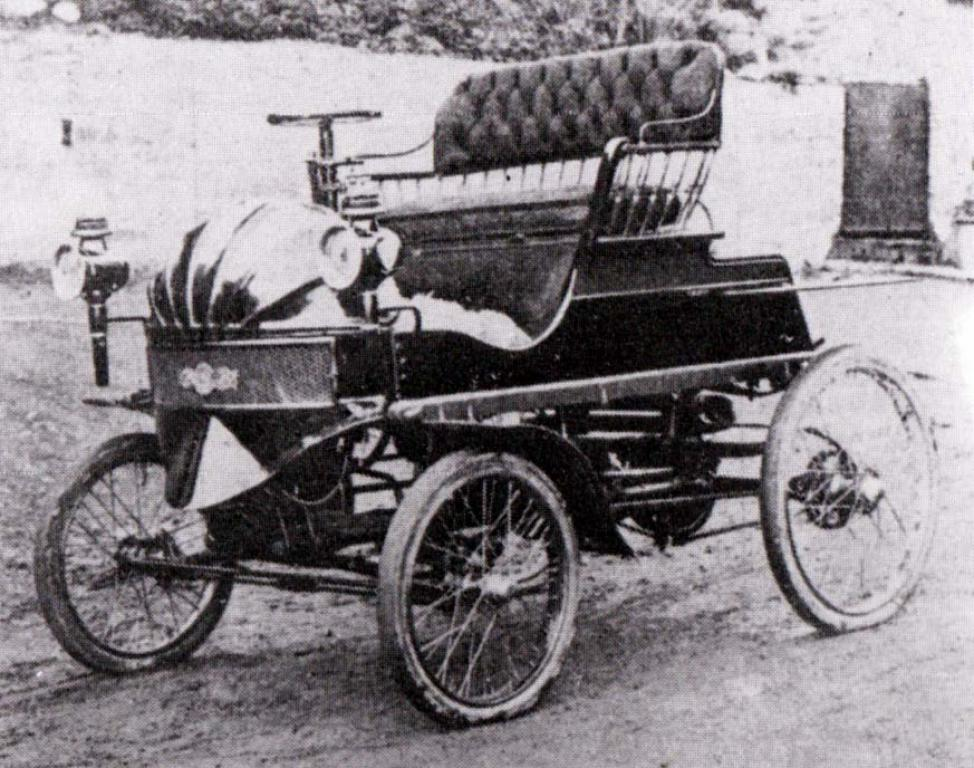
1900 Pieper Hybrid

1900 Pieper Hybrid

The hybrid style that mimics most current hybrids — like the Prius for example — came a few years later and was patented by Henri Pieper. He applied for a U.S. Patent for a parallel hybrid system in 1905 and received it in 1909. The design uses both the gasoline engine and the electric motor to power the vehicle as needed. In the case of the Pieper vehicle, it had an electric motor that charged a battery pack. The battery pack was used to give the gasoline engine a boost when climbing steep hills — or other situations when more power was required.

Today’s hybrids continue to push the technology envelope. The Ford C-Max Energi concept car is even using solar power to keep the electric battery charged. But, they have a twist since solar panels on a car currently can’t produce enough electricity to warrant their inclusion — Ford’s version includes a portable charging station that utilizes a Fresnel lens to intensify the effectiveness of the panels. They assert, the sun could power as much as 75 percent of all trips made by the driver.

If that turns out to be true — that is impressive.

Categories: American History | Tags: , ,