
Books I have read

Books I’ve Read: Sideswiped Offers Insider’s View Of American Political Machinery

Bob NeyIn my ongoing quest to research what my Congressman John Boehner has — or has not — done for his district, I came across this book by former United States Congressman from Ohio Robert Ney. Ney, was a colleague of Boehner and, let’s just say, there does not appear to be any love lost between the two.

Ney was convicted of a felony in 2006 in what came to be known as the Abramoff Scandal. Sideswiped: Lessons Learned Courtesy of the Hit Men of Capital Hill is an autobiographical look at Ney’s life, the scandal, the jail sentence and beyond. Even if you are not aware of the scandal — or only have a cursory interest in politics — I highly recommend the book because it adds to the public arena two aspects of America that most citizens will not experience firsthand.

  1. It gives the average American a look at how the political machine — regardless which side of the coin a reader lands on — is bigger than any one individual and how it can consume and corrupt. Makes no bones about it, Ney does not excuse his behavior, he readily admits he is a recovering alcoholic and that he had ethical lapses. He does not write from the angle of ‘have pity on me,’ but writes almost as a dispassionate journalist relaying what transpired in his life and career. Because he was in politics for such a long time, he provides some interesting insight to modern U.S. events like voting reform legislation — and on the less newsy side Freedom Fries.
  2. Ney also provides an interesting look at how the penal system works. Ney matter-of-factly relays how he and other, especially political, felons were treated inside the system. Most interesting, I think, was how the halfway house was run and some of the ludicrous — and archaic — rules that were in place that tended to prevent, rather than promote, a convict’s re-entry into society.

In his book, though, Ney, who seems to have little to lose (he went from about $600-a-day salary to less than $2,000/month), shows his southeastern Ohio roots and is more than willing to throw others under the bus — including Boehner. He writes,

“[Boehner] was considered a man who was all about winning and money. He was a chain-smoking, relentless wine drinker who was more interested in the high life — golf, women, cigarettes, fun, and alcohol.”

When the book was released in 2013, Boehner’s spokesperson Michael Steel said,

“This is a convicted felon with a history of failing to tell the truth making a lot of baseless accusations to try and sell books. More than anything else, it’s sad.”

Readers will decide for themselves who they believe, but despite the mud-slinging, the book does shine a light on the unscrupulous connection between lobbyists, politicians and the resulting legislation that is imposed on the American public because of who has a Congressman’s ‘ear.’

Rated 4 out of 5. My main critique of the book are the sidebars. It appears Ney is sifting through a lot of information as he writes. In his defense, it would be very difficult to compress nearly three decades of public life into a 363 page book. However, what he does is include some of the ‘extra’ information in parenthesis and italics, which, at least for me, was somewhat distracting as it tended to interfere with the overall flow of the book.


Categories: 8th congressional district, American History, Books I have read, Politics

Books I’ve Read: Blue Collar Conservatives Seek to Solidify, Define Party’s Role

Rick SantorumAlthough my political leanings differ from Rick Santorum, I picked up the book in an effort to better understand my Congressman John Boehner, who was a co-member of the Gang of Seven with Santorum. The Gang of Seven became a household name in the early 90s by exposing fellow members of the House in the House Banking Scandal.

Whereas Boehner would remain in the House, Santorum would head to the Senate and would run for president in 2012. Blue Collar Conservatives: Recommitting to an America That Works is Santorum’s recounting of the presidential bid and the stories, problems and solutions he uncovered along the way.
As I read the book, I found Santorum to be a likable character. Because of his blue collar roots, I definitely felt I could connect with him and some of the points he makes in the book, I agree with. He puts a lot of emphasis on family as the smallest unit of government and cites various studies and research that link a strong country to strong families.

What I found most interesting about the book was his willingness (albeit constrained) to admit some of the shortcomings of the Republican Party and how it has not solved — or listened to — the problems of working class America. He deliberately hands over the numbers that prove the growing divide between those who have and those who have not. He even admits that the economic crisis America faces today is not the same as the one faced by his political idol Ronald Reagan (and should not be handled the same way).

“Everyone was struggling then — businesses, investors, and workers alike. Today, large businesses are doing well, and stock and commodity prices are strong. If you are an owner or investor, life has been pretty good. But for workers, it’s a different story: unemployment and underemployment are high, and the percentage of working-age Americans who have given up looking for a job is at a thirty-year high.”

Despite his willingness to shoulder some of the blame, in the sense that the Party has not adequately addressed the needs of American workers, the book, unfortunately falls back on political rhetoric as too much of the blame for the current situation is levied at one person — President Obama. In fact, the book overshadows any potential economic setback by sounding the alarm that the Affordable Care Act (often called ObamaCare) must be replaced.

Although, in the end he falls back on the common Republican — and Democrat — tactic of placing blame on a president, the book really is an interesting read. I would recommend it as it offers some insight into how a presidential campaign is run — and for the stories of the average Americans that Santorum met and successfully wove into his life’s story.

Rated 4 out of 5 stars.

Categories: American History, Books I have read, Politics

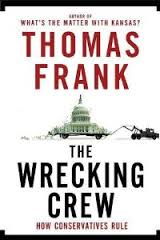
Books I’ve Read: The Wrecking Crew Shines Spotlight On Republican Not-So-Hidden Agenda

The Wrecking CrewBefore I started reading books by Thomas Frank, I thought maybe I had slept through the 80s and 90s, especially as I listened to the Republican rhetoric in this ‘Ronald Reagan was the greatest president’ era. I thought I remembered, Reagan — and both of the Bush presidents for that matter — driving up the national debt, increasing the federal deficit and being unable to balance a budget.

Turns out I remembered correctly.

In The Wrecking Crew: How Conservatives Ruined Government, Enriched Themselves, and Beggared the Nation, Frank takes a hard, uncompromising look at the cronyism that came to define the conservatism movement and how government became inept because of it. In example and example, Frank views historical moments — current events that most of us remember — and shows what occurred on stage and behind the scenes.

Disasters like Hurricane Katrina and the fumbling government response by the head of FEMA — and George W. Bush’s crony  — Joe Allbaugh. Allbaugh was appointed to the position despite the fact that he had no experience in anything remotely akin to responding to a disaster.

But, examples like that are old news, so it’s Frank’s piecing together of some of the lesser-known events and persons that makes the book such an interesting read.

Frank devotes an entire chapter to one of America’s most powerful groups — lobbyists, showing what they have accomplished in Washington D.C. since the early 1990s. Embarking on the time period filled with the righteous indignation of Newt Gingrich and the Freshmen Class of 1994, Frank unveils the agenda of Indiana freshman Republican David McIntosh. McIntosh is ready to face this lobbying problem head-on, well sort of, by trying to get a bill passed to ban lobbying — at least by certain groups.

In his trademark, biting wit, Frank writes,

“This was a form of idealism in the way that poison ivy is a tasty and nutritious salad green. McIntosh’s antilobbyist bill, as it turned out, would have applied solely to organizations that received federal funding and would thus have damaged only advocacy lobbyists like environmentalist and good government types; in Republican circles his proposal was commonly referred to as a ‘defund the left’ bill. Instead of staving off government-by-money, McIntosh’s measures would have only eliminated the competition for corporate lobbyists.”

Of course, as the book points out, the idealistic, anti-lobbyist McIntosh became a lobbyist the year he left Congress.

What I like about Frank is the amount of research he does for his books — the breadth and scope of his reading must be enormous — as can be seen by the somewhat obscure examples he uses, including this one which he uses early on in the book.

He opens a scene with an example from a 1945 children’s book. The book explains all the good that can come from a single dime when coupled with a benevolent government. The 1945 dime was all about service, so Frank modernizes the story, showing how a privatized and outsourced government creates a dime that is all about profit.

And as Frank shows — with plenty of footnotes for the doubters —  this new model of selling off government to the highest bidder has cost the American worker more than just the equity in their homes — or a  Great Recession.

It costs them their voice in government.

Rated 4.5 out of 5. The only reason I don’t give this book 5 stars is because it is so fact-dense (which is a good thing) that the notes and footnotes tend to slow the reader down.


Categories: 8th congressional district, American History, Books I have read