
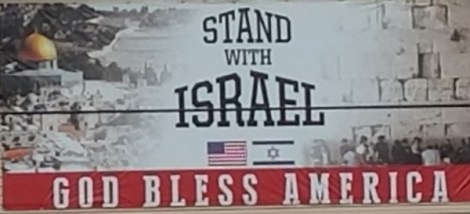
We have lots of Stand With Israel signs in Preble County. One can only speculate what the signs would say if the Shepherd of Hermes, instead of The Revelation of John, had been included in the Bible as originally planned. This sign is attached to a Baptist Church in Camden, Ohio.
Two men walking up the hill, one disappears and one’s left standing still — I Wish We’d All Been Ready, Larry Norman, Upon This Rock, 1969. This song, which includes the phrase, ‘the Son has come and you’ve been left behind,’ was a conservative Christian anthem in the late 60s and early 70s. It may have been the inspiration for the Left Behind series penned by Tim LeHaye and Jerry Jenkins. More than 65 million of the books have sold worldwide. The song has been recorded by Pat Boone, Cliff Richards and a slew of CCM artists.
Let me begin by saying, I don’t believe it.
I don’t believe in the Rapture. I don’t believe in Armageddon and I certainly don’t believe that Israel is part of God’s plan. It’s about politics and exploiting fear.
But I wanted to learn about the Israel movement because of the overwhelming number of ‘Stand with Israel’ signs in my county. When I first noticed them years ago, I mocked them, not grasping what they really meant — that a regressive, apocalyptic worldview was invading my community. It’s a worldview that believes the end of time will occur with Armageddon in Israel.
Growing up in an evangelical church whose brand had a muddy view of the end times, I was never overly interested in Armageddon — or its common partner — the rapture. The rapture is a worldview that asserts the righteous will be ‘taken away’ into paradise while the rest of us are left on earth to learn a hard lesson.
This worldview was told (and sold) in exhausting detail via the Left Behind book series.
The Fearful Faithful
Fundamentalism is the preferred form of Christianity in my part of America. Literal signs of this belief structure are everywhere — from the ‘If you die tonight, will you go to Heaven or Hell?’ billboards along I-70 to the ‘repent and be baptized’ sign as you enter Camden, Ohio. In the past several decades, despite a declining population, we have seen the number of our churches grow — with an increasing move toward stricter interpretations of what the ‘Bible really means.’
Despite our growing number of churches, fear is pervasive, with many local churches compelled to remind citizens that we are a ‘Christian nation’ under siege by the forces of evil. In a recent letter to the editor the minister of the Eaton Church of Christ explains the presence of small white crosses starting to pop up throughout Preble County.
“We have decided that if our local, state, and federal governments are going to bow to the demands of those who would see all the symbols of the Christian foundation of this nation removed, then we will do our best to remind them…They (the white crosses) are a way to remind those around us that this nation became the greatest nation in the world because of its Christian foundations: true morality, Christian principles and the providence of the one true God and creator.”
This approach to interpreting America’s history is common among fundamentalist who have decided that, just like with the Bible, they are the only ones to be trusted with understanding our country’s nuanced beginnings.
God Knows Best
Fundamentalism exploits the simple faith of many, and few do it better than bestselling author Michael D. Evans. In American Prophecies: Ancient Scriptures Reveal Our Nation’s Future, Evans details how America is in the path of prophecy as he analyzes current and past U.S. events surrounding the Nation of Israel. According to Evans, the U.S. and Israel were chosen by god as part of a divine plan to save (most of) the world.
The book is worth reading to better understand the reasoning behind the Stand with Israel movement. This peculiar, fundamentalist movement has believers sadistically waiting for a nuclear war to prove their interpretation of the Bible is correct.
Evans builds his case for Israel’s holy role in America (and vice versa) by relying on Old Testament verses that, he says, prove America is part of the ‘prophecy stream.’ He details the various times in American history when presidents succeeded, or failed, to follow God’s will concerning the Jews. Overall, it appears that the GOP has been better at understanding God’s will than the Democrats, as one would expect based on the author’s political affiliations. But, politics aside, Evans does appear to truly believe that we have divine protection as a country.
God’s Protection
One example Evans gives is General George Washington.
According to Evans, on the battlefield bullets tore through Washington’s coat, but did not pierce his flesh. This, and other events like it, are proof to Evans that that God’s hand was working as a shield for Washington as God guided the country’s inception. But, as anyone who has read war accounts know, these type of ‘miracles’ are fairly common throughout history.
By Evans’ logic Dick Winters (Band of Brothers) or a Preble County WWII vet I met years ago were protected by God. This local soldier’s story of survival includes many ‘intuitions’ that saved his life (‘move away from that tree’) and in one incident, as an 18-year-old soldier, he was one of only two to survive a SS ambush. This man, who detailed other unexplainable events, said he struggled with understanding how he was saved in battle when the guy next to him was killed.
This phenomenon is commonly referred to as survivor’s guilt, but for Evans, in the case of Washington, it was part of a master plan.
What Were They Thinking?
The book employs a retelling — or a ‘getting inside the head’ — of past president’s action and in Evans’ defense his life has intertwined with a lot of high-ranking political figures so he would be privy to some of their thought processes. The book was published in 2004 so 9/11 and the president all conservatives love to hate — Bill Clinton — was still fresh on Evans’ mind.
So, as expected, throughout the book Evans political leanings often influence his spiritual insights. But, at times, his reasoning feel insane.
For example, Evans quotes an unnamed ‘brilliant and respected scholar whom I have known for decades,’ who gives yet another verification that God is protecting Israel. The scholar says,
“If you look at a satellite image of the city of Jerusalem, you will see the tetragrammaton YHWH. It is clearly visible in the photos.”
YHWH is the Hebrew word for Yahweh — the ‘unspoken name of God,’ Evans says.
Moving The Embassy
As spiritual advisor to 45* Evans was elated when the U.S. Embassy was recently moved to Jerusalem, saying at a December ceremony honoring Trump,
No president in history has ever built such an alliance for the State of Israel and the Jewish people, and no president has courageously stood up for the State of Israel on the global stage as you had Mr. President.
The embassy move is a mixed bag of blessings. If you believe in biblical prophecies, we’re one step closer to the end, and if you don’t believe, well a hard lesson is awaiting.
No Rating on Book. If one wishes to understand the ‘end times’ mindset, but does not want to read the 16-part Left Behind series, this succinct work should do the trick. The book I read is a signed edition –and since I bought it at Goodwill it was discarded by the original owner. I’m not sure what that says about the destination of his/her soul.
Afterthought
As Evans explains in the book, 65 million Americans profess to be Christian and he pontificates what would happen if the Rapture occurred today emptying the country of their souls. It was this argument that almost made me a believer since I could not see a downside.
“Realize, also, if that (the Rapture) happened today it would take our president. Who else would it take? How many members of the Senate? The House? How many judges? How many governors? How many mayors and city council members?”
Although I find the belief system superstitious, one part of the book I did find intriguing — and somewhat entertaining — was the list of Bible verses each U.S. president used when sworn in. Some, like Reagan understood the marketing power of a verse while others, like Lincoln, just let the Bible fall open. At least one president, Pierce, chose not to use a Bible at the inauguration.


 But, what I never knew, until reading



 Charlie R. Claywell