Books I have read

New York Times Bestseller, ‘Hillbilly Elegy,’ Mentions My Hometown, Describes Region’s Poverty

My father, far right, with his brothers in Cumberland County, Ky.

My father, far right (holding infant), with his brothers in Cumberland County, Ky.

Hillbilly Elegy: A Memoir of a Family and Culture in Crisis is described as one to read to understand the Trump win but, I was drawn to the book for a different reason.

I happened upon a TED Talk by the book’s author, J.D. Vance, about a year ago (The struggles of America’s forgotten working class) and when Vance mentioned he was from Middletown — located about 30 miles south of my home — I decided to read his book. Upon reading it, I discovered that as a grade school student he lived in Preble County (where I live) for a short time.

When I was about nine years old things began to unravel at home. Tired of Papaw’s presence and Mamaw’s constant ‘interference’ Mom and Bob decided to move to Preble County, a sparsely populated piece of Ohio farm country approximately thirty-five miles from Middletown.

The ‘experiment’ in Preble County ends, he says, when his mother overdoses and Vance returns to his grandparents’ home in Middletown.

Shared Lineage

The book has garnered good and negative reviews — and some reviews raise legitimate questions, but as a resident of the region with a similar background, I can relate with much of the story he tells, even if his characters are significantly more colorful than the ones I know. (The volume and type of cursing that exists in the book starkly contrasts with the language I heard growing up, even from the ‘unsaved,’ in my lineage.)

Vance’s lineage is from Jackson, Kentucky, mine is from Cumberland and Clinton County, Kentucky.

His tale is about a hardworking, tenacious and, quite often, self-destructing culture. As Vance unveils a landscape of poor, unrepresented Americans we see a group that does not escape its impoverished past. In southwest Ohio, where much of the story takes place, Kentuckians migrated here during the 1950s-1970s because union jobs offered a better standard of living. The company Vance’s grandfather worked for — AK Steel — actively recruited working-age men from Jackson County and the surrounding area, Vance reports.

By the time Vance is raised, though, the livable wage jobs are mostly gone as unions lost their foothold.

Dysfunction and Hard Times

So, the book is a tell-all about his dysfunctional family and the economic hardship they faced. The story is real and relatable since many people still live that way here.

My qualm with the book is the heavy-handed advise sprinkled throughout, that quite frankly, will not work. He is writing to ‘his people’ telling them government policies won’t change their situation, only they can. As the Jacobin review points out Vance overlooks the reality that systems already in place had, in many ways, locked this demographic into perpetual poverty. As Bob Hutton writes,

It’s a somewhat eccentric but fairly harmless idea. But at no point does Vance suggest that Kentucky and Ohio residents might benefit from higher wages, better health care, or a renewed labor movement… Hillbilly Elegy is misnamed. Elegies are poems dedicated to the dead. The American hillbilly isn’t dead; he’s just poor. The book should have been titled Hillbilly Reprimand, because Vance doesn’t want to mourn the hillbilly — he wants to make him a good worker.

What Is Versus What Could Be

I agree with Hutton. More than 200 years of history has proven this demographic has not found a way to achieve the American Dream. On the whole very few escape the poverty. Their communities have been filled, as Vance points out, with hardcore drug problems, addictions that are nearly impossible to shed (like meth and heroin), something he indirectly proves through the reoccurring theme of his mother’s failures and drug abuse.

As I am seeing in my own community, drug abuse will not resolve itself. It requires government intervention. As I write, in today’s local paper, out of the 21 indictments handed down by the Grand Jury in January, 15 were drug-related. We are a county of 40,000 residents.

‘Hillbillies’ also have few economic opportunities because their job options are often fast food or retail, so even those ‘hard-working’ individuals with multiple jobs will not achieve any upward mobility on those salaries. One 50-something man I recently met from the Middletown area, who had taken on seasonal work, noted that with his new job he was now working about 90 hours a week. Another woman I met stated the temporary job was her third source of income. They were doing their part — working hard — but they were hardly ‘living the dream.’

The real underlying story in Vance’s memoir is he was lucky to make it out. And it is his escape, that points to the real solution. He openly admits the upper echelon of our society have a different set of mores and values and, to become successful, Vance embodies them.

Brain Drain

His story also reveals he is the exception, not the rule. Vance follows the tried-and-true method of upper mobility for most Appalachians. He leaves the region. In his case, he goes to the Silicon Valley where more economic opportunities exist. Most of ‘his people’ do not have that option. They will not become a Yale-educated attorney. Instead, their life and economic choices are significantly more bleak and they will be exploited by the existing economic conditions in their communities.

And, because of their poverty, many will die prematurely.

Rated 4 out of 5: In spite of his ‘pull yourself up by your bootstraps’ mentality, the book does provide a peak inside the mores and values of some Appalachian working poor.

Categories: Appalachia, Books I have read

Oneida: A Utopia Of Free Love — And Silverware

oneidaOneida: From Free Love to the Well-Set Table is one of the most intriguing books I’ve read. It is the backstory of Oneida, a silverware manufacturing company that was a household name for much of the 20th century. Although the book does cover some of that history near the end, it is mostly about the Utopian society created in the mid-1800s by John Humphrey Noyes.

Noyes, the son of a Puritan, established himself as a minister in his early 20s, but his approach to Christianity is radical compared to his upbringing. The group he establishes in New York, known as Bible Communists, share property, working responsibilities and childrearing duties. For the most part, none of that is significantly different from the other Utopian societies that were popping up across America in its early years.

But, the author, Ellen Wayland-Smith, a descendant of one of the original 1800s Community members, digs much deeper into the story — painting a compelling image of life in the 1840s to 1880s community. She does this by relying on historical documents, company publications and diary entries. This community is eventually incorporated and would be the foundation of the Oneida Company.

A significant portion of the book deals with the more unusual beliefs the group cherished. They practiced a program of eugenics, called stirpiculture, where they attempted to breed a more perfect human through scientific selection. They also had sessions where people would volunteer to be judged by the community — where all of their faults and sins revealed to them. (It feels a little bit like Festivus’ Airing of Grievances)

But, by far the most unusual belief was their concept of Complex Marriage — which basically meant that everyone was married to each other — sharing and trading partners. But it was not communal in the sense that everyone gravitated to the one or ones they were attracted to, instead partnerships were under the control of the church leaders. They, mostly Noyes, would determine which adults would be partnered. The church was not a believer in marriage between any two individual — a condition referred to as ‘stickiness.’ Where a pair became too attached Noyes would separate the pair often coupling them with new partners. The book is worth reading for this section alone because of the rules and guidelines created by the church to make it work. To say the least, it was a very unusual concept.

It is where, though, some of the author’s humor shines through including one section where she references diary entries about the escapades. One entry is from a woman who spends the last day of Complex Marriage — the church officially ended the practice in the 1880s — by rearranging her schedule on that final day so she could have coitus with three partners. On a less humorous note, though, the author point out the devastation the unmarried women in the church faced once Complex Marriage ended.

Noyes, realizing these women would be held to a different standard by mainstream society, especially since some of the women had children by three and four partners, Noyes made it his mission to help them find spouses before Complex Marriage officially ended.

Rated: 5 out of 5. The book is well-written, poignant and funny (at times), but mostly it is a well-researched, obscure and entertaining tale. It sheds light on a fringe religious group of the 1800s — one that practiced relative gender equality, practiced Socialism, and by and large was successful in its approach to society for more than 40 years. But, the story is also about the company’s effort to hide that past once the community disbanded and the corporation moved into the 20th century.

Categories: Books I have read

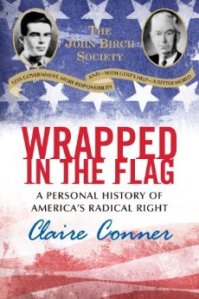
‘Wrapped In The Flag’ Offers Peak Inside John Birch Society

Wrapped in the FlagIn my life I have heard some strange theories. Three random ‘truths’ I’ve heard at various points in my life are:

  • During the late 80s/early 90s a coworker advised me that AIDs was created by a man having sex with a monkey ‘over there in Africa.’ (Hunters exposed to blood of chimpanzee introduced the disease to humans.)
  • In my teens I learned ‘we did not land on the moon’ that was all ‘staged in Hollywood.’ (I’ll let Buzz Aldrin address that one.)
  • As my 10-year-old self stood nearby, a John Birch Society supporter explained to my father how the Communists were going to create Districts (instead of states) when they took over the country.

So, somewhere along the way I became interested in why people believe what they do. This interest led me to Wrapped in the Flag: A Personal History of America’s Radical Right by Claire Conner.

View From The Inside

In Wrapped, Conner tells the story of the John Birch Society from the inside out. Her parents were beginning members of the organization and her father, in his leadership role, rubbed shoulders with JBS leaders — including founder Bob Welch.

Although Conner’s book is an autobiography since she had interaction with so many JBS members the reader gets an intimate view of the minds and ideas that shaped the movement. The book’s greatest accomplish is the documentation of her parents’ paranoia, bizarre beliefs and behaviors (which inflicted a lot of pain in the her personal life) but it also puts into perspective the role various politicians played in pushing the country to the far Right.

Progress An Affront To American Exceptionalism

Seemingly unimportant events in the author’s life take on a sinister tone when interpreted by her parents. One example is when Conner learns, as a 12-year-old seventh grade Catholic school student, that in the 1930s ‘farms in Sweden had electricity in their barns before most farms in the U.S.’ When she tells her parents this bit of trivia, her father overreacts seeing it as an attack on Americanism. He says,

“What in God’s name are you talking about? Sweden? Sweden in a socialist country. One of the worst in the world.”

As she points out in the book, by 1930, 50 percent of Sweden’s farms had electricity compared to three percent in the U.S. South and 13 percent in the Midwest. However, this fact does not deter her parents. They send a note to school explaining the truth to the teacher, placing their daughter in the ideological crossfire that culminates with her parents embarking on a ‘textbook war’ and the author switching schools.

Her parents later tell friends how their daughter was nearly ‘brainwashed.’

Persecution Complex

One of the scenes in the book that resonated with me was a story her parents told of a father in Spain whose son was captured by the Communists. In their telling of the story, the young boy is handed a phone and instructed to tell his father he will die unless the father does as the Communists command. The father tells his son to ‘Say your prayers, my son, and die like a true Spaniard.’

The boy is shot in the head, according to her parents.

Growing up during the 1970s, I remember an obsession with Communism. At an evening church service we watched a film — a 1950s-style PSA movie — which went into great detail about the build up of nuclear warheads in the Soviet Union. I remember hearing, from the pulpit, that when the Communists take over the country they will round up all the Christians. The Christians will have a choice to make: Admit they are Christian and be executed, or deny it and burn in Hell. I had nightmares of being captured and being forced to make the choice.

It was a heavy burden for a 9- or 10-year old kid.

Who Is Doing The Brainwashing?

But, my exposure to the conservative viewpoint was nil compared to the author’s. By the time Conner is 13 she is a card-carrying member of the John Birch Society — hardly an age when one truly comprehends what they are endorsing. And, although, her parents were concerned about their child being brainwashed by the ‘establishment’, in the end, it was them brainwashing her. They exposed a vulnerable child to a worldview at odds with reality.

As the reader uncovers, it takes years for the author to find a more sensible understanding of American and global politics.

Fortunately she does — and, just as fortunately, she chose to share her story of enlightenment.

Rated: 5 out of 5. Very well-written, heavily documented and an intriguing look into the life of one person coached in the ways of extreme patriotism.


Hard To Fathom

Wrapped shines a light on how factions of our society are drawn into a mindset of fear, but it is also a study in how people dig in their heels and believe what resonates with them. In many ways, the John Birch Society reminds me of the countless religious leaders in American history that have predicted the end of time. When the world does not end on their predicted date, though, their followers do not always abandon them, choosing instead to rationalize why the date was in error. They latch onto their emotional response, blindly following the errant leader.

For about six decades, the John Birch Society has predicted a Communist takeover — or that Insiders are already running the show. Yet somehow, America — and the organization — is still standing.

Pre-Donald Trump

Of course, you cannot read a book like Wrapped without relating it to the current Donald Trump phenomenon. Conner published the book in 2013 and, based on comments in the book, she began writing it somewhere around 2008. What is a little unnerving is much of the behavior she describes dovetails with Trump’s tactic of tapping into off-the-wall beliefs and fear.

Categories: Books I have read, Politics