
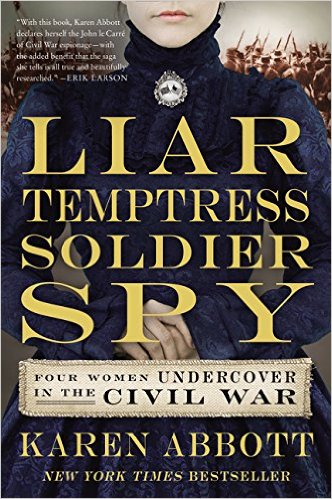
 If you enjoy obscure stories of espionage, you will definitely enjoy Liar, Temptress, Soldier, Spy: Four Women Undercover in the Civil War by Karen Abbott.
The book follows the lives of four women described by the author as “a socialite, a farm girl, an abolitionist, and a widow,” and each of the women contributed to the War effort. The women are:
- Belle Boyd, one of the Confederacy’s most ‘notorious’ spies.
- Emma Edmonds, a women who successfully served in the Union Army as Frank Thompson.
- Rose O’Neale Greenhow, socialite and ‘renowned’ Confederate spy.
- Elizabeth Van Lew, a Richmond, Va. Unionist who spied for the Federal government.
As the list shows, both sides of the conflict are included. Two of the women are Unionists — the other two are Secessionists, but they have a common bond — a desire to serve their country in an era where they risked more than their male counterparts because of the social stigma attached to women fighting in a war.
Diaries and Journals
What makes the book especially appealing is besides relying on historical documents, diary entries and other family sources to create the dialogue, the author weaves in the battle scenes and the stories of the well-known generals and leaders of the conflict. This way the stories of the women, which include the very specific details of their espionage, are understood within the framework of the overall war. This gives the reader a very realistic viewpoint of the danger each of these women faced.
But, what I also liked, were the obscure facts the author sprinkles throughout the book.
War is Hell
She reminds us that, like Union General William Sherman said, War is Hell, as she slyly slips in facts about soldiers using the shin bones of enemy combatants as drum sticks. Or when she reiterates one of the common problems of the war — misusing God. Abbott notes how CSA General Stonewall Jackson, like others, prayed for divine guidance. When faced with the dilemma of executing a father of three who had deserted the Army, Jackson prayed about what to do. As Abbott wryly notes, Jackson often found that the Will of God often mirrored his own (the man was executed).
(Even President Lincoln struggled with this phenomenon. In 1862, Lincoln wrote,
…In great contests each party claims to act in accordance with the will of God. Both may be, and one must be, wrong. God cannot be for and against the same thing at the same time…)
Moving Past The War
After rounding out the tales of the four women, Abbott reports on their post-War life. Some received a small level of fame and one of the women, Emma Edmonds, successfully petitioned the U.S. government and received a military pension.
Rating: 5 out of 5. This book has all the right elements for a historical nonfiction account of the Civil War. The stories are intriguing and well-rounded, obscure enough to bring new information to the forefront, and quite simply very engaging tales of personal fortitude. I listened to the audio version of the book, however, the paper version may be a better reading experience since it also includes historical maps and photographs.

 reports that 137 soldiers deserted an Army of the Potomac detachment of 625 men. The men had been sent to reinforce a New Hampshire regiment, but 86 of them joined the Confederacy while 36 soldiers simply headed back home.
 , with a short story about Lincoln’s peculiar habit of checking his height against other men.



 Charlie R. Claywell