Genealogy

Grandma lives on through her quilts

My grandmother Malinda (Smith) Beaty shows my daughter Molly a quilt she made.

My grandmother Malinda (Smith) Beaty shows my daughter Molly a quilt she made.

I’ve always had a wide range of interest, and while many people collect things — I prefer to collect stories. But sometimes, the ‘thing’ is part of the story — and that’s the case with my grandma’s quilts.

My grandma Beaty quilted for as long as I can remember. When I was a child, one of the enjoyable parts of traveling ‘back home’ (from Ohio down to Kentucky) once a month was to see what she’d created. Over the years, the list of patterns she crafted was nearly endless. I remember star patterns and Dutch girls to name a few. I also remember the heavy-duty quilts Grandma created out of denim for warmth — they felt like they weighed a ton, but boy could they trap in the heat. (I grew up in a home heated only with a wood stove, so the blankets were especially appreciated during cold Ohio winters).

When I was about 12, I spent a week of my summer vacation with Grandma and Grandpa Beaty and while there I asked Grandma to teach me how to hand quilt. So she did. I would stitch a couple of quilt pieces together. She would look them over and show me what I needed to correct. Even though she was patient with me, I never did get the hang of it, but I did walk away with something as valuable as the skill — an appreciation for how difficult the craft of quilting was — regardless of how easy she made it look.

When my daughter was born, I knew Grandma would quilt a blanket for Molly. When Molly was five or six, Grandma let Molly pick a quilt from her collection. Ten years later, the quilt still graces Molly’s bed.

Although part of me wanted to keep the quilt unused, I know Grandma prefers it this way.

Categories: Appalachia, Family History, Genealogy | Tags:

Personal letters from 1930s offer clues into relative’s untimely death

Newspaper clippingMy paternal grandmother, Mary D. (Lewis) Claywell, lost two brothers — one when he was 10 and another when he was 24. Growing up, I often heard how my grandmother woke up in the middle of the night from a nightmare telling her 24-year-old Bennie was dead. Her fear was later confirmed when the family learned her brother had died in a logging accident while he was employed in a Civilian Conservation Camp in Idaho.

A few years before her death, my aunt Anna Lee (Mary’s oldest daughter), gave me several items related to Bennie including two personal letters. One letter, written about six months before he died, was addressed to a cousin, the other, written just a week before he died, was addressed to his mother. Both letters offer some insight into his life, but they also include information about the company he was assigned to and where he was living.

I have transcribed the letters to the best of my ability.

Letter to Mom

The envelope is addressed to Mrs. G.H. Lewis and is postmarked May 13 in Pritchard, Idaho. The postmark on the back of the letter is May 17, Forest Cottage, Ky. The letter was written on May 10, 1935. Bennie died on May 17.

CCC Co 587 F151
Pine Flat
Prichard, Idaho
May 10, 1935

Dear ones at home:

Florence Surratt

Ben’s mother, Florence

Here I am agin. Writing is all the Pass time I have so I’ll let you all here from me. How may this find you all. Well is my wishes as for me fine and dandy.

Yet its a snowing like everything here, its the first snow I have seen falling since last winter as a year ago so it seem like old Ky kindly but my thing — May and 5 ft of snow on the ground. Seems funny doesn’t it. But I am liking fine so far. What is everybody doing? Planting corn? Mother how is your garden looking? Don’t work to hard git old Edna and someone to help or to do your work, don’t you git out there and work like you use to.

Say mother send me ten dollars I want to git me some heavy close (sic) for it is real cold here. I want to git me a leather jacket and a pair of pants and a pair of slippers. With that 10 and the other 5 I’ll know I can git them if you all don’t need it. Mother do you ever hear from Martin? How are they gitting along? Send me his address

Well I guess I had better close and go to work

Mother don’t worry ans[wer] soon and all the news.

One that loves you all,

Ben

Two things about the letter, Martin is his older brother — and the money. Under the rules of the CCC program, Ben earned $30 per month. He received $5 and the other $25 was sent home — which is why he is requesting $10 that he will add to his $5 to buy winter clothing. Also, there was a severe winter storm in Idaho at the time he is writing this letter.

Letter to Gladstone Surratt

Six months earlier Ben wrote a three-page letter to his cousin Gladstone Surratt, who is about 20 years old at the time. In the 1920 Census, Gladstone is listed in the same household as Ben.

CCC Co 587
Morina Lake
Pine Valley Calif
Dec. 19 1934

Dear Gladstone: —

Gladstone Surratt

Gladstone Surratt

Will ans[wer] your letter I rec a few days ago was glad to here from you, how may these few lines find you, as for me just fine and dandy. Well they say you all have a big snow back there it makes me shiver to think about it, I have never saw any snow here yet. We can see a mountain covered in snow from the look out. Its about 90 miles from here, it sure looks pretty and the fall moutains are covered too but we have to look through field glasses to see them.

Well how is things rocking along back there. Are you going to git married this Xmas? Boy leave that off if you have got it on your mind.

Say Kid wait till I come home and we will have a real time. Don’t git disgusted and say you had rather be away from home for there is no place like home.

Say tell old Hue to kiss my foot and to be careful and not let Jim Jill (?) knock him in the head again.

Well I guess this is all this time. Think of me at Xmas and have a good time for me. Be careful and don’t drink for you can’t have a good time drinking.

Ans real soon and a long letter.

One that loves you,

Bennie

Categories: Appalachia, Cumberland Plateau, Family History, Genealogy | Tags: ,

Family history filled with loss, murder

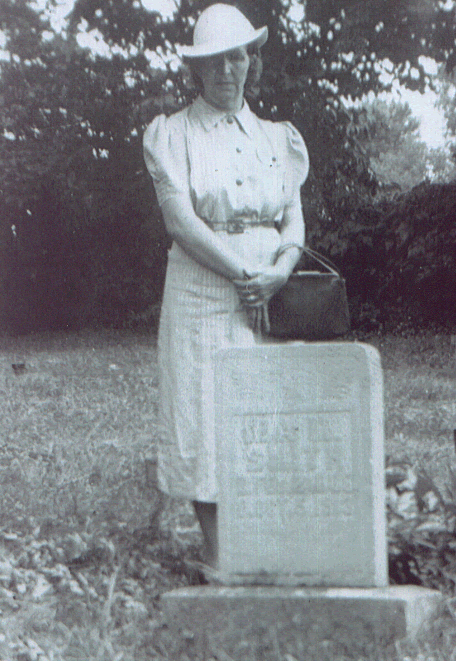
Ida's sister Mollie stands next to Ida's grave.

Ida’s sister Mollie stands next to Ida’s grave.

“It was the best of times, it was the worst of times,… it was the season of Darkness...” – Charles Dickens

As I unravel my daughter’s family history — it doesn’t take long to realize that many of her forefathers suffered a great deal. Families lost land and money, parents buried their children and husbands their wives. Here are a couple stories of loss from each side of her family tree.

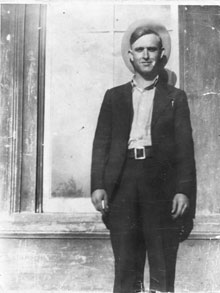
Joe Lee Claywell

Joe Lee Claywell

Joe Lee Claywell

Joe’s wife Sallie Guinn died from complications of labor during the birth of their fourth child, Sallie. At the time of her death, his oldest child, Charlie (Molly’s great-grandfather) was only six. Joe’s other two children, Ruby and Jim were four and two respectively. The fourth child Sallie only survived about three weeks past her mother’s death.

Joe would remarry and have five more children and one of them would die at a young age. Less than three months after he turned 15, Glendon C. Claywell died, presumably due to injuries caused when he was thrown from a mule. When I spoke with his sister Minnie Conner, she said a winter storm prevented the family from getting Glendon the help he needed. He died on Feb. 28, 1934.

Christopher Hughes

Christopher Hughes, on Molly’s maternal side, definitely lived through hard times.

Just two years before he died, he was hit by a train causing him to lose a leg. When he was younger, his brother-in-law Oscar, was lynched by a mob. Oscar had the misfortune of being held in a county jail at the same time as a horse thief. A mob broke into the jail, and since the mob did not which person was the horse thief, both men were hanged.

But the greatest tragedy Chris faced was the murder of his daughter Ida May when she was 27.

Ida is my mother-in-law’s grandmother. Ida’s oldest son James, who was seven when he witnessed his mother’s murder, is my daughter’s great-grandfather (my mother-in-law’s dad).

The shooting took place in the middle of the afternoon on Sunday, Oct. 5 1913 in Wilmore, Kentucky when Ida and her three children, James, Warren and Mary (an infant) were at High Bridge Park — an area which was still in the prime of its tourism appeal. The park was site of the first cantilever bridge built on American soil and besides the attraction of the bridge, the park had “picnic grounds, a restaurant, a dancing pavilion and riding stables.”

It was in this public venue where Ida was killed. Ida Hughes Smith articleAccording to a news article describing the shooting,
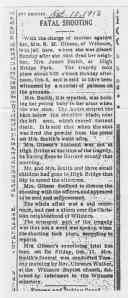
“The strangest part about the tragedy was that not a word was spoken when the shooting took place.”

The article further states that Ida was holding her baby when she was shot.

The woman accused of killing Ida was her neighbor, Lillie Gibson, who would have also been about 27 at the time — and that’s where the story’s trail starts to go cold. Gibson was determined to be a ‘lunatic’ by a jury and of ‘unsound’ mind so the court committed her to the insane asylum in Lexington, Ky. I have been unsuccessful in determining if she lived out here life there — or if she was ever tried for the crime.

Her husband, Silas, died about six years after the murder on July 4, 1919 — a Lillie Gibson is buried next to him. This Lillie died in 1977 at the age of 95. I am currently tracking down death certificates for both of these Gibsons.

As far as the Smith family, James Franklin would marry Mollie Pitcher a few years after the crime and they would have five children. He died in 1944 and is buried in Kenton County, Kentucky.

After Ida’s death, the three children were initially raised by their paternal grandparents. James Luther, the oldest, would eventually leave home when he was around 12 years old.
Categories: Family History, Genealogy | Tags: , , , , ,