
movies

‘Selma’ Is A Reminder Of The Barriers To Freedom

Selma, an Oprah produced film about the march from Selma, Alabama by Martin Luther King and other civil rights activists in the 1960s, opens with a powerful scene of an elderly black woman trying to register to vote in the South. She is at the county courthouse with her voting application, but the completed application is not enough.

First, the white clerk asks her to recite the Preamble to the Constitution — which she does. Then the clerks asks her how many county judges Alabama has.

Sixty-seven, she correctly answers.

Name them, he said.

She walks away, once again, denied the right to vote.

Right to Vote

The core issue the movie tackles is Martin Luther King’s attempt to get voting rights for the black community. Although they technically have the right to vote, they are being systematically denied this right through a series of laws and acts of intimation designed to keep them out of the polling booth. When King visits president Lyndon B. Johnson at the White House, King explains to the president that the black community needs the president’s help to secure the voting right.

Calculated Choice

After being rebuffed by LBJ, King embarks on a plan to force the president’s hand. As the movie points out, Selma was not an incidental choice for the march. King and other civil leaders strategically chose the city for its intense hatred of blacks as well as for the local political structure that would be conducive to a march. What unfolds over the course of the movie are the methods and strategies — from marches to court proceedings — used to secure voting rights for blacks.

Stellar Performances

Since the movie is based on a historical event, the film pulls in all the correct political and civil players that were instrumental in the conflict — including Governor George Wallace and FBI Director J. Edgar Hoover. It also uses King’s extramarital affair to move the story forward. But, at times, the movie is painful to watch — like seeing four young black girls die when their church is bombed or when a 82-year-old black man is unmercifully beaten by Billy club-toting white police officers. But so many of the actors deliver powerful performances that, in the end, you get a sense of the desperation, pain, hatred and even hope the citizens and civil leaders have. English actor David Oyelowo’s portrayal of MLK is inspirational especially when reciting some of King’s most well-known speeches.

Rated: 5 out of 5

Definitely a 5-out-of-5 stars film. Besides delivering an accurate (albeit condensed) account of the historical event, it also incorporates the file the FBI kept on MLK. The file — and the notes typed out on the screen — are a stark reminder of how much the government monitored King and the civil rights movement. Overall, the film is a testament to a man who refused to give in — even when it meant death for so many — because he knew his involvement in the movement was an act of morality.


Footnote

BG3MRY Emanuel A.M.E. Church, Charleston, South Carolina, United States of America, North America

As it happened, I watched Selma the night before a 21-year-old white man walked into a black church and executed nine church members. His actions are a reminder of how much more the white culture needs to do to curb the hatred and erase our naïve belief that as a race we are superior to others. And, when I read posts on social media about recent events in Ferguson and Baltimore where white people say — I would protest and riot, but oh yeah, I can’t I have a job, I know Solomon is right when he says there is nothing new under the sun. During The Birmingham Campaign in 1963, white clergy urged black demonstrators to quit participating in the marches, counter sit-in and boycotts.

Categories: American History, movies

12 Angry Men Exposes Prejudice, Bias Of Jurors

12 Angry MenPart of the appeal of the American Way, is the fact that when accused of a crime, Americans are judged by a group of their peers — and presumed innocent until proven guilty.

Anyone who has ever served on a jury, knows that one or both of those facts are suspect.

In the 1997 remake of the 1950s-era movie, 12 Angry Men, veteran actor Jack Lemmon puts those beliefs to the test, rising up initially as the lone ‘not guilty’ vote in a ‘open and shut case’ of murder.

Except for a small clip at the beginning and end of the film, the entire movie is filmed inside the deliberation room. The 12 men are a varied group with all of them being considerably older than the 18-year-old Hispanic man on trial — accused of murder — in the stabbing death of his father.

Lemmon has some questions — and openly admits he is not sure if the boy is innocent or guilty — so he wants to discuss the case. It is the ongoing discussing of the case that forces the men to face their own selfish desires and hypocrisies. As the state’s case unravels, the 12 men are forced to look at what they are and what they believe.

Although I’m sure when some watch the film, they will find holes in the logic that dismantles the state’s case against the accused teen, but that isn’t the point of the movie.

It’s about finding the truth in oneself.

The movie contains an all-star cast. Some of the more well-known actors include: Tony Danza, Ossie Davis, Edward James Olmos,  James Gandolfini and for those from the Miami Valley — Dayton, Ohio native Dorian Harewood (Full Metal Jacket) plays juror #5.

Rated 4 out of 5. Acting is superb, but since all the action is driven by dialogue, there are a few moments throughout the film where the point feels belabored.

Categories: movies

American Sniper Explores Murkiness of War

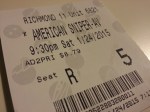
am-sniperI’ll admit all the hype about the movie, American Sniper, made me reluctant to watch it. I had read the comments from Michael Moore, Kid Rock and a handful of others on social media and when the posturing on the subject was reduced to conversation-blocking words like idiot, coward and moron — well, I’ve just grown tired of the mentality.

But my daughter and a friend of hers wanted to see the movie, so I went and was impressed by what I saw.

The film, about the life of U.S. Navy SEAL and sniper Chris Kyle, is based largely on the book, American Sniper, written by Kyle. As I watched the movie I did not presumed it would be one-hundred percent accurate (Time Magazine has separated the movie’s fact and fiction) or that it would be completely true to the book (which I have not read).

The movie is a story of what war does to the human psyche.

As you watch Kyle make excruciating decisions time and time again (to kill or not kill) — and then watch him try to readjust in civilian society at the end of each tour, you have a stronger appreciation for what American soldiers fighting these endless wars go through.

You also come to understand the dichotomy of his mind. He seems drawn back to the war zone — he does four tours of duty — because war, he understands. Despite how gruesome the scene, the job — although extremely hard — is simple. Kill the bad guy (or woman or child) before they kill your comrades.

After his final tour, Kyle is forced to re-entry a civil society that he has not been a part of for nearly a decade. His Post-Traumatic Stress Disorder comes to a climax when he nearly kills the family dog because he mistook the pet’s playfulness with a child as an attack. At this point he seeks professional help and starts volunteering at the local VA — working with the veterans of the Iraqi War whose bodies are marred and dismembered by the conflict.

In some ways, the movie is a modern-day Platoon in that the innocence of why a soldier fights (to protect his country) gets blurred by the atrocities seen and committed. Kyle is American through and through. He struggles with the mental aftermath of war, but his conscious is clear because every kill, he says, was to protect his comrades.

It was a duty he volunteered for and he never shirked from it.

Rated: 5 out of 5. Definitely a film worth watching as it explores the concept of war and what it does to the victors and the victims.

Categories: American History, movies