
My America

10 Things I Learned This Week

new-orleansSince this has to be the making of one of the most asinine eras of American history, from time to time I’m going to list what I learned over the course of seven to 10 business days.

  1. Risk-based screening. I was reminded that word choice is integral to shifting public opinion when I read an update from my Congressman Warren Davidson (OH-8th). Davidson, who noted he had been on Fox & Friends to discuss national security, advised in his newsletter that,

    “It is time for Congress and the President to work together to pass legislation reforming risk-based screening for refugee and other immigration programs.”

    It reminded me of the words by 20th century journalist and satirist H.L. Mencken,

    “The whole aim of practical politics is to keep the populace alarmed by an endless series of hobgloblins, most of them imaginary.”

  2. Fast-Track ILC (In Lieu of Conviction). Although an individual who utilizes medication-based therapy to kick a heroin habit has a 70-90 percent chance of relapse — and those who try ‘willpower’ alone tend to relapse with 30 days — my local prosecuting attorney’s office has created a plan to fast track heroin cases so defendants can get treatment instead of jail time. I’ll be following the results of these cases because it feels more like fast-tracking defendants through the system and creating a new crop of felons. (See 13th)
  3. Americans are (still) angry — My Senator from Ohio, Rob Portman, is denying allegations that he refused to allow Democrat constituents to attend a Presidents Day event.
  4. Farmers who supported Trump, may get the shaft. Since I live in a rural, farming region, I found these stories interesting. Some farmers who use immigrant labor were hoping for a status quo approach to deportation since it affects their bottom line. That, of course, is not happening. Farmers who export crops to China or Mexico may also be negatively impacted if relationships between the countries continues to be strained.
  5. The GOP ‘mavericks’ are voting in line with Trump. Talk is cheap and despite the maverick image of GOP heavyweights like John McCain and Rand Paul or even my governor — John Kasich, the image appears to be more hype than reality since they are voting (or in the case of Kasich — meeting) in line with Trump’s agenda.
  6. Boehner says Repeal and Replace won’t happen. Whether you like him or not, former House Speaker John Boehner, at times, can be very direct. With regards to repealing Obamacare he says the GOP is just blowing smoke. It’s not going to happen.
  7. Deportation is fueling private prison profits. Follow the money is the old journalism adage. Big actions often mean big profits for some and such is the case with the drive to rid of the country of the ‘bad dudes.’
  8. Trump travel costs outweigh Obama’s — by a lot. The GOP loved to moan about Obama’s vacations, golfing, etc. Turns out Trump is outperforming the former president in money spent on getaway trips.
  9. Losers go home. Mitch McConnell, the Senator from the state where I was born, Kentucky, is apparently tired of all the protests and demonstrations. He said he is not opposed to obstructionism, but the losers in this election need to get over it, because winners enact the policies and losers go home.
  10. Americans still have a sense of humor. Apparently Alec Baldwin’s portrayal of the president is gaining popularity.
Categories: 8th congressional district, My America, Politics

Mark Twain On The Hypocrisy Of Prayer

374px-twain1909Although I agree with the premise presented in The History of Prayer in America by James P. Moore Jr. that prayer has been a very common thread among Americans throughout our history, at times the book overplays the importance of public prayer by politicians by ignoring the politics behind the act.

Not every politician that prays is a believer — some are just exploiting those who are. And, some politicians offer prayers that are woefully (intentionally?) naïve of the societal ills (and their solutions) that exist in their own communities. These individuals often oversimplify complex problems — expecting God to solve everything without any intellectual, spiritual or humane work on their part.

Prayer For Our Soldiers (But Not Theirs)

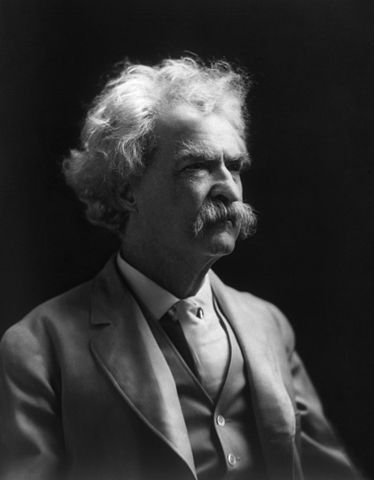
When it comes to dealing with America’s hypocrisy, few did it better than American humorist and satirist Mark Twain.

By the end of his long literary career Twain had grown very tired of America’s imperialism, patriotic fervor and, in general, the gullibility and hypocrisy of the Chosen. Around the time America went to war with Cuba in the late 1800s, Twain wrote a short story for Harper’s Bazaar called War Prayer, but, as Moore reports in his book, the story was rejected because Twain’s publisher feared the work would impede the sales of his other books.

After Twain’s death, though, Moore notes, the story was published in Harper’s Weekly (1916).

In Twain’s story an old man interrupts the prayer service of the patriotic saints — as the minister is beating the war drums. This old man wants to teach the saints how to pray more honestly, because as he explains, when a farmer prays for rain for his crops, that same rain may destroy his neighbor’s harvest.

But, his most pressing goal is to teach the church the most effective way to pray about our wars — brutally honest. Get rid of all political correctness and cut to the chase. Part of the old man’s prayer goes like this:

O Lord our God, help us tear their soldiers to bloody shreds with our shells; help us to cover their smiling fields with the pale forms of their patriot dead; help us to drown the thunder of the guns with the shrieks of their wounded, writhing in pain; help us to lay waste their humble homes with a hurricane of fire; help us to wring the hearts of their unoffending widows with unavailing grief; help us to turn them out roofless with their little children to wander unfriended in the wastes of their desolated land in rags …

For our sakes who adore Thee, Lord, blast their hopes, blight their lives, protract their bitter pilgrimage, make heavy their steps, water their way with their tears, stain the white snow with the blood of their wounded feet!

In the original version of the story the old man’s words are typed in red ink.

Categories: American History, My America

Heroin, Meth Just Part Of Life In Small, Rural Town

14889598603_32441c00b0_zI live in Ohio, a state where the Attorney General has declared a heroin epidemic. My county is no exception. The possession of heroin cases in Common Pleas Court have skyrocketed from about five in 2012 to around 50 in 2016.

But heroin, is just one of the drugs the county deals with — meth has been in the region for years and it does not appear to be going away. In August, 2015 there were nearly as many meth cases (based on the presumption that the ‘manufacturing’ indictment is for meth production) as heroin — three versus four respectively.

When a community is hammered by drugs, typically thefts or burglaries rise as addicts seeks ways to fund their habit. In this regard, Preble is, again, no exception. In August, 2015 the grand jury handed down seven theft-related indictments.

Meth Nearly Destroys Iowa Town

methlandIn Methland: The Death and Life of an American Small Town, author Nick Reding examines a small rural, agricultural-based town in southeast Iowa which is about the same size as my hometown. The tale, mostly about the town’s (Oelwein) triumph over meth is an interesting read as it lays bare the wide-ranging reasons for the epidemic.

Three of the reasons are: political indifference, corporate irresponsibility and the myth of the American Dream.

Political Indifference

What may be most troubling about the meth situation is it never had to happen. As the author details in the book, research to create an alternative to pseudoephedrine — the chemical extracted from Sudafed to manufacture meth — was halted as in 2000. Before 2000, two approaches were being pursued that could have eliminated the ability to extract meth from Sudafed. The first was a chemical ‘mirror’ alternative to pseudoephedrine that eliminated the stimulant effect — making it worthless to the meth industry. The second approach was to use additives that blocked the ability to extract pseudoephedrine from cold tablets.

In the end, much like with the current heroin/opioid situation, Big Pharma’s profit potential influenced politicians to take a hands-off approach to regulating the industry — siding with business at the expense of American communities.

Corporate Irresponsibility

As president Calvin Coolidge famously said, the business of America is business — and this holds true even when it destroys livelihoods. Part of Methland deals with Ottumwa, Iowa where the meth trade skyrocketed in the late 1980s — making Roseanne’s Barr’s former sister-in-law Lori Arnold a very wealthy woman (and eventual felon). Arnold became wealthy by distributing meth to an ever-increasing base of factory workers.

When large companies, like Cargill, acquired food processing plants in the region, one of their first lines of business was to slash wages from about $18 an hour to $5. Workers, forced to work double shifts or take on a second job to sustain their earnings, turned to meth for the energy to get through the extended work week.

The companies also began actively recruiting immigrants, mostly from Mexico, to take jobs at the plant. The influx of immigrants, some with a direct line to the Mexican meth industry, increased the drugs presence in the workplace.

Today, with president-elect Donald Trump riding to the White House partially on the immigration issue, it remains to be seen if he will address one of the reasons illegal aliens are here. As Reding points out in the book, U.S. companies recruit inexpensive, illegal foreign labor and then hide behind legalities. Under U.S. law, companies are not responsible for knowing whether a worker is in the United States legally. They bring them here — and pretend to not know how they showed up. The scam has played a role in perpetuating an anti-immigration stance among Americans whose misdirected anger exists because they do not realize companies in their community caused the problem.

The American Dream

A significant portion of the book deals with Arnold who, within months of entering the Ottumwa meth business, becomes a very wealthy individual. Arnold looms high above the other small-time meth manufacturers featured in the book. But even the small time players create a significant cash flow because they have a captive market base — people working 60-90 hours weeks just to stay ahead of the economic curve.

The book is worth reading simply for Arnold’s story.

Even though the story is empathic to Arnold, and the other large and small time dealers, it does not shy away from what they are or what they do. It is very much a ‘warts and all’ type of tale. But, a bright side to the story does exist. It is seen mostly through the major of Oelwein, a progressive determined to purge his small town of meth while also returning viable jobs to the region. He takes some big gambles — and in the end they pay off.

It’s an approach small towns in the Rust Belt would be wise to follow.

Keen Observations

The book’s strength is the author’s many observations, including one about the American economic system. Reding posits that our economy is proving the theories of Karl Marx to be more accurate than Adam Smith’s —  noting that even the agricultural industry is being cannibalized by a handful of companies. This handful of large companies control the lion share of the market, pushing small farmers to the brink of extinction, destroying local economies in the process.

One small way this is seen, he notes, is the disappearance of locally-owned grain elevators. Under locally-owned systems, every dollar created through the sale of grain generates another three to four dollars in local transactions, Reding explains. This keeps small economies thriving.

Today, though, grain is typically owned and handled by one seed company and the dollar transactions are reduced to a 1:1 ratio, eliminating any local upside. This guts the local economy often causing family-owned grain elevators to close. It happened in the Iowa town — and in my community as well. The grain elevators that existed in the village of West Alexandria and the city of Eaton closed years ago.

In Eaton, a Dollar General store sits where the former grain elevator operated.

Rated 5 out of 5: The book is fairly short, very well researched and a nice blend of investigative journalism and personal essay writing.

Categories: Life In A Red State, My America, Ohio, Politics, Preble County, Small Town Politics