
Understanding Trump Counties

‘Godfather Of Modern Popular Gay Fiction’ Graduated From My Local, Rural High School

If you walk into Eaton High School in Preble County you will not find any quotes from our most prolific author. In fact, you’d be hard pressed to find anyone who has heard of Victor J. Banis — a 1955 EHS graduate.

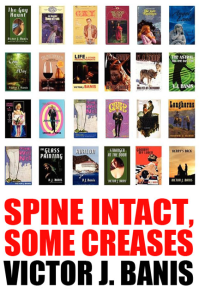
I stumbled across his name on the Preble County Wikipedia page — and then I read his 2008, 400+ page memoir, Spine Intact, Some Creases.

I found him to be a very interesting individual.

His book should appeal to at least three categories of readers:

  • those interested in First Amendment rights,
  • the gay community, and
  • locals interested in Preble County’s 1940s-1950s history.

First Amendments Battles
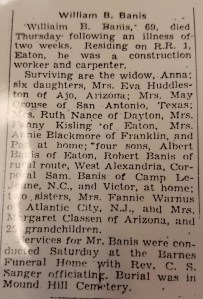
Victor is listed as a juvenile living at home in his father’s 1954 obituary. In the book, Banis details his last conversation with his father.

Banis moved out of Preble County after high school and within a decade found himself indicted in Sioux City, Iowa for ‘conspiracy to distribute obscene material’. Banis was indicted for his novel The Affairs of Gloria. As Banis writes in the foreword of the re-release of The Why Not Gloria,

…had one ‘damn’ in it and one ‘go to hell.’ It did, however, significantly have some — again tepid — lesbian scenes.

The federal government and the U.S. Postal Service found the lesbian scenes morally offensive.

Banis would eventually be dropped from the case (the other defendants were not), but he still spent the first decade of his writing career with a suitcase packed and an open offer to move overseas should another indictment be handed down.

A conviction in these obscenity cases could yield a 20-year or longer prison sentence.

But, instead of prison, for more than a decade Banis was at the forefront of the popular gay fiction scene. And, in true capitalism form, it proved quite profitable because he had found an unmet need. In the early 1970s, Banis was earning about $200,000 a year — the equivalent of $1.2 million today.

Not bad for a former Preble County resident.

Eventually, Banis would write in several genres, including straight romance, but it is his 1960s gay C.A.M.P. series that collectors seek out. Those interested in his work will find a bibliography of about 150 titles in Spine Intact.

Being Gay In Small Town America

Although I found his First Amendment battles intriguing, and his personal life interesting, another appeal was the local history. Included in the 27-chapter book are roughly four chapters worth of local history. Some of it is a little salacious for this region — his cross-dressing Halloween adventure at the Armory at the age of 12, the first time a male classmate expressed a romantic interest in him, and his romantic liaison at 17 with his 26-year-old Boy Scout leader. He writes,

When I began a relationship with my friend I was lonely to a suicidal degree. I knew only one other gay youth in Eaton, Ohio. There were gay adult males in town but, mindful of their own safety, they avoided involvement with someone so young…In retrospect I suppose that the folks in Eaton, Ohio, who guessed what was going on with my friend and me thought it none of their business.

Banis’ parents are buried in Preble County.

The relationship would lead to a nonfiction work, Men and their Boys: the homosexual relationship between adult and adolescent (1966), in which Banis interviews homosexuals males that had relationships with older men.

Crimes Against Humanity

Early in this memoir, Banis states that Sherwood Anderson’s Winesburg, Ohio is about Preble County (Anderson was born here, but moved by age two to Clyde, Ohio). If Banis’ assertion is accurate, Anderson’s work paints our dark side.

And when you read some of the incidents in Banis’ life, his assertion may be true.

In his book, Banis describes how his family ‘saw’ his oldest brother on a back country road in Preble County the night he was killed in Italy. Banis’ brother died in WWII shortly after his 23rd birthday.

As a Preble County resident, Banis grew up poor in the 1940s and 1950s. It was an era where being gay was a crime and it was a region, then as now, where homosexuality, by and large, is not accepted as natural. But, indirectly, this book challenges what we say we believe by showing us who we are. Banis mentions the gay local politicians, the homosexual book he found at a Preble County drug store in his youth, and the regional gay bars and hangouts that he frequented in his late teens/early 20s.

And he also exposes the crimes committed against gays by those in authority. Banis admits being gang raped by three officers (he does not offer location) and reports how, in Indianapolis, police officers abused gays at a party he attended. As you read the story of his youth and early 20s, the man has a right to be bitter, but he is not. Instead what flows through his words is a kind man filled with understanding, forgiveness and humor. He is witty. He occasionally ‘name drops’ (Hugh Hefner comes to mind). He jokes about his sexual liaisons with military personnel and, in general, he upholds his journey as one he was blessed to have travelled.

He also acknowledges the challenge his mother faced — being a Christian with a gay son. But, I feel his mother may have had a mischievous side when it came to the whispers that she almost certainly heard from the righteous.

While visiting him in California, Banis’ mom asked for a copy of some of his work (probably C.A.M.P., the gay male series, based on the vignette). And, as Banis notes, he presumed the books would go into a drawer somewhere so she could say she had a copy of them. Instead, mom decides to let her minister (Church of the Brethren), an aspiring writer who had expressed interested in her son’s writing career, read one. Banis writes,

The Reverend never expressed to her or to me any opinion on the books’ literary merits. Indeed, he never mentioned them to me at all, but he did look at me rather differently on my subsequent visits.

He never asked again about my writing either, and the next time I visited church with my mother the sermon was on ‘the Unintentional Sinner.’ I kept my gaze straight forward and sang the hymns with gusto, although I got through ‘He knows me as I am’ with some difficulty.

A Little Long

My only criticism of the book is it could have ended a little sooner. By his own admission, he meanders. By the end of the book, you will read several chapters offering would-be writers advice and some self-esteem tips. It’s all solid writing, it just feels somewhat out of place for this book.

Rated: 4 stars out of 5.


Local Trivia

Residents of Eaton, Ohio should know at least one of Banis’ sisters, Fanny. She was mayor of Eaton from 1993-1998.

Categories: Americans Who Got It Right, Books I have read, My America, Preble County, Understanding Trump Counties

America’s Political Dysfunction Called A Security Concern

Preble County church sign appears less than a week after Trump inflames country by calling attention to Colin Kaepernick peaceful protest, calling the former NFL quarterback a son of a bitch. Trump attacked Kaepernick’s First Amendment rights during Constitution Week. Although I will not be able to hear the sermon, the minister blogged about the situation. You can read it here.

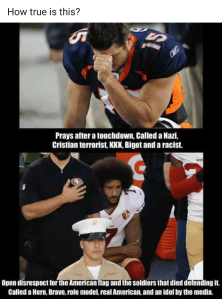
Because of my evangelical and Appalachian background, when Trump escalated his battle with the NFL, my Facebook Wall lit up with memes supporting Trump’s revision of Colin Kaepernick’s peaceful protest. Kaepernick began his protest to draw attention to police accountability after numerous unarmed black men were killed by white police officers.

But in our era of ‘politics is war by other means’ Trump danced past Kaepernick’s intent and reframed the protest to appease his base. As the president was campaigning for losing candidate Luther Strange in Alabama, he told a mostly white crowd on Friday, Sept. 22,

“Wouldn’t you love to see one of these NFL owners, when somebody disrespects our flag, to say, ‘Get that son of a bitch off the field right now. Out! He’s fired. He’s fired!’”

In typical Trump fashion he doubled down on the rhetoric with a NFL-centric Tweet Storm — successfully diverting attention away from Roger Stone’s testimony and the White House’s cobbled approach to the Puerto Rico crisis.

Kneel Or Stand?

As memes with Trump’s new narrative, including I ‘kneel for the cross and stand for the flag’ populated my Wall, allegations surfaced that the Draft-Dodging president was hypocritically mocking veteran, and war hero, John McCain’s physical disability (caused when McCain was tortured by the Viet Cong). Missing from my Wall were posts of the soldiers that approved of Kaepernick’s act. Just like the country, soldiers are divided on the issue. Veteran, and former CIA director Michael Hayden, who admits he is not a fan of Kaepernick, wrote this in an op-ed piece for The Hill,

As a 39-year military veteran, I think I know something about the flag, the anthem, patriotism, and I think I know why we fight. It’s not to allow the president to divide us by wrapping himself in the national banner. I never imagined myself saying this before Friday, but if now forced to choose in this dispute, put me down with Kaepernick.

Understanding This Presidency

During Trump’s Tweet Storm, I attended a presentation by Katty Kay, Lead News Anchor for BBC. I was interested in her views as an ‘outsider.’ (The program was billed as The View From the Outside: Insights on American Politics.)
Kay has covered the White House since 1996, an era she described as more optimistic — a honeymoon stage since the United States was still seen as the winner of the Cold War. During her presentation, Kay described a conversation she had with former Secretary of Defense Robert Gates.

According to Kay, Gates explained the four security risks the United States currently faces. As a student of history and politics, the first three did not surprise me: China, a declining Russia and the Middle East. The fourth one did. According to Kay, Gates explained

…the fourth national security issue is America’s political dysfunction. The fact that this country has become virtually ungovernable. There is so much division between the left and the right and so little ability to compromise — it’s hard to get things done.

Kay also said,

America is a system that was built on — and for — compromise, but compromise has become a dirty word. You’re a presidential system acting like a parliamentary system with the result that nothing can get done.

A day or so after the her speech, I learned that the Freedom Caucus was continuing its participation in the dysfunction. Warren Davidson, Congressman for Ohio’s 8th Congressional District where I live, introduced legislation attacking the Congressional Budget Office. The Freedom Caucus began its attack on the institution in a July op-ed piece after a GOP majority failed, for the umpteenth time, to ‘Repeal and Replace’ the Affordable Care Act.

Dismantling Is Rough On Low-Income Counties

The beginning of the end for Small Town USA?

Before the presentation, I finished reading a 80-page 1994 Heritage Foundation publication. It gave me additional clues to when this modern ungovernable debacle was conceived.

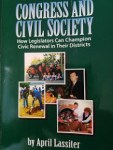
The Heritage Foundation, a right-wing think tank, issued a booklet titled Congress and Civil Society: How Legislators Can Champion Civic Renewal in Their Districts. It was written at the height of the Republican Revolution — after the Party won a majority in Congress for the first time in 40 years. The book champions the ideas of then House Speaker Newt Gingrich — the man who ushered in the No Compromise approach to politics.

This approach was pushed further to the Right by The Tea Party and The Freedom Caucus.

The booklet is a blueprint for dismantling the federal government by pushing governing responsibility down into local communities. The book cherry-picks successful community and faith-based organizations, mostly in large metropolitan areas, holding them up as proof that ‘what works here can work there’. The featured solutions suggest that most, if not all, problems are best solved at the local level.

However, the publication does caution the Party not to impose this on low-income communities that cannot rise to the challenge of self-efficiency. Apparently not everyone got the memo, because the dismantling began and low-income communities, like mine, paid the price.

Losing At The Local Level

As I research my county’s history, by the late 90s — five years or so after the booklet was published — meth was a significant problem in Preble County. We were, and are, ill-equipped to handle it. The drug entered our community despite a growing national economy — and locally strong unemployment rates. Eventually, as automation and not immigration, stole about 70 percent of manufacturing jobs, including many where Preble County residents worked, area wages fell and the job vacuum was filled with low-wage retail jobs.

By the 2000s, we lost the drug war.

Today, as in 2000 — and like many communities in the nation — we arrest users at a higher rate than drug manufacturers and distributors. The addicted are easier to snag. Of the 25 indictments handed down this month in my county, 20 were drug related. Out of those 20 cases, two cases were allegations of distribution or trafficking, 18 were indictments for drug use.

I’m old enough to remember when 10 indictments a month in Preble County was a lot.

Social Media And Our Loss Of Connectivity

We lost the drug war for the same reason social media blew up the NFL story. We have lost a connection with our community and each other. Social media has amplified the problem of talk radio by removing the discussion and reducing everything down to a one-liner — and generally an offensive one.

This year I attended four drug and/or heroin educational events, and at one of them a recovering addict, who credits Jesus with curing her addiction, stated the reason she was able to get clean was because someone treated her humanely. She said a woman helping her inside a clothing establishment connected with her and,

… for the first time, in a long time, the woman talked to me like I wasn’t a monster. And I wasn’t the lowest of the low. She treated me like anyone else.

In the ‘war on drugs’, Portugal, unlike us, found out more than a decade ago, that the key to solving an epidemic is to help people reconnect with their community — just like the Preble County woman did with the recovery addict.  What does not work is treating the chemically-addicted like criminals — prey to be caught and trapped.

(Trapping political opponents in a snare on social media doesn’t work either as we are learning in the current chaos. Political parties, and their base, must reach across the aisle and talk.)

Left Behind

As the movement blaming the federal government for the country’s woes grew, our ability to govern declined. And, by turning the federal government into a dragon to be killed, communities like mine — ones that lacked the economic and political savvy to solve mounting problems — were left behind, unable to attract much-needed human and capital resources.

Categories: 8th congressional district, Life In A Red State, My America, Preble County, Small Town Politics, Understanding Trump Counties

Is Ohio A Cesspool Of Hate, Fear And Ignorance?

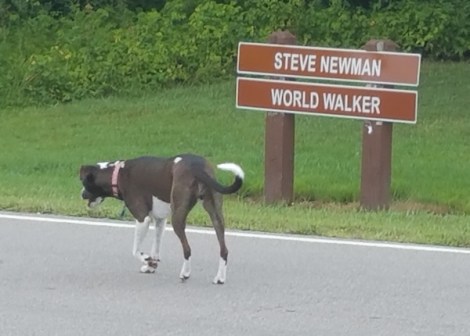
Steve Newman, a Clermont County native, gained fame for walking the globe between 1983 and 1987. He details the trek in Worldwalker. Newman picked a good time to walk, Ohio’s unemployment rate in 1983 was 12 percent. Ronald Reagan was two years into his first term as president.

Roughly a week after Charlottesville happened, resulting in the death of Heather Heyer, my wife, dog (Versa) and I spent the weekend hiking in a Ohio state park in Clermont County. As we traipsed through the woods we were not disappointed, spotting deer — including a large buck that ran across the trail five yards in front of us — a gaggle of turkeys and two water fowl I’ve never seen (possibly King Rails).

On Saturday evening as we read inside our tent before falling asleep — the calm and quiet of the evening was interrupted by a loud truck barreling down the main entrance with its occupants yelling ‘white power.’

As the rebel yell pierced the night, it was a sign of where we are as a nation. Current polls suggest 65 percent of Americans believe hate and prejudice have increased since the November, 2016 election.

Childhood Friends, Family

We have 35 hate groups in Ohio — ninth in the nation. The man accused in Heyer’s death (James Fields) is, of course, from Ohio as is Daniel Borden, accused in the racially motivated beating of DeAndre Harris.

When I browse Facebook it’s easy to understand how we arrived at this place. In my part of the world, and Borden lives about 30 minutes south of me, fear and ignorance are the foundation too many build their worldview on. For example, a childhood friend, who attended the same church I did, posted a meme from an organization that views liberals, like myself, with disdain. The site revels in dividing the country into red versus blue — with the reds being the ‘good guys.’

One of their memes, promoting a odd-looking wrist decoration, says:

Send the liberals running for the hills with our handmade Six Shooter Leather bullet bracelet.

I’m not sure what ‘fearful’ liberals they are targeting with the text because I would be more apt to mock an individual childish enough to wear such a ridiculous looking bracelet — a leather bracelet designed to hold six bullets. But, I do wonder how someone taught the same brand of Christianity as me arrived at a place in midlife where they view the rhetoric as healthy or sensible.

How did they get to the point that threatening — or implying violence — toward a fellow citizen feels natural, Christian, American or humane? Do they live in a constant state of fear, convinced that someone, like myself, is hell bent on destroying them or the country? What information does one have to consume — and how long must they consume it — before they feel this type of statement is normal (let alone ‘Christlike’).

Another individual posted a ‘I’m proud to be white,’ meme apparently oblivious to the atrocities committed by our race. This particular individual also posts a lot of Native American ‘wisdom’ memes making me wonder if they have read any American history.

History Is Not Holy

My first realization that the past is a toolbox and not a pedestal came while I was researching my paternal line. I was looking into the life of Jesse Claywell, a War of 1812 veteran, who also served in the Black Hawk War (Illinois). As I researched the Black Hawk War, I came to understand three things about the white settlers that fought in it (including Jesse Claywell).

  1. They were thieves. They willfully stole the property of Native Americans.
  2. They were cowards. In the first ‘act of war’ the white settlers, significantly outnumbering the Indians, retreated.
  3. They were murderers. After successfully driving the Indians out of the region, they trapped a handful of escaping women, children and elderly crossing the Mississippi River. The white soldiers engaged in a ‘turkey shoot’ shooting the retreating Indians in the back.

Not much to revel in if you’re proud of simply ‘bein’ white.’

Let Freedom Ring

A ‘persecution complex’ meme loses some of its momentum when Christian is misspelled. But one local gatekeeper is convinced that the struggle is real.

Just a couple blocks from my home, the Confederate flag flies in front of two houses. This is in Ohio, a state that was in the Union, a state that lost more than 35,000 men to the war. It is the state that produced Ulysses S. Grant and William T. Sherman.

I’m doubting the owners of the Confederate flags know their state’s role in the Civil War. They are undoubtedly more interested in ‘their right’ to fly the flag, than in Ohio’s history. Preble County has a significant population with ties to Kentucky and Tennessee, so I’ll let Tennessee comedian Trae Crowder set the record straight on the flag. In his book, Liberal Rednecks — written with fellow comedians Corey Ryan Forrester and Drew Morgan — Crowder says,

The flag issue (unlike the flag’s defenders) is a little more nuanced than you might think at first, but, regardless, the flag is done. There’s no getting it back. There’s no repairing its image. It’s irredeemable. Any possibility of the flag ever being seen as a benign symbol of regional pride vanished forever on June 17, 2015, the day of the hate-fueled massacre at Emanuel African Methodist Episcopal Church in downtown Charleston, South Carolina.

Political Hate

Some of the hate, though, is being pushed down into our society. Members of the Trump team have definitely validated it. Recently, political operative Roger Stone, a Trump confidante and champion, went after Senator John McCain on Twitter after McCain denounced Trump’s decision to pardon sheriff Joe Arpaio. Stone said,

Karma about to get you, John McCain, and you will burn in hell for all eternity.

Stone who, like Jim Bakker, said a civil war would occur — and implied that members of Congress lives would be at risk — if Trump was impeached, has a long history of unsavory tactics.

But it is the words of support from evangelicals I grew up with that I find even more troubling. I expect Stone to be an evil POS, but Christians are applauding Trump’s decision to pardon a man who oversaw ‘Tent Camps.’ One hundred and sixty people died in those camps.

One evangelical, commenting on Arpaio’s pardon (and not the deaths), wrote:

Illegals aren’t American citizens. I am very happy about this!

The comment makes me wonder if I was given a alternative version of the Bible to read when we attended church together. The statement, at the very least, puts an ill-conceived national interest over a humanitarian one. My inner cynic finds the statement completely understandable had a politician said it. I understand why Trump pardoned ‘Sheriff Joe’ — it’s cronyism 101. They are fellow ‘birthers.’

But, it’s an unfathomable position for a person who follows ‘the Prince of Peace.’

Afterthought

After browsing Facebook the past couple of weeks, I do understand Gandhi’s viewpoint on Christianity. He said,

I like your Christ, I do not like your Christians. Your Christians are so unlike your Christ.

Categories: Life In A Red State, maga, My America, Politics, Preble County, Understanding Trump Counties