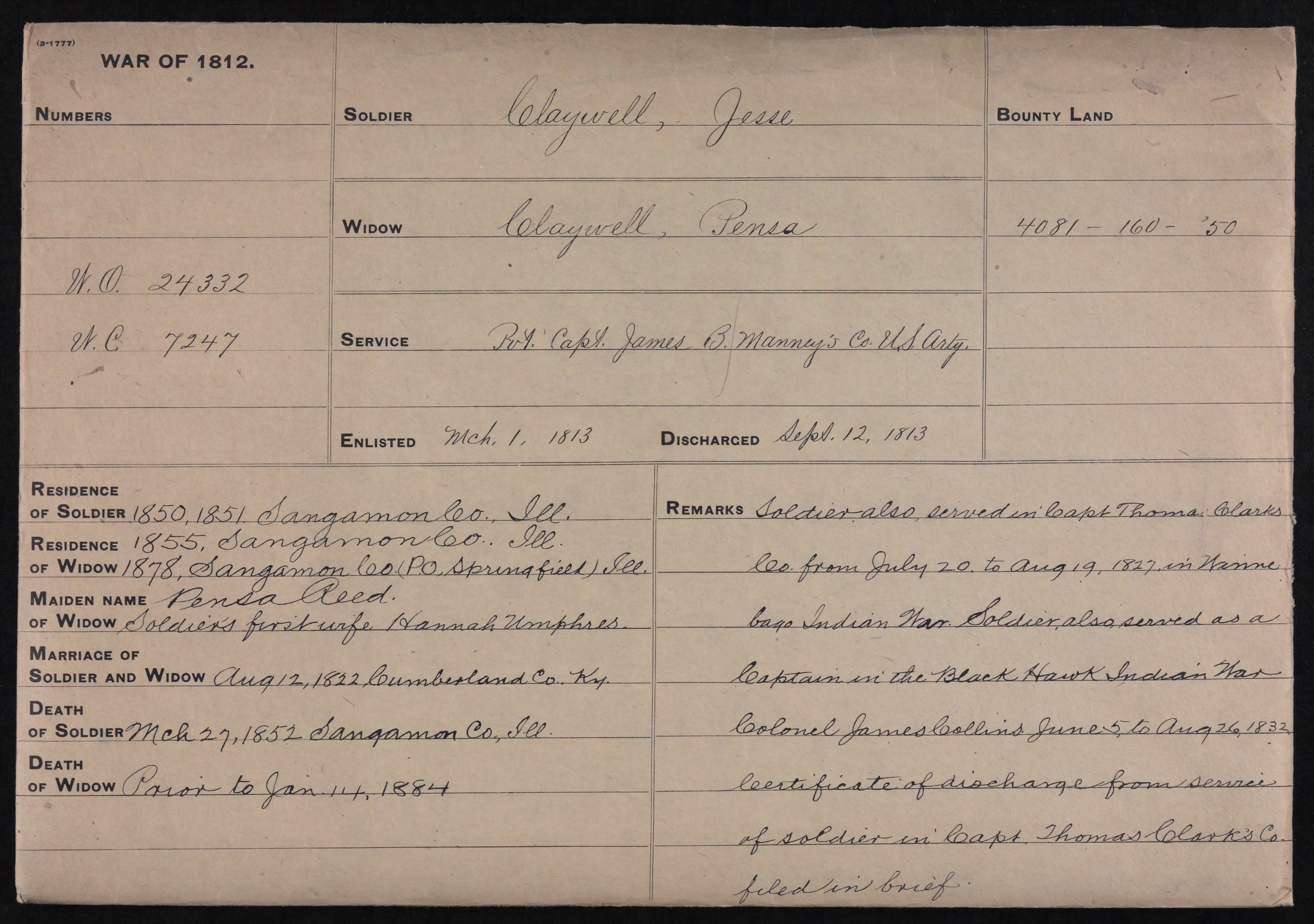
Click on image to enlarge and read notes on Jesse’s War of 1812 service record.
One of the neatest aspects of tracing a family tree back into the 1800s or earlier, is the odds of being associated with a famous American increases. Shadrach Claywell’s oldest son, Jesse, is a classic example of this phenomenon because of his Black Hawk War service.
Shadrach landed in Kentucky in 1806 and, like many other soldiers, Shadrach came to claim the land given to him in exchange for his Revolutionary War service. Shadrach definitely seems to fit the frontiersman stereotype since he lived out the last part of his life on the edge of civilization.
It is a trait carried on by several children, including Jesse.
Physical Attributes and Marriages
Although photography was invented in 1839, it did not take off until the Civil War era, so most images in Jesse’s lifetime were commissioned paintings — which, of course, were limited to the wealthier elements of society. But in the case of Jesse, we do get a glimpse of what he looked like since his second wife, Percy (Reed) Claywell, was asked to described how Jesse looked when he enter the military during the War of 1812.
Percy describes Jesse as “farming, England, 6′ 3″, light hair, blue eyes, fair complexion.”
Heading Home, Then West
After his discharge from the War of 1812, Jesse moved back to Cumberland County living “near Bear Creek” for about two years, before moving west near present-day Springfield, Ill. While in Cumberland County, Jesse married Hannah Humprey, but little is known about her except that she died in Alabama. After her death, Jesse married Percy Reed, also of Cumberland County, on August 12, 1822 in Cumberland County.
Within seven years, Jesse moved to Illinois and stayed there until he died in 1852, about five miles from Springfield, at the age of 62 (Census documents put his age at 69). At the time of Jesse’s death, Percy, was 45.
When Jesse moved to Illinois it was the current frontier of the United States and Native Americans villages were interspersed among the white settlements.
Military Service
Jesse served in three wars during his life: The War of 1812, The 1827 Winnebago Indian War and the 1832 Black Hawk War. The years he served, though, are sketchy at times, because some of his records were lost. What is known is Jesse enlisted at Burkeville, Ky. during the War of 1812 at the age of 17/18 and he was discharged in New Orleans on September 12, 1813. During this enlistment period he joined as a private and was honorably discharged in New Orleans with the rank of corporal. He served in both the light artillery unit (under Lieutenant Samuel Price) and in the heavy artillery unit.
In the two Indians Wars he served between 30 and 90 days.
The term war seems a bit of a stretch for the first conflict, The Winnebago War, since it basically centered around the murder of two families of white settlers. After the first family was murdered six members of the Winnebago tribe were accused, but four were later released. When the U.S. Army decided to transport the remaining two men, rumor spread among the Winnebago tribe that the men were tortured and murdered. The Winnebago went on the offensive and killed another family of white settlers.
In the Black Hawk War, Jesse served as Captain (under Col. James Collins) while a much more well-known American — Abraham Lincoln — served as a private in another company. Other famous Americans to fight in this war were future president Zachary Taylor, future CSA president Jefferson Davis and renown minister Peter Cartwright. Jesse and those that served under him appear to be from present day Logan County — northeast of Springfield.
The Black Hawk War ended in a brutal massacre on the banks of the Mississippi after U.S. soldiers and militia rejected the white flag of surrender from the Native Americans. Soldiers proceeded to shoot the aged, women, children and starving warriors as the Indians attempted to swim or boat across the river. The U.S. also shot cannons from a river boat in the massacre. The Native Americans were reduced from about 1,000 strong to less than 150.
Land Purchases
In a 1878 document filed by Percy Reed to obtain 160 acres of land granted to Jesse a couple years before his death (for his Black Hawk War service), it appears Jesse had never taken possession of his land. In 1878 Percy also applied for a widow’s pension based on Jesse military service stating, among other things, that she was destitute, blind and had no one to care for her. She received the $8 monthly pension until she died in 1880.
During the pension application process, neighbors testified that Percy had lived in the Springfield area — some said 20 years, others said 40 — but based on land purchases 40 years is the most accurate. In 1829, Jesse purchased 160 acres (for $1.25 an acre) in Sangamon County, Ill. He purchased an additional 40 acres in 1833 and 53 more acres in 1836.
The Great Mystery: Warren Claywell
In an earlier post I wrote about Warren Claywell, lynched in 1856 for horse stealing, while his mother and brothers helplessly stood by and watched. Warren is Jesse’s third oldest son. The mob forced a confession out of Warren’s older brother, Frank (by hanging him until he talked), who admitted they had stolen five horses from Free-Soilers (anti-slavery individuals) and pressed into service 22 horses. This — and the fact when the family leaves the Kansas Territory they head to Missouri (a slave state) — suggests that the family supported slavery since “pressing” is the act of confiscating a horse for an army or militia. Some of the Claywells did support slavery — Warren’s uncle John was a slave holder in Cumberland County as was his great-uncle Peter, a Methodist minister, in North Carolina (and several generations before them owned slaves).
One newspaper, though, goes so far as to say the only reason Warren was lynched was because he stole five horses from the Free-Soilers. (If you have never read anything about the Kansas Territory and the bloody battles and massacres that transpired, War to the Knife: Bleeding Kansas, 1854-1861
But, contradicting the theory that Warren and his family supported slavery is a 1878 document in which Percy notes she had five sons in the Union Army — which, of course, suggests the family was anti-slavery. They were:
- James L. Claywell, private, Missouri Volunteers
- Francis M. Claywell, private, Illinois Volunteers
- Benjamin F. Claywell, private, Illinois Volunteers
- Joseph Simon Claywell, private, Illinois Volunteers
- Thomas A. Claywell, private, Illinois Volunteers
So was the family pro-slave, anti-slave — or neither? Well, one other possibility is survival.
Horses were worth about four months wages and stolen ones sold on the black market for about half that much — so the family may have been simply trying to survive in a lawless territory. According to several sources, many of the settlers in the Kansas Territory were extremely poor. Since they are in Kansas and not Illinois, it’s possible the family lost their Sangamon County land and hoped for a new start by squatting on some land in the Kansas Territory. For me, these questions remain unanswered, but whatever the family’s political leanings were, they eventually move back to the Springfield area.
Date of Death And Birth
Although, I cannot find a gravestone or death announcement, most sources record Jesse’s death as March 27, 1852. In a 1850 document (Jesse’s first attempt to obtain the 160 acres Black Hawk War land), it states Jesse turned 60 on Nov. 18, 1849. This would make his birth year 1789 which basically coincides (off by a year or two) with his sworn statement that he enlisted in the military in 1808 at the age of 18 (Percy said Jesse was 17).
1850 Census
In the Census taken before Jesse’s death we can glean the ages of his children:
(Notations: Left to right the columns are: name, age, gender, occupation, property value, place of birth and X for illiterate)
- Claywell, Jesse 67 M Farmer 800 VA X
- Claywell, Pencey 44 F NC X
- Claywell, James 21 M Farmer IL X
- Claywell, Frances 17 F IL X
- Claywell, Warren 15 M IL X
- Claywell, Benj. 14 M IL X
- Claywell, Simeon 9 M IL X
- Claywell, Thos. 6 M IL
Connection to Me
Jesse Claywell is the son of Shadrach Claywell and the brother of Shadrach Claywell Jr. Shadrach Jr. is my great-great-great-great-grandfather. If you use the cousin calculator, that would make Jesse my 4th Great Grand Uncle.
| Jesse’s Lineage | My Lineage |
|---|---|
| Shadrach Claywell | Shadrach Claywell |
| Jesse Claywell | Shadrach Claywell Jr. |
| John Anderson Claywell | |
| Ed Claywell | |
| Joe Lee Claywell | |
| Charlie L. Claywell | |
| Billy D. Claywell | |
| Me |
Sources & References
Black Hawk War: There is just no way to concisely explain the Black Hawk War because it involves treachery on both sides, but the conflict can be traced back to a contested 1804 treaty. To understand the Native American side, the Autobiography of Black Hawk is a great place to start (it’s free) and the American side is explained in several works including, The Black Hawk War of 1832 (Campaigns and Commanders Series)
Jesse’s Military Service: The pension application filed by Percy and the 160-acre land grant filed by Jesse contain about 30-40 pages of documentation that paint a fairly well-rounded look at Jesse’s military service. But, it also offers clues into his family members, marriages and gives insight into where he lived. Fold3 has copies of the records and many libraries offer free access to the content with a valid library card. There are also several rosters listed online and in county history books written in the late 1800s (about Sangamon County Illinois) that discuss the various regiments and companies utilized in the Black Hawk War. However, most of these written histories only contain a paragraph or two about Jesse.
Land Purchases: All of Jesse’s land purchases can be viewed online at Illinois Public Domain Land Tract Sales Database by searching for Claywell Jesse (no comma between names), Claywell J or Claywell.
This is the first in a series of posts about Shadrach Claywell’s children. Jesse is his oldest.





 Charlie R. Claywell
