Author Archives: CharlieClaywell

Unknown's avatar

About CharlieClaywell

I have been a writer for years, mainly as a reporter, but I have always enjoyed history, especially non-mainstream stories buried inside old documents. My blog mostly centers around those stories. On occasion, though, I deviate and talk about my dog, vintage toys and what it's like to be middle-aged.

Uncle Wiggily: Classic Children’s Board Game Holds Its Value (Photo)


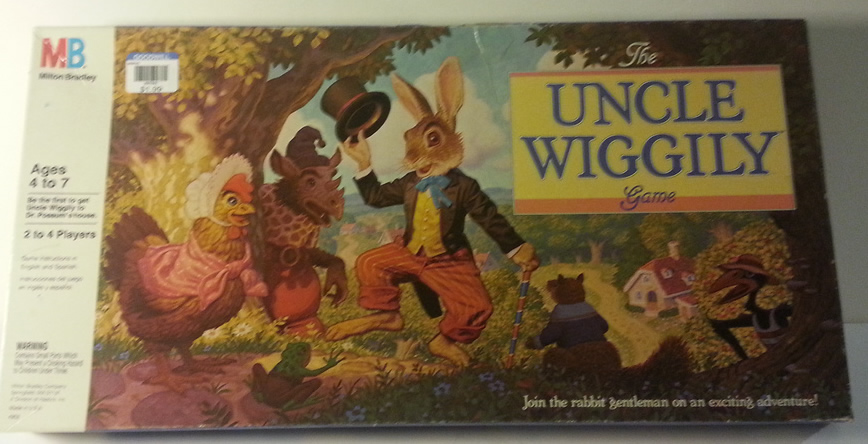
Uncle Wiggily: 1988 Milton Bradley versionAccording to Wikipedia, Uncle Wiggily  — along with Candy Land — is considered a classic juvenile American board game. Oddly enough for me, and even for my daughter, we never played the game. In my childhood — and my daughter’s — Monopoly was the game of choice, although my daughter did introduce me to Risk and Stratego.

Uncle Wiggily is based on a children’s story character created in 1910 by Howard R. Garis. The board game was introduced by the Milton Bradley Company in 1916 and the company revised the game at least three times: 1923, 1949, and 1955. The game is now owned by Hasbro.

During the early years (before 1930) a few variations of the game were also created like Put a Hat on Uncle Wiggily.

Description
The game is designed for 2-4 players and for children ages 4 and older. It is a game of chance so there isn’t a strategy per se because players roll the dice and draw cards trying to be the first to arrive at Dr. Possum’s house.

Value
I own the 1988 Milton Bradley version which sells for around $30 in sealed MIB condition. The more valuable versions of the game are the one-off versions like Put a Hat on Uncle Wiggily, the pre-1930 versions or even 1950s and 1960s versions in nice condition. These versions can sell for $30-$60 based on year produced and condition of game.

Resources
To learn more about the game, its various versions and their values visit BoardGameGeek or the Elliott Avedon Virtual Museum of Games.

Categories: board games, Vintage Toys | Tags: ,

My Memories of the Big Red Machine

Cesar GeronimoWhen it comes to baseball I was lucky. I was in the prime of my Little League career when the Big Red Machine was making sports history. When I was 11 they won the World Series by beating the Red Sox in seven games — and then won it again a year later by sweeping the Yankees in four games.

I also had a good problem — both of my favorite teams were in the ’75 World Series. Although I was a die-hard Reds fan, the Red Sox were winning me over with Fred Lynn, Jim Rice, Carl Yastrzemski — and of course, Dwight Evans. Evans almost cost the ’75 Reds the Series when he robbed Joe Morgan of a go-ahead home run in the 11th inning of game 6.

Growing up with the Big Red Machine, meant I had plenty of baseball players to idolize. Of course, Pete Rose, was my favorite. He played with such intensity — he could switch hit — dove head first into base when sliding and even ran to first when he was walked. But a close second, was Cesar Geronimo, possibly the least known of the Great Eight.

Cesar was much more than just a dependable outfielder (he won Golden Glove awards for 1974-1977), in fact, he proved to be a great clutch player during the 1975 World Series. His .280 batting average in the Series was second only to Rose’s .370 average. Cesar, who only hit six home runs during the regular season, had 2 home runs in the Series, a triple, scored three times, had 3 RBIs and was walked three times. The only teammate to hit more home runs during the ’75 Series, was Tony Perez, who had hit 20 during the regular season.

But Cesar’s greatest contribution to the team was in Game 3. He hit a solo home run in the fifth expanding the Reds lead 5-1, but it was the 10th inning that matter. In the 10th, Cesar led off with a single, advanced to third on a bunt when Carlton Fisk’s throw-out attempt to second sailed into centerfield, setting the stage for Cesar to score the winning run on a deep centerfield fly by Joe Morgan.

The Machine

The Machine is one of the best books written about the 1975 Reds season and what is arguably the best World Series in baseball history — the 1975 clash between the Reds and the Red Sox. Whether you lived through the season, or are just a fan wanting to know why the ‘Great Eight’ are legendary — this well-written book by Joe Posnanski — will entertain and enlighten. Highly recommended.

Resources


Categories: Baseball, Sports | Tags:

Cabin A Link to My U.S. Revolutionary War Heritage

headerThe image I use in the header of my blog is not just a random log cabin I photographed. It has historical significance to me. It was the dwelling place for my grandfather of the American Revolutionary War generation Shadrach Claywell — and he is believed to have built at least a portion of the cabin.

Originally located near Settle, Ky. on U.S. 90 in Cumberland County, the cabin was moved to Veterans Park in Burkesville in 1969. My paternal grandparents moved to within a mile of Veterans Park in 1968.  And, despite spending a considerable amount of time with my grandparents in the late 60s and early 70s, I knew nothing of the cabin’s existence until around 2000 when I started doing genealogy research after my father’s death.

According to historical documents, portions of the cabin, including the 1/2 dovetail section is believed to be original and may have been built as early as 1794. In 1969, Randolph Smith wrote a piece for the Cumberland County newspaper called the History of Shadrick Claywell Log Cabin and states his belief that Shadrach built the second portion of the cabin when he purchased the land in 1813.

The cabin and much of the land associated with it left the Claywell line with Shadrach’s death.

Shadrach, who lived in Virginia at the onset of the War was a bit of a restless soul. He was captured by the British during the Battle of Guilford Courthouse, lived in Canada awhile before eventually returning to Virginia. Before heading to Kentucky, he would first moved his family to North Carolina where his brother, Peter, was a minister. Then at the age of 46, Shadrach left North Carolina to settle in Kentucky on the land given to him for his War service.

Shadrach lived in the cabin and worked the 200 acres surrounding it more than 20 years until his death in 1839. In his Will, Shadrach bequeaths the cabin and surrounding land on Bear Creek to his daughter-in-law Obedience Shugart Claywell. Upon her death, Obedience would will it to her daughter Permelia B. Keen. The cabin remained in the Keen family until it was moved in 1969.

Historical documents describe the cabin as a one story log dogtrot (20′ x 52′), built mostly of poplar logs, consisting of two pens (20′ x 22′ and 20′ x 20′)  connected by an enclosed 10-foot breezeway. It has gable and cut stone hipped chimneys.

Categories: American Revolutionary War, Appalachia, Cumberland Plateau, Family History | Tags: , ,