Author Archives: CharlieClaywell

Unknown's avatar

About CharlieClaywell

I have been a writer for years, mainly as a reporter, but I have always enjoyed history, especially non-mainstream stories buried inside old documents. My blog mostly centers around those stories. On occasion, though, I deviate and talk about my dog, vintage toys and what it's like to be middle-aged.

Broken Spirit: Leaving the Past Behind

I’ve got to start another circle and leave the past behind — Larry Norman

[This is part of an ongoing series of what a rescued dog has taught me about life. Read entire series here.]

Leaving the Past Behind

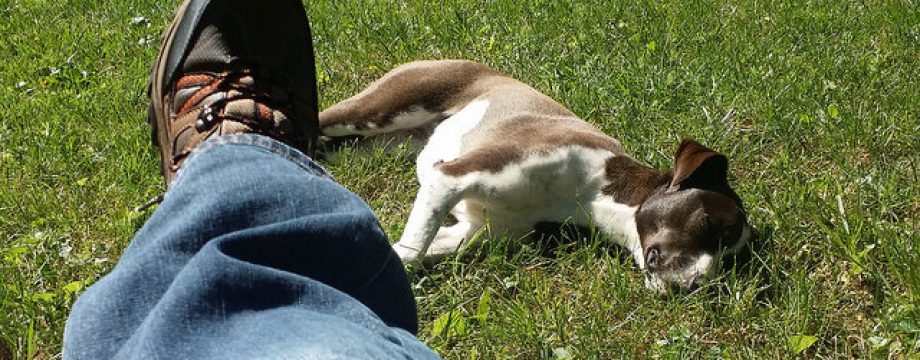
Versa’s past is somewhat uneventful — which is her problem. She was brought to the pound as a pup with her sister (who I always presumed was named Vice — the first half of Vice Versa), but a strange thing happens to puppies inside kennels and rescues — they never learn how to be a pup. There is no fighting, tumbling, or chasing after their brothers and sisters– just a pen, food and daily exercise. It’s not the fault of the organization — but it’s a harsh reality — pups like Versa struggle with fear.

Fear aggression is most recognizable by a dog’s need to bark at anything new — situations, people — and the tendency to cower. When Versa first came home, she would quiver and bark whenever strangers came into our house. Even today, nearly nine months later, she barks at visitors until I can calm her down.

Although, fear aggresion cannot necessarily be cured — several things help — and they boiled down to the same idea — making Versa feel secure. Security lessens the pull of her past.

Slow and Steady

With Versa, I’m using the tried and tested approach of slow and steady. I take her to a local kennel every three or four weeks so she can interact with other dogs. I walk her a lot without a lease. She is learning she can run off and come back and everything is fine. When family and friends visit they feed her treats and she learns strangers don’t have to frighten her.

It’s working. Her demeanor is slowly changing. In recent weeks, she has approached family members, without being coaxed, and let them pet her.

Past Limitations

We all have a past — my past included being bullied at school and in some ways just like Versa, limited socialization. But at some point, the past is just that — the past and you cannot allow it to dictate the present. You move forward, slow and steady, and find a way to come to terms with the pain and the mistakes.

And, eventually you learn, that starting another circle is just the cycle of life.

Late 70s/early 80s Christian blues album by Larry Norman.

Late 70s/early 80s Christian blues album by Larry Norman.

Something New Under the Son

Larry Norman was extremely influential in the creation of what is today known as CCM. He released his first Christian-themed album in the budding (non-existent) Jesus Rock genre in the late 60s. His four strongest albums are Only Visiting This Planet, So Long Ago the Garden, Upon This Rock and Something New Under the Son.

Categories: Middle age, Pets, Versa

See Jim, It doesn’t hurt — history of product testing on humans

See Jim, It doesn’t hurt the caption under a photo in a 1970s small town newspaper said.

It was an image of a school teacher having a patch placed on her upper arm — in the same place where a polio vaccine would be administered. But what really caught my eye  — She was participating in a school fund raiser.

The caption went on to say,

Upon completion of the testing program, each person is expected to earn $19.50 for the band parents to be used on uniforms, etc. … P&G wouldn’t disclose what they were testing other than it had something to do with products.

I mean what marketer thought, here’s a good idea — let’s test our product on an unsuspecting public, garner some positive press and help pay for some band equipment. I know it was the early 1970s and everyone was coming out of the decade of free love and hallucinogens — but really, unnamed product testing on humans?

Turns out testing on people was business as usual. Although some participants didn’t a have a say in it. NBC News reported,

The late 1940s and 1950s saw huge growth in the U.S. pharmaceutical and health care industries, accompanied by a boom in prisoner experiments funded by both the government and corporations. By the 1960s, at least half the states allowed prisoners to be used as medical guinea pigs.

But, after a 1973 congressional hearing, that too became a thing of the past, but at least the pharmaceutical industry had a good reason for using inmates.

They were cheaper than chimpanzees.

Yes, industry officials admitted that in the hearings.

However, American ingenuity could not be stifled with a little thing like legalities  — or ethics for that matter — so the industry persevered.

The found children — not real children like American children — but children in other countries.

In their defense, it’s hard to find cheaper test subjects than children in impoverished areas of the world. Besides, the tests are more conclusive since companies are not hassled with inconvenient regulations — and often the subjects are not on any other form of medication (which could, of course, confuse or contaminate test results).

As late as 1996, one U.S. pharmaceutical company was using Nigerian children as guinea pigs. The company faced legal issues after 11 children died.

Pfizer was sued after 11 children died in a clinical trial when the northern state of Kano was hit by Africa’s worst ever meningitis epidemic in 1996. A hundred children were given an experimental oral antibiotic called Trovan, while a further hundred received ceftriaxone, the “gold-standard” treatment of modern medicine.

Five children died on Trovan and six on ceftriaxone.

In addition to the lawsuits filed by family members, the company paid the Kano state government $75 million despite accepting no blame in the children’s death. The company argued meningitis and not the antibiotic led to the childrens’ death.

In its 2011 annual review to the shareholders, Pfizer noted it had executed clinical trials in more than 60 countries.

Categories: American History

Books I’ve Read: Owning It — Zen and the Art of Facing Life

First, let me start by saying I know very little about Zen — and even less about practicing it. This is one of my thrift store books — when my wife and I go to thrift stores, I always pore over the shelves to find interesting books to read — especially about topics I know little about.

Even though this book is about koans — those philosophical questions that when truly contemplated lead to valuable insights — it’s really about current people with current problems. It’s about finding ways to handle change, deal with uncertainity and how to thrive in our day-to-day existence. Zen, as part of the Buddhist tradition, sees life as suffering and seeks to comes to term with what is — in the moment — by learning not so much how to change things, but how to become what is.

…there’s a difference between coping with the ebb and flow of our lifes and becoming the ebb and flow. We suffer most when we buck up against changing circumstances, but once we own them, dropping our bodies and minds into them, even changes that are hardest to take can release us from suffering.

As you may expect, this is the theme the book keeps coming back to — owning your situation. In many ways, this book offers no answers and it definitely places the ultimately responsibility of living a fulfilled life on you the reader, but the author does keep leading the reader into a deeper understanding of the benefits of Zen practice.

She does this without being preachy — just practical. Near the end of the book, she notes,

Life’s toughest moments — the ones that toss us the changes we don’t want — offer the best opportunities for spiritual insight, provided, of course, if we are ready to own them.

Categories: Books I have read | Tags: