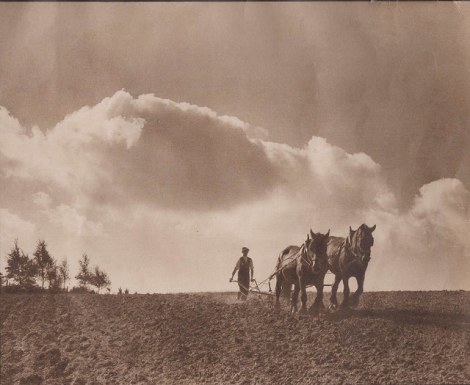
In some ways, for me, Kentucky is synonymous with tobacco. I live in southwest Ohio, where corn and soybeans are the main crops and Kentucky is the only place I’ve ever seen fields planted in tobacco. Besides both of my grandfathers — Kentucky natives — earned some of their livelihood processing tobacco.

Rob Beaty
Tobacco was also the cash crop that rescued the early colonists. When the English settled in Jamestown they came in search of gold. When gold proved elusive, the settlers sought out other ways to ensure their sponsors received a strong return on their investment. The ventures included glassblowing and vineyards, but the settlers hit it big with tobacco — a product loved in England. By 1630, more than one and one-half million pounds of tobacco was exported annually from Jamestown.
Turns out, tobacco played an integral role in several generations of the Claywell family as well — especially in the years before Shadrach. Many of his forefathers in Virginia and Maryland made a living by growing the crop.
But it was also tobacco which indirectly shortened the life of one of Shadrach’s sons — John Peter Claywell.
1840: Kentucky Ranks Near Top In Tobacco Production

Charlie L. Claywell
Despite his misfortune, tobacco was the crop to grow during John’s era as historical records show. Around the time John died the state was second in the country in production of tobacco. In 1840 Kentucky farm crops ranked:
- First: Hemp and Wheat
- Second: Tobacco and Corn
- Third: Flax
- Fourth: Rye
Just two decades later, in 1860, tobacco accounted for half the agricultural income for Kentucky.
South To New Orleans
It was a trip selling tobacco in New Orleans that caused John’s death. John was only 43 when he died in 1837 of yellow fever, so it’s highly unlikely that the 1835 trip was his first time in New Orleans. Fleshing out his complete life story is somewhat difficult, but his Last Will and Testament, written June 16, 1835 in New Orleans, offers clues. John begins the legal document by saying,
This to John Marten Alexander and Granville Bowman of Burkesville as I feel very bad and that I have but little time to live. I beg the favor of you two to settle my business when the return of my tobacco comes home. I have a great many open counts against the people, that are all just, and I want you informed yourselves if any should be disappointed, for I am certain there is not one cent in my books unjust, as to my estate it is very small to leave to my dear wife and children but it was honestly got and I hope it will wear well as I do not understand writing the form of a will. I hope the judge of the court will not allow mine to be broke, by any means whatsoever.
Although John lived more than two years after writing this, he never makes it back home to Cumberland County — dying in New Orleans on Sept. 5, 1837.
Net Worth
In the will, John lists his livestock– hogs, cattle, sheep and horses — and once his debts are paid he appears fairly well off — leaving his wife, Obedience, with more than $4,000 in cash — the equivalent of about $100,000 today.
Farming And Slavery
It is through this will we learn that John is a slaveholder. Although, in 1830, one-fourth of the state’s population was black, it did not mean a lot of people owned slaves. In reality, 75 percent of southern landowners did not and most did not own many — nearly 90 percent of slaveholders owned 20 or fewer slaves. John had four. Upon his death three of them are sold — possibly to settle his estate — and John wills one, Mary, a “negro girl” to Obedience.
Obedience And The Kids
When John died in 1837, Obedience was 35 with five children to raise — Permelia, 16, was the oldest and the youngest, Daniel, was a toddler. John wanted Obedience to keep the children together after his death — and, based on the 1840 Census, she does. But, the picture of Obedience’s life of suffering becomes apparent by piecing together all the significant dates and milestones of her life.
John’s premature death was just one of a series of tragedies Obedience endured. Even though Obedience was left with five children to raise, that doesn’t tell the whole story. She had already lost three children before John’s death and John’s namesake, a three-year-old, died the same year as his father. Another daughter, Martha, would die three years later at the age of eight. Adding to her struggles, Obedience’s father, Eli Shugart, died just three months after John contracted yellow fever. In the year after John’s death, Obedience’s father-in-law Shadrach Claywell, died (1838).
Borrowing from some online research, we know this about John and Obedience’s children:
- Permelia B. Claywell, born Jan. 13, 1821 in Cumberland County married William H. Keen a few years after John’s death.
- Elizabeth V. Claywell (1822-1851) married Sampson T. Keen
- James Solomon Claywell (1824-1870) married Elizabeth Hicks
- William Keen Claywell (1826-1826)
- Jane H. Claywell (1827-1828)
- Joseph L. P. Claywell (1829-1833)
- Martha J. Claywell (1832-1840)
- John P. Claywell (1834-1837)
- Capt. Daniel W. Claywell (1836-1902). He was a Union captain during the Civil War.
Moving In With Her Daughter
By the 1860 Census 58-year-old Obedience, although still living in Cumberland County, is part of her daughter’s household. The names are listed in the following order, meaning her son-in-law, William Keen, is the head of household:
- William Keen, 51
- Parmelia Keen, 39
- Alderson Keen, 19
- Mary O. Keen, 17
- John S. Keen, 11
- James R. Keen, 9
- Eliza E. Keen, 7
- M. A. L. Keen, 2
- Nicholas B. Keen, 16
- Martha A. Keen, 14
- Parmelia Keen, 10
- Obedience Claywell, 58
Everyone in the household was born in Kentucky except Obedience (North Carolina) and 10-year-old Parmelia. She was born in Arkansas.
John Says His Goodbyes
John closes out his will with a special message to his wife.
Dear wife, these are my last words to you, and I know this is a world of trouble, I want you to comfort yourself with the thoughts of meeting me in a better world, where our worrisome times is over – you are young yet I want you to take care of your health, and take care of our dear little children, don’t greave yourself about me, but strengthen your thoughts, that we shall one day meet where our troubles will be over – Amen
Obedience, born in Surry, North Carolina and buried in Cumberland County outlived all of her children except Permelia and Daniel. She was named after her grandmother, Obedience Hutchins of Virginia.
John was born May 20, 1794 in Bedford Co., Virginia. John and Obedience were married April 6, 1820. At the time of his death, they had been married 17 years.
List of John’s Assets And Liabilities
When John’s estate is settled in 1837, these goods are entered into the public record:
Debtors
- Amount of public sale bill Oct. 9th and Nov. 15th 1837 — $501.00
- 100 barrels of corn sold — $100.00
- 1 Negro woman Silva sold to James Clark executor $525.00
- 2 Negros Charles and Talia sold — $1,150.00
- Amount of note for inventory filed in clerk’s office –$6,021.66
- Amount of newer loans $1,671.63
- There is also a list of interest payments due, etc., but his total assets appear to be $10869.85
Liabilities
This is where the list gets harder to decipher but the total liabilities appear to be: $6,021.60
Learn More
New Orleans would eventually become known for its yellow fever epidemics, but the larger death tolls came many years after John’s death. The New Orleans Public Library reports a spike in deaths in 1835 (284) and 1837 (412), but the 1853 epidemic claimed the most lives (8,000 to 11,000 deaths). According to Family Letters of Wilhelmina Boehm Ney (1835-1923),
By June (1853) the epidemic was raging and it continued through July with hundreds dying daily. The epidemic peaked at 250 deaths on August 20, before ending in September. Out of a population of 100,000 persons, New Orleans had 40,000 cases of Yellow Fever that summer, and 11,000 of those died. All economic activity halted in July and August. Burials went on all day, and continued late into the night.
A cure for the disease was discovered in 1900.
Series: Shadrach’s Children
Shadrach and Amelia Rush had 10 children. They are:




 reports that 137 soldiers deserted an Army of the Potomac detachment of 625 men. The men had been sent to reinforce a New Hampshire regiment, but 86 of them joined the Confederacy while 36 soldiers simply headed back home.



 Charlie R. Claywell