
Author Archives: CharlieClaywell

Unknown's avatar

About CharlieClaywell

I have been a writer for years, mainly as a reporter, but I have always enjoyed history, especially non-mainstream stories buried inside old documents. My blog mostly centers around those stories. On occasion, though, I deviate and talk about my dog, vintage toys and what it's like to be middle-aged.

Most Popular Posts in 2015

WildhorsesowyheeEach year, I like to look back and see which posts resonated with readers. Here are the Top 5 from 2015.

5.) 1800s Wild West Lynching Claims Life Of Claywell Man. This is one of the most interesting family stories I have researched. In this post, I relay the story of Warren Claywell, a young man tried and convicted in the Kansas Territory, of stealing horses. The trial was nothing short of a mob lynching and Warren was hanged to death in front of his aged mother and brothers.

4.) Quote For The Week: Be Thankful. Just like the headline says — these are quotes, taken mostly from religious writings, that encourage us to focus on what is right in our world. The post ends with Mark Twain’s maxim on what we all should be thankful for.

3.) Printing Errors Alter Biblical Meanings. This is one of my rare attempts to look at the lighter side in a book review. In this post, I pull out all humorous printing errors that have occurred over the years including one that financially destroys a printer. If you are interested in Bible printing and translation history A Visual History of the English Bible: The Tumultuous Tale of the World’s Bestselling Book is an excellent resource. Post ends with a funny, religious joke about Hell.

2.) ‘Becoming Madison’ A Nice Preamble To Constitution. In this recent December post I wrote a book review about Becoming Madison: The Extraordinary Origins of the Least Likely Founding Father. The book, which I highly recommend, takes a short, yet insightful look, at James Madison’s formative years and the role Patrick Henry played in determining Madison’s place in United States’ history.

1.) Original News Report on Lincoln’s Assassination Shows Much Has Changed. In this short post from April, I reference the New York Times reissuing of the original news article announcing Lincoln’s assassination. What is most interesting in the original article is what the reporter felt the need to relay to his readers — and what he left out.

Click here to view was what popular in 2014.
Categories: Year In Review | Tags:

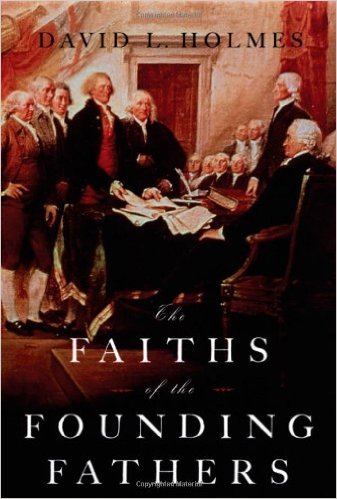
‘Faith Of Founding Fathers’ Revisits Christian Leanings Of 6 Early Leaders, Wives

thefaithsofthefoundingfathersAmericans tend to be in one of two camps concerning the religious beliefs of the Founding Fathers. Those who believe the leaders were Christians determined to create the republic as a Christian nation. The other camp believes the country was founded in a secular manner with care being taken to “build a wall” between church and state.

In The Faiths of the Founding Fathers (2006) author David L. Holmes succinctly analyzes the religious leanings of six Founding Fathers. These six are:

  • Benjamin Franklin
  • George Washington
  • John Adams
  • Thomas Jefferson
  • James Madison
  • James Monroe

His examination, among other things, focuses on the words these men used when talking about God in a personal letter to a family or a friend. Reading these letters bypasses the political persona of the leaders and shows what they said in private.

Holmes zeroes in on specific words these men used concerning God or their use — or nonuse — of Christian phrases. For example, a Deist usually avoided traditional Christian phraseology using “the Grand Architect” instead of “God,” while Christians like John Adams would sprinkle “Redeemer of the World,” or “the grace of His Holy Spirit” throughout a letter.

Besides these six men, Holmes examines the men’s wives and a few of their children to see what family traditions and beliefs were passed on. The book concludes with a two-to-three paragraph about each of the modern presidents — beginning with Gerald Ford and ending with George W. Bush (who was president when the book was published).

Even though I found the whole book intriguing, the most interesting section was Holmes’ discussion, at the beginning of the book, about the religious climate during the Revolutionary War era. In this section, Holmes reports which church denominations existed in each of the 13 colonies, and their specific beliefs. This detailed account provided a picture of the variations of Christian doctrine and dogma that existed when the country was born.

Rated 5 out of 5: The Faiths of the Founding Fathers is an interesting read and a great introduction into the religious beliefs of the Founding Fathers. It also sheds some light on how those beliefs played out publically. With only 185 pages the book is also a quick read.

Categories: American History, American Revolutionary War, Books I have read

Early Draft Of King James Bible Found In University’s Archives

KINGJAMESI find the history of the Bible — and it’s influence on the United States — interesting. Of course, one of the most popular versions is the King James Version. It was commissioned by King James and first published in 1611. Although, when published, it was not the official, authorized Bible of the church of England (the original title page of the 1611 King James Bible read: Appointed to be read in Churches), it nonetheless became the standard other Bibles were judged by– with some asserting it is the only true version of the Bible.

Old Notebook Reveals Translation Process

Recently Alan Miller, an assistant professor of English at Montclair State University in New Jersey, uncovered one of the earliest drafts of the King James Bible. The document was found in an “unassuming notebook held in an archive at the University of Cambridge.”

According to the New York Times, this artifact is unique and different from other surviving drafts because,

… it shows an individual translator’s initial puzzling over aspects of the Greek text of the Apocrypha, indicating the reasoning behind his translation choices, with reference to Hebrew and Latin as well.

Although creation of the Bible was commissioned by King James and the companies doing the work were told to do their work as a group, this new discovery shows that the way it was ordered to be done, and the way the work was actually completed, was different. This recently discovered notebook suggests that

“beyond a reasonable doubt” that at least some of the companies ignored the instructions and divided up the work among individuals…

Which suggests even the Bible was subjected to a labor-management clash since, just like today, the bosses handed out the orders and the workers finished the project the best way they knew how. It is important to note, though, that the discovery does not take away from the work that was completed — or diminish the integrity of the work. It just shows that sometimes, individuals — and not a team — labored over the correct translation of a passage.

The passage being translated in the document is from the Apocrypha. The Apocrypha was removed from most U.S. versions of the King James Bible by the mid-1800s.


Learn More

1760_Cambridge_Edition_King_James_Bible

The Bible’s role in the country is unmistakable, but what many do not realize is that the King James Bible was not the preferred translation of the first white settlers. The Puritans preferred, preached and studied, the Geneva Bible.

The Geneva Bible had two (and maybe more) distinctive qualities that made the Scriptures more accessible to the common person. First the Geneva Bible included marginal notes — called commentary in today’s vernacular — that interpreted various phrases and statements for the layperson. But, the single most important improvement the Geneva Bible implemented? Verses. Before the Geneva Bible, the Bible had not been divided into numerical verses.

If you are interested in understanding how the Bible, as we know it today, came into existence, read How the Bible Was Built.

Categories: Religion | Tags: