

 I am, by no means, a historian, but I have read enough about the United States to have a good feel for the various eras of our country’s history — and the wedge issues that have united and divided the population over time.
One arena I have always found intriguing is the concept of morality.
For some people, it is cut and dried with no grey or middle ground. For me, though, I’ve never thought is was quite that simplistic. And, if you read American history, you will find that what is consider immoral has shifted over time.
Take, for example, my hometown of Preble County which is deep inside the Red zone. The last Democrat-based newspaper, the Eaton Democrat, ceased publication in 1940, so for my lifetime, all I have known as far as local news coverage is conservative papers like The Register-Herald.
You can imagine, then, my amusement when I stumbled across two sex-themed movie ads sandwiched between a grocery store and a clothing store ad inside a 1960s newspaper. At first, I thought the ads were for the movie theatre located on U.S. 35 that showcased pornographic films during the late 60s and early 70s. That theatre was well-known enough that when I went to work 30 miles away at a Dayton newspaper in 2000, an older gentlemen asked me if I knew the theatre had existed inside my conservative county.
But, these films I saw in the advertisement (which would be rated PG-13 or R today) were being shown about 20 miles from Eaton at an outdoor drive-in.
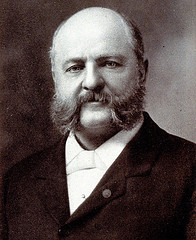
The movies, though, reminded me of Anthony Comstock — that lone American somewhat lost to the pages of history. Comstock was a man on a mission in the early 1870s — his goal was to rid the country of all obscene materials.
Anthony Comstock
After reading about Comstock, I came to believe he was just one unhappy soul. He seemed to oppose more than he embraced and he was always looking for someone to arrest on obscenity charges. It was because of Comstock’s lobbying efforts that Congress, in 1873, passed a law and set criminal penalties for those who sent ‘obscene materials through the mail.’ Of course, the rub, then as today, was what was ‘obscene,’ since it is a subjective interpretation. In the modern era, United States Supreme Court Justice Potter Stewart in 1964 would famously describe his threshold test for obscenity in the case Jacobellis v. Ohio.
I shall not today attempt further to define the kinds of material I understand to be embraced within that shorthand description [“hard-core pornography”], and perhaps I could never succeed in intelligibly doing so. But I know it when I see it, and the motion picture involved in this case is not that.
So, at least for one judge, it was a matter of let me watch and then I’ll decide. Of course, for another judge Clarence Thomas, watching it nearly wrecked his career.
What The Law Attacked
A significant portion of the Comstock Act was designed to target women’s reproductive rights. Because of the underlying belief that married women were legally obligated to have children, the Act labeled as obscene a wide range of content including information explaining birth control products. Strengthening the enforcement of the Act was the fact that Comstock was conveniently appointed to a position inside the U.S. Postal Service to oversee and enforce the law.
It created a situation where Comstock’s opinion became law and his interpretation of morality placed honest people behind bars.
Cupid’s Yoke
One of the most famous cases handled under the law centered around the secular magazine, Truth Seeker. In a method, that today would be entrapment, using an assumed named Comstock wrote the Truth Seeker editor requesting the pamphlet “Cupid’s something or other.” The editor complied and sent Comstock Cupid’s Yoke. The booklet, described as ‘silly, but not obscene’ by opponents of the Comstock law was a 23-page piece about why free-love was a better living arrangement than marriage.
For the crime of mailing the ‘obscene’ material, the 60-year-old editor was sentenced to 13 months of hard labor in a federal penitentiary.
Opponents of The Law Fight Back
One of the most significant issue with the law was the ability to censor magazines or literature that Comstock deemed obscene. As one might expect, plenty of freethinkers were opposed to the law, which they viewed as legalized censorship. Authors like Walt Whitman, Mark Twain and George Bernard Shaw were just a few to attack the hypocrisy of the Act.
Political cartoonists joined the conversation as well.
In an 1890 cartoon, titled, “How To Sell Bibles — A suggestion To The American Bible Society,” a Comstock officer is seen chasing a man holding a poster that reads, “Buy a Bible — All About Amnon and Tamar” a reference to the story of Amnon (King David’s son) who raped his half sister. Under the Comstock law, such a passage, if found in literature would have been deemed obscene.
President Issues Pardons
In fact, Comstock created enough of an uproar with his overzealous enforcement of the Act that President Rutherford B. Hayes often pardoned the individuals convicted under the Act. The Truth Seeker editor mentioned above was not pardon, though, because Hayes’ wife, Lucy, despised the editor. She found him distasteful, not because of what he had printed or sold, but because he had cheated on his wife.
Birth Control
The most significant abuse of the law was aimed at information about birth control. Margaret Sanger, a trained nurse who worked with the poor in New York City, began distributing pamphlets about birth control in an effort to halt the high number of unplanned pregnancies. It wasn’t though until she founded a magazine and distributed birth control information by mail that she ran into legal trouble. Sanger was indicted under the law in 1913 and the magazines were confiscated by the U.S. government under the provisions of the Comstock Act. The information explaining birth control methods was deemed obscene under the Law.
Eventually Sanger would go on to create an agency to help disseminate family planning information. The institution is today known as Planned Parenthood.
Still On The Books
For me, possibly the most intriguing part of the Comstock story is the fact that parts of the archaic law are still on the books today. In fact, as recently as 1994, Congress passed revisions to increase the fine limits to as much as $250,000 and expanded the law to include not only information disseminated through the mail, but also over the Internet.
Attempts by Planned Parenthood to challenge the law were dismissed by a New York court since the law had not been enforced.
 From The Horse’s Mouth
If you want to get a better feel for what Anthony Comstock thought and believed, you can read his book, Traps for the Young


 , author Peter Schweizer, poses a simple question:



 Charlie R. Claywell