
American History

‘Becoming Madison’ A Nice Preamble To Constitution

Knowledge will forever govern ignorance; and a people who mean to be their own governors must arm themselves with the power which knowledge gives. — James Madison
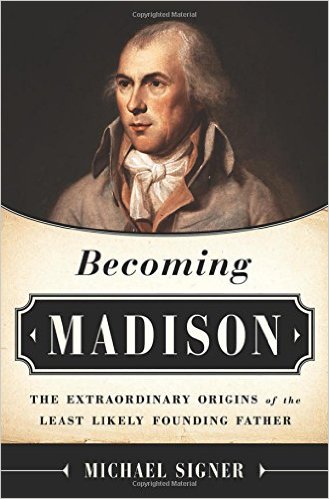
Becoming-MadisonMany an argument in America, I’m certain, has ended with the phrase “it’s in the Constitution,” despite the reality that many Americans have never read the document and would be ill-advised to debate what is in — or not in — the Constitution.

But one who man could say it with certainty was president James Madison.

Becoming Madison: The Extraordinary Origins of the Least Likely Founding Father, centers around the younger, formative years of the country’s fourth president and author of the Constitution. Most of the story is neatly sandwiched between two defining moments in Madison’s life and both incidents involve his political nemesis, Patrick Henry. In the first moment, Henry see a great political opportunity in, of all things, the decline of church membership in Virginia. Henry tries to exploit the electorate’s belief that the closing churches indicate the country is heading down the path to Hell, immorality and eventual destruction.

Salvation Through Taxation

Henry offers up a solution — the Bill Establishing a Provision for Teachers [Ministers] of the Christian Religion. The bill, which initially proved very popular with politicians and voters alike — would assess a tax on all citizens to fund churches. Since this was in the pre-Constitution era, the concept of a wall between the church and state did not exist. Madison, though, saw the inherent flaw with Henry’s popular concept and set out to defeat the proposal. Madison initially scribbled some notes on the back on an envelope contesting the concept. His note began,

The true question was not whether religion was necessary. It was whether religious establishments were necessary for religion. No.

From the simple answer of No, Madison would write a 15-point essay and address the Legislators in opposition to Henry. Madison, a short, soft-spoken man was definitely in a David versus Goliath fight when he chose to engage in political battle with the Revolutionary War icon who famously spoke, “Give me liberty or give me death.” Just as in biblical times, Goliath fell, but more importantly, it was in this singular event that led to the creation of Madison’s method of political attack. The method consisted of nine interlocking tactics:

  1. Find passion in your conscious.
  2. Focus on the idea, not the man.
  3. Develop multiple and independent lines of attack.
  4. Embrace impatience.
  5. Establish a competitive advantage through preparation.
  6. Conquer bad ideas by dividing them.
  7. Master your opponent as you master yourself.
  8. Push the state to the highest version of itself.
  9. Govern the passions.

The book ends with an even larger political battle with Henry — ratification of the U.S. Constitution. Henry was adamantly opposed to the proposed Constitution — viewing it as the enemy of freedom — and, of course, Henry was considerably influential. In fact, it was assumed in his day that if his home state of Virginia did not ratify the Constitution — then the Constitution would fail to garner the nine states needed for acceptance. In the end, Virginia narrowly ratified the document.

Unelectable Today?

Although the focus of the book is on the forces and influences in Madison’s younger years — especially the ones that channeled him into being a statesmen — the book is also filled with enough real life stories to let reader understand who Madison is. Madison, at 5′ 4″ and a 100 or so pounds, probably would not have been elected in today’s TV-driven presidential races where the passions are intentionally enflamed by demagogues. Although by no means perfect, Madison was a believer in a governmental system that kept all the various passions in check so that the good of the nation — and its citizens — would be served.

Panic Attacks

The author points out several of Madison’s weaknesses and the most pressing one was panic attacks. The problem plagued Madison his entire life. As a young man Madison — a believer in armed opposition to the British — collapsed on the battlefield unable to participate in war. At the age of 36, during the ratification process of the Constitution, Madison retreated to his room for days unable to face the controversy. Despite this weakness — which was potentially debilitating in politics — Madison rose above his pain, authored and then fought for the document that governs our nation.

Principle Proves Costly

Madison was a believer in reason and it nearly costs him his political career. He suffered his first defeat by refusing to participate in a common practice of securing votes. Most politicians in his day would supply voters with alcohol on election day and, of course, the drunker the voters became the more apt they were to cast their ballot in favor of the one supplying the alcohol. Madison felt the practice demeaned the nation, believing that those who govern had a moral obligation to be statesmen and push the state to the highest version of itself.

Final Note

In a book review it is not possible to explore all the reasons a book is worth reading and the list of childhood influences and educational choices are just two subjects the book explores that I have not touched on. But, the fact that Madison was educated under the tutelage of John Witherspoon was extremely influential in the creation of the U.S. Constitution. It was while being pushed, educated and challenged by Witherspoon that many of the ideas in the Constitution first surfaced.


Rated 5 out of 5. Before reading the book all I knew about Madison was he authored the Constitution and I was pretty sure he married Dolley. After that I knew little about the man. After reading the book though, I must say, my impression of Madison is he was a man of principle and believed that for a country to succeed, strong checks must be in place to counteract voters’ passions. His main weakness, I would contend, was he put too much faith in the morality of elected officials, presuming they would govern from a sense of morality and the higher good.
Categories: American History, American Revolutionary War | Tags:

Homegrown Terrorism: The Story Of John Brown

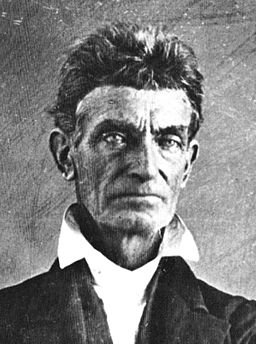
John_brownUntil I read the War to the Knife: Bleeding Kansas, 1854-1861 by Thomas Goodrich I only knew the sanitized version of the John Brown story. Brown — a God-fearing abolitionist is credited with starting the Civil War. The story I knew went basically like this. John Brown was an abolitionist from the East who moved to present-day Kansas to make sure the territory was slave-free. After his stint in Kansas, Brown headed East, overtook a fort in Virginia as part of plot to incite slaves to revolt against their owners.

In a very basic sense, all of that is true, but it in no way describes the utter depravity of John Brown.

Congress Shirks Duty And Bypasses Slavery Issue

In 1854 the United States Congress passed the Kansas-Nebraska Act giving the Kansas Territory residents the power to decide whether the region would be slave or free. With the advantage of history, it’s easy to see the error in judgment with this decision, but in 1854 it seemed like the correct approach. After all, it is standard operating procedure in the United States to let decisions be made as local as possible. But this single Act propelled the country into the Civil War.

A lot was at stake when the Act was enacted with the balance of power in Congress being a significant one. When the Act was approved 13 states held slaves and 13 did not.

Adding to the difficulty was Missouri, home to an estimated $100,000,000 worth of slaves. Missourians had a vested interest in Kansas becoming a slave state to protect their ‘property;’ while in the East, abolitionists were determined to halt the spread of slavery.

It unleashed a violent storm in the Kansas area.

Emigrant Aid Society

Shortly after the Nebraska-Kansas Act passed Massachusetts resident (and future Congressman) Eli Thayer established the New England Emigrant Aid Company for the sole purpose of transporting abolitionists into the Kansas Territory. These Easterners, with no frontier experience, headed west and quickly established abolitionist cities in the region. The most well-known city was Lawrence (the location for the worst civilian massacre during the Civil War).

Locals, Not Really Local

With abolitionists arriving from the East and Northeast and proslavery men coming from the South and Missouri, the region was quickly divided into three distinct groups: Proslavery, Abolitionist and settlers. Although, the Act was designed to let the settlers make the decision, it was the settlers that had the least interest in the political battle. Most were just ‘regular folks’ wanting to raise a family on their homestead.

Rigged Elections

When the first election was held inside the Territory, Missourians poured over the border on election day to vote — often by force. Their tactic worked as the Territory was declared a slave-holding region based on the election results (despite the fact that the number of voters exceeded the number of Territory residents).

Abolitionists refused to honor the new government — naming it the Bogus Government. Violence eventually broke out between the Abolitionists and Proslavery men and caught in the crossfire were the settlers.

It was during this upheaval, in 1855, when John Brown moved in.

Acts of Terror

In 1856, after the town of antislavery town of Lawrence was attacked by armed proslavery guerillas, John Brown decided the pacifist approach of the Abolitionists is hindering their cause. So he decides to meet force with force with a retaliatory attack. It is at this point the delusional side of Brown becomes more apparent. Even several of his children are shocked by the action he is proposing and John Brown Jr. refuses to participate.

But John Brown — often referred to as Old Man Brown — is convinced God has chosen him to rid the country of slavery. Before heading out to attack and kill several settlers, Brown said,

“I have no choice. It has been ordained by the Almighty God, ordained from eternity, that I should make an example of these men.”

Brown’s small group of men, armed with pistols and swords, then ventured out into the night to commit their first gruesome act. Their victim was a transplanted Tennessean, James Doyle, a proslavery man who was simply a settler in the wrong place at the wrong time. According to those who knew him, Doyle never agitated for slavery. In fact, when neighbors attempted to get Doyle to be a Legislator for the Territory, he said,

“I came to this territory to secure a home for my family, not for political purposes.”

Around 11 p.m. on May 24, 1856 Brown and his gang knocked on Doyle’s cabin door. According to one of the assailants that night, James Townsley, Brown order Doyle and his two oldest sons to surrender to his gang. The youngest son was spared because Doyle’s wife cried and pleaded for his life.

Brown and his followers then led the three Doyle men a short distance and order them to halt. Brown shot James Doyle while Brown’s two youngest sons attacked the Doyle boys with swords and killed them. The gang committed the same crime the following night killing two more men and those victims were “chopped into inches.”

The gruesomeness of the acts caused two of Brown’s sons to suffer mental breakdowns.

Brown wasn’t through though. He would remain inside the Territory until 1858, recruiting additional men for his cause. As his followers grew to 100 or so men, Brown led them in guerilla warfare and the body count and terror continued to rise. After two years of doing ‘God’s work’ Brown and his sons finally left the Territory.

Brown’s Capture And Execution

Brown’s most famous act came in 1859 when Brown and his followers overtook an armory in Harper’s Ferry. They had kidnapped several prominent men — including a relative of George Washington, Lewis Washington — and held them hostage inside the armory. The confrontation ended when Federal troops led by Robert E. Lee overthrew Brown and the surviving members of his ragtag army. During the battle, two of Brown’s sons were killed. As one of Brown’s sons groaned in the throes of death, Brown allegedly told him to ‘shut up and die like a man.’

Brown was convicted of treason, murder and slave insurrection and sentenced to death by hanging. He was executed on Dec. 2, 1859 in Virginia (present day West Virginia).

He was 59.


Trivia

Early in life, John Brown went to college to become a Congregational Minister, but he dropped out due to eye problems and a shortage of funds.

Categories: American History, Civil War History | Tags: , ,

The Crucible Even More Applicable In Era Of Terrorism

thecrucibleDespite a National Anthem that proclaims we are the land of the free and home of the brave, Americans have a long and storied history of fear — and that fear is often manipulated by demagogues.

In The Crucible playwright Arthur Miller examines our fear by showcasing society’s tendency to react in illogical ways when frightened. As Miller shows, these reactions are fueled and guided, in large part, by powerful players who intentionally override the common good and replace it with a political or personal agenda.

Written as a play, The Crucible is the retelling of the Salem Witch Trials. In the 1996 film version, starring Winona Ryder and Daniel Day-Lewis, Ryder plays the role of Abigail Williams the lead accuser during the witch trials. Lewis, who plays John Proctor, is the sole voice of reason as hysteria sweeps through the small New England community, a hysteria that inflicts death, incarceration and torture on innocent citizens.

But, as is often the case with fear, the voice of reason must be silenced, as Procter eventually learns.

As the story unfolds and the personal agenda of Abigail becomes apparent, the illogical beliefs that overthrow reason, justice and sensibility seem juvenile to the viewer especially when many of the accused ‘admit’ they are a witch simply to avoid prosecution and possible death. After these fake confessions are spoken, though, and the accused have renewed their allegiance to God, the community and church forgives them of their egregious sin. These actions highlight the obvious weaknesses of manipulating a society’s fear — citizens begin to tell people what they want or need to hear so they can be spared — and the victim is Truth.

Circle Logic And Faulty Use of Deductive Reasoning

Throughout the play, Miller examines the common human weakness of faulty thinking. In one scene the presiding judge, Thomas Danforth (Paul Scofield), explains to the court why the testimony of children (the ones exposing the witches) is valid. The court is forced to rely on the children’s testimony, Danforth says, because “witchcraft is an invisible crime and by its very nature we cannot call up witnesses.”

The ludicrousness of this approach is driven home when a woman is accused of being a witch because she predicted her neighbor’s pigs would die. When the court asked her how she knew the animals would die, she replied, “I have raised pigs all my life and know if they are not fed properly they will die.” Her truthful, logical answer is dismissed as a lie because she had successfully ‘predicted’ the animals would die thereby ‘proving’ she could foretell the future and/or cast a spell.

In the court where reason is replaced by fear, the only action necessary to be guilty, she learned, was to be accused.

That Was Then, Not Now

In 2015 it’s easy to mock the settlers for being superstitious and naïve, but that is the twist of the story. Miller wrote the play in response to the Congressional Communist witch hunts being conducted by Senator Joe McCarthy during the 1950s when — just like in Salem — reason, justice and sensibility were cast aside — and the accused often admitted guilt to avoid a more severe punishment.

The Problem Of Fear

In a world with very real threats — like the Paris terrorist attacks — fear  is often exploited to manipulate an unsuspecting society. Scarcely before the bloodshed in Paris had ended, American politicians and pundits were using the element of fear to push their agenda. Within hours, social media was filled with posts condemning President Obama for the attacks, opportunists were crying “close the borders” and Ann Coulter said the attacks sealed Donald Trump’s presidential victory.

However, as ridiculous as those responses were, possibly the most asinine remark came from former House Speaker Newt Gingrich who tweeted,

Imagine a theater with 10 or 15 citizens with concealed carry permits. We live in an age when evil men have to be killed by good people.

Gingrich’s statement devalues the lives of the highly-trained U.S. soldiers who have died over the past decade and a half engaging a multitude of extremist and terrorist groups. By suggesting that any Tom, Dick, Harry or Jane with a gun could have neutralized the terrorists oversimplifies the situation and minimizes the amount of legwork and intelligence-gathering soldiers and their commanding officers engage in on a daily basis.

If predicting and eradicating evil was as simple as Gingrich suggests 9/11 would not have happened — and Able would have outlived Cain.


Rated 5 out of 5: The Crucible should be required viewing for all Americans. Although it’s ‘just a story,’ its principles are crucial to curtailing leadership by fear. This type of leadership, used over and over throughout America’s history, is one of the greatest obstacles to liberty.

Categories: American History, movies | Tags: