
American History

‘American Evangelical’ Explores Group’s Historical Fear Of Immigrants

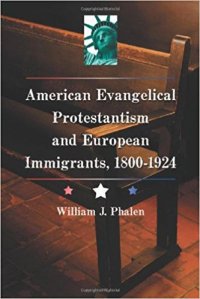
Roughly a week before Trump ‘used rough language‘ to describe his desire to keep certain immigrants out of the country, I found American Evangelical Protestantism and European Immigrants, 1800-1924 sitting on the bookshelf at the Richmond, Ind. Goodwill.

The book relies heavily on historical writings to flesh out the view of Evangelicals concerning which immigrants they did not want coming to America (spoiler alert: Trump was playing to them with his recent Norway/shithole comment).

Public Enemy No. 1: Catholics

During the 1800-1921 era, few groups generated more fear among the Protestant Evangelicals than immigrants from mostly Catholic countries — like Ireland. But, in the Irish, the Evangelicals found a formidable foe. The Irish, because of their dealings with the British in their homelands, were highly interested and highly skilled in politics. A host of battle lines were drawn between the Irish, and the Catholics as a whole, but few generated as much animosity as public schools. Protestants were determined to force all school children to be taught from their Bible and passed laws to forbid the Catholic Bible from being used in schools. Catholics fought back, and in time, largely through the help of the Irish, pushed out the religious intolerance.

They’re All Ungodly Drunks

Even though at its core, the battle over immigration was one of religious preference (and a convenient interpretation of the Founding Father’s belief systems — as if there were one unifying interpretation of religion), but part of this also included what the nativists viewed as moral actions. During this era, the Irish and German, were coming to the country in large numbers to fill the labor shortage. Both groups had a significantly differ view on the consumption of alcohol. The view of evangelicals had shifted from the country’s inception from one that did not view drinking as a sin (only drunkenness) to a view that all consumption of alcohol was evil. This, of course, jarred with the customs of many Irish and German citizens, who not only enjoyed drinking, but were also inclined to do it on the only day they had off – Sunday. The Evangelicals fought back eventually ushering in the Prohibition.

Assimilation, Through Coercion

One of the most interesting aspects of the book, to me, is the fact that (as the author successfully demonstrates), Evangelicals members of the Republican Party, were also believers in free will, except that did not apply to moral choices. The group tirelessly worked to impose their version of morality on the country. They did not shy away from using denigrating language to describe those they considered ‘undesirable.’ Their xenophobia (and at other times racism) is also apparent in the words of many of their leaders. One leader, Josiah Strong, believed Germans were of an ‘inferior stock’ than Anglo-Saxons, and pushed for immigrants to be brought in from ‘acceptable areas’ of Europe.

After reading the book, and seeing how the views of Evangelicals today mirror 19th century views, I do wonder why they never learned to live the words of the Apostle Paul, who said,

“When I became a man, I put away childish things.”

My Rating 4 out of 5 stars. The only reason I ding the book slightly is because it is more scholarly than popular in tone. There are a lot of historical quotes and footnotes, which can may it difficult for the casual reader to read. But, those interested in seeing how deeply-rooted fear is difficult to weed out of a country’s soil, this book supplies ample quotes from 19th and 20th century Evangelical leaders — words that could have just as easily be spoken by Franklin Graham, James Dobson or Jerry Falwell Jr.

Categories: American History, Books I have read, My America

‘Stranger With A Camera’ Explores Filmmaker’s Murder In Kentucky

After reading What You Are Getting Wrong About Appalachia, I walked away with more films to watch and more books to read. My family hails from the outlying regions of Appalachia, and as a family historian, I have always found the culture and region intriguing. It was my ‘other home’ since my family migrated from the region before I was born — and by the age of four, I was living in southwest Ohio.

The film, Stranger With a Camera, explores the murder of renown Canadian filmmaker High OConnor who was killed by a Jeremiah, Kentucky man while he was filming one of the man’s tenants. The documentary is filmed by a member of the Appalshop and resident of the region where the murder took place.

Since the film is short — about one hour (it can be live-streamed here for $3) — I won’t go into the ‘plotline’ but will instead discuss its broader theme. The backdrop for the film is the death of a filmmaker and the man who fired the gun. However, the director is really exploring the concept of who gets to tell a community’s story. The region where the story takes place was visited heavily by government officials and VISTA volunteers in the late 1960s as part of the War on Poverty. The filmmaker looks at how the community — and which parts — became part of the national dialogue. To set the stage she uses various news reels about the region and points out the individuals that she personally knows on the camera.

Those interested in storytelling — or how a community deals with ‘outsiders’ — will find the film enjoyable. Besides filming ‘locals,’ including the man who witnessed the murder, the director interviews crew members and the daughter of the murdered man.

My Rating 5 out of 5. The film successfully captures the ‘heart and soul’ of Jeremiah, Kentucky in a sensitive, yet objective and informative, way.

Categories: American History, Appalachia, movies, My America

My County’s Symbolic Connection To Country’s First Post-Revolutionary Conflict

One of the United States’ first acts of war, The War on Tripoli (1801-1805) is largely unknown. I became interested in it because my hometown, and county, are named after some of the conflict’s key players. It was the country’s first significant win at sea and the founder of Eaton, Ohio — William Bruce — used the patriotic fervor to get a county created.
As noted in the 1915 History of Preble County, Ohio,

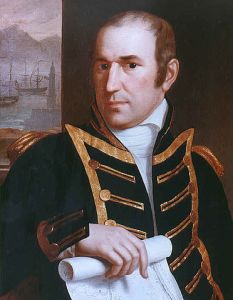
William Bruce proposed a county eighteen by twenty-four miles, which should be called Preble, after Commodore Preble, and that his town should be called Eaton, after Gen. William Eaton, the two great naval and land heroes of the United States war with the pirates of Algiers and Tripoli. He did not forget to call attention to the fact that he had named the principal streets Barron, Somers, Wadsworth and Decatur, after other heroes of that war. In this way, Mr. Bruce succeeded in getting at least an interested hearing (from those opposed to the county’s creation)…

The War on Tripoli (modern day Libya)

Jefferson and the Tripoli Pirates: The Forgotten War That Changed American History by Brian Kilmeade and Don Yaeger is a short, but lively, account of the conflict. Besides the key players mentioned above, the story weaves in the actions of president Thomas Jefferson, Secretary of State Thomas Madison and vice-president John Adams.

The conflict arose as U.S. ships attempted to sail in the Mediterean area. As they reach the Middle East (Benghazi was a problem even then) they were only permitted free passage if they paid a tribute. The fledging country could not afford the ‘fee’ so eventually U.S. ships, and the sailors, were captured and held prisoner.

Six navy ships have been named after Commodore Edward Preble. The most recent in 2002.

What unfolds next is a series of negotiating attempts, but they ultimately fail, so Preble, Eaton and Stephen Decatur engage in various acts of war to subdue the enemy. One of the most fierce battles involves Decatur who, to avoid detection, boarded a ship with his men armed only with knives and swords. They were able to surprise the enemy and keep the noise of gunfire to a minimum.

Preble was also successful in destroying a captured U.S. ship so the enemy could not use it in acts of war against the United States.

Was It A Holy War?

The only downside to the work is the attempt by the authors to frame the conflict as a holy war of Christianity versus Islam — an easily disputed position. A couple examples of this can be seen where the authors state that Jefferson regulated the Koran to his bookshelf filled with Greek mythology. Although the statement is undoubtedly true, the Bible would be on the same shelf — a fact omitted by the authors. Jefferson rewrote the Bible and did not believe Jesus was the son of God. He also said the miracles in the Bible belonged on the ‘dunghill.’

Another example of the ‘holy war’ bias can be seen in the terminology used to described the Muslims — pirates. However, when referring to Preble’s earlier career as a pirate the authors use the term privateer. Pirating was a widespread form of war, and business, in the pre- and post-colonial years, as anyone who has spent any time along the U.S. coastline knows.

My Rating 4 out of 5. Even with the pro-Christianity revisionism, the book does an excellent job of telling the story of a relatively small handful of men, who overcame significant odds, to uphold their country’s honor while giving the nation its much-needed freedom of the seas.

Categories: American History, My America, Preble County