
Books I have read

‘Trespassing Across America’ Details Hiker’s Quest For Answers

51BKbdirvkL__SX329_BO1,204,203,200_The Keystone Pipeline introduced me to American politics. It came along at a time when I was becoming more aware of the disconnect between the GOP pro-business stance and what it was doing to small towns in America like mine. It was when I first began seriously researching what Ohio’s 8th Congressional District possessed — with regards to affluence and jobs — compared to what was promised by the ‘if we support business all will be well’ maxim.

My former Congressman John Boehner was an ardent supporter of the Keystone XL Pipeline project, which truly and honestly baffled me. The project offered nothing for his constituents, and overall offered very little for the state and country as far as long-term jobs. It felt as if he was doing a favor for a sponsor instead of looking out for the interests of the people who voted him into office.

So my interest was piqued when I came across the story of a man who hike the pipeline for environmental reasons. I knew the oil was ‘dirty’ and consumed a lot of energy to process, but what I did not know was which regions of the country were impacted by the project.

Author Ken Ilgunas sheds considerable light on the people and areas impacted by the proposed project — which was vetoed by President Barack Obama in 2015. But with a new president heading into office next year, that is no guarantee that the deal is done.

Hiking The Pipeline

Trespassing Across America: One Man’s Epic Never-Done-Before (And Sort Of) Illegal Hike Across The Heartland by Ken Ilgunas is a travel-based memoir and an engaging look at America’s heartland. The book opens with Ilgunas. a North Carolina native, hatching a plan with a co-worker in Deadhorse, Alaska to hike the Keystone XL pipeline. The opening provides aglimpse of what life is like in an oil-rigging town where all the ‘good jobs’ exists. He expands on it by looking reporting on one of Canada’s largest oil towns, Fort McMurray, Alberta — a town located near the Keystone Pipeline’s starting point.

Drawbacks on the Highway to Hell

The road to Fort McMurray is called the Highway to Hell by locals, he reports. The 150-mile stretch of road, officially known as Highway 63, is also one of the deadliest roads in Canada.

In 2004, the Royal Mounted police gave out 18,000 tickets on juts one stretch of highway, the average ticketed speed being 100 miles per hour. Between 2002 and 2010, there were 66 deaths, and between 2001 and 2005, there were more than 1000 collisisons and 250 injuries.

Much of this is attributed to oil-town workers who — off only a couple days per month — speed home to reconnect with family before returning to their 12-hour shifts and 12-day stretches of work. According to one worker, who gave the author a ride to Fort McMurray, alcoholism, drug addiction, gambling and prostitutions wiles away much of the workers’ time and money during the off hours — giving the town an 1800s coal mine town feel.

Heading South

The author’s goal is to follow the pipeline form Canada to Texas by hiking directly above it. This means he will be trespassing. However, as the story unfolds, he does not trespass the entire 1900-mile trek. The fear of being shot prompts him to stay on public grounds for significant portions of the journey.

But the real story is not so much about the pipeline and the hike — it is about the people he meets along the way. Many are die-hard, anti-environmentalists, who view him with open suspicion. This becomes especially true when he enters Kansas and Oklahoma, where he is repeatedly stopped and questioned by police officers. In one small town he is even investigated for two home break-ins.

Rigid Thinking

As Ilgunas describes ghost town after ghost town, it also becomes apparent that America the Great has fallen into disrepair — whether through neglect or exploitation — and people along the path of the pipeline often allow the pipeline on their land due to economic need. But in many cases, too, he is running into people opposed to government intervention and people who dislike everything — especially Obama and the EPA. What is often lacking in the individuals he describes, though, is a willingness to discuss an issue. When he asks one man why policy of Obama he disagrees with — the man replies ” all of them.” Ilgunas, discussing this mindset, writes,

They weren’t free-thinking men, but stone tablets onto which dogma had etched its wicked creed.

In another part of the book, he reintegrates this reoccurring theme. For the most part, Ilgunas admits he was treated kindly, but his walk revealed an unstable and uneasy undercurrent in America — a segment of our population driven, not by pride or patriotism, but by fear.

I’d been ID’d nearly every day of my walk through Kansas. I was approached by paranoid Montana men and kicked out of Boone County, Nebraska. If it’s this hard for me  — a Caucasian walking thorough homogenous Caucasian country — what would it be like if I were black, or gay, or Korean, or Muslim, or woman, or all of the above?

In the end, the book is about more than the pipeline. It is about who we have become.

Rated: 4 out of 5 stars. As with most memoir-styled books, the title only hints at what the book addresses. Even a 1900-mile trek can become uneventful on the printed page. So Ilgunas intersperses his travels with stats, ancedotes and personal musings that move the story forward. It’s only weakness, is a couple of passages where the story lags a little. Overall, though, the book is an easy read and it offers a nice slice of American life while highlighting what our dependency on oil has done to our society. This is Ilgunas’ second book. He also wrote Walden on Wheels.

Categories: Books I have read

‘Inventing A Christian Nation’ Tackles Narrative Of Religious Founding

christian-americaAs an amateur student of American history, my reading and research has upended three previously held beliefs.

These are, in no particular order, the belief in upward social mobility, the belief we are a society without a class structure, and the belief we were founded as a Christian nation. A book I recently read, White Trash: The 400-Year Untold History of Class in America, addresses the first two. Author Nancy Isenberg dismantles the myths about class and mobility in a fairly straightforward — and at times a very direct — manner.

The approach of author Steven K. Green in Inventing A Christian America: The Myth of the Religious Founding, feels a little more lowkey. Like White Trash, Green’s book is very detailed and highly readable although some may find Christian America controversial since Green does not believe the country was founded as a Christian nation.

But, for the most part, Green takes a very non-confrontational approach as he slowly and methodically disassembles the Christian Nation Narrative. (Note: This book is not dealing with whether the population was or was not mostly Christian, but rather if the Declaration of Independence, the Constitution and other founding documents were written in a way to create a government built on Christian principles.)

Diverse Beginning

By reading other historians, like David Hackett Fischer and Colin Woodard, I had already come to the conclusion that the country’s founding was significantly more complicated than the simple narrative I had learned about the Pilgrims. In Albion’s Seed, Fischer highlights the differences in the four British American colonies. Woodward’s American Nations builds on this idea by looking at the 11 nations that eventually became the United States.

In Christian America, Green opens by developing a backdrop of the country’s early years. He dips into the writings, laws, practices and religious beliefs of that time period. By unwinding how the Christian Nation Narrative began, Green gives the reader a stronger understanding of just how complicated — and diverse — society was in the years leading up to 1776 and beyond.

And his approach is fair.

Dissecting The Arguments

Green does not shy away from the various Christian influences in early American history — like early Supreme Court rulings or the decision of Congress to hire a chaplain to open sessions with prayer. Nor does Green bypass the only religious reference in the Constitution — the clause prohibiting religious tests for office (i.e. I believe Jesus is the Son of God).

He fearlessly broaches both sides of the argument, painting a detailed picture of the thought-process and precedents behind the Constitution, the Declaration of Independence and other founding documents. He does not cherry-pick statements, quotes or arguments to prove his position. Instead he lays it all out — both sides of the argument — while explaining why and how he arrived at his conclusion. He most certainly does not come across as anti-Christian. He comes across as an historian on a quest to understand how and when the Christian Nation narrative began.

In some ways, the book reminds me of a well-crafted Sherlock Holmes story, because Green embraces a wide body of evidence, and then he whittles it down to his well-defended, and well-thought out position. Reading the book, I felt a like bit like Watson, wondering why I had not made the connections before reading the book (in my defense, though, I am not as knowledgeable on all of the early historical documents as Green is).

When The Myth Began

In Green’s estimation, the Christian Nation myth started during the 1830s when the young nation, undergoing a spiritual renewal and a generation removed from the Founders, was seeking to understand why its republic and revolution succeeded when France’s did not. This prompted many writers, historians and clergymen to simplify the story of the country’s beginning. It also led to a desire of these writers to link God’s Guiding Hand to the Founding — largely in an effort to broaden the philosophical and political divide between the revolutions of the United States and France.

Both revolutions were based on Enlightenment ideas, but the French revolution led to the persecution, and massacre, of Christians and culminated in the eventual dictatorship of Napoleon. In contrast, the American revolution led to religious freedom (at least for Protestant Christians) and a (mostly) democratically-elected republic form of government.

So, to explain the divergent paths the revolutions took, writers in the 1830s deified the Founding Fathers while dismissing their Enlightenment beliefs. The words and works of the Founding Fathers were minimized as new stories — like the famous myth of George Washington cutting down a cherry tree — were invented to elevate the men into the role of conduits of God’s will.

Imposing Modern Beliefs on History

As Green points out, when the Christian Nation Narrative was created, the religious inklings of the population had shifted. The Second Great Awakening introduced a new strain of Christianity — evangelical Protestant — with a heavy emphasis on being born again and personal revelation. Being born again, though, would have been a foreign idea to the Founding Fathers, including many of the Christian Founders. As a whole, these men did not believe in revelations of a personal nature. Unlike some modern fundamentalist, the Founders easily combined science, rationalism and natural law with the spiritual teachings of Jesus.

In many cases, Founders (even Christian ones) chose reason and science over miracles. Some of the Founding Fathers Founders saw no moral conflict in dismissing biblical miracles despite being a Christian. (The concept of the inerrant Word of God evolved after most of the Founding Fathers had died. It was not until the late 1800s that it became, for many, an issue of faith. During the late 1800s, the belief of inerrancy was strongly, and famously, defended by Benjamin Warfield and Charles Briggs.)

When the Constitution was ratified, many political leaders — including the Founding Fathers — were criticized for the creation of a non-religious Constitution that omitted the role Jesus/God had played in the country’s creation. Clergy and newspaper editors reviled the politicians for their ‘reckless’ behavior.

Rating: 5 out of 5 stars

If you are interested in learning more about whether the country was founded as a Christian nation — and can open your mind to the evolution of laws in society, it can be an enlightening book. The book is technical at times, dealing with concepts like higher law, natural law, covenants and compacts, but Green explains them in laymen terms.

The book is filled with plenty of examples, anecdotes, footnotes and familiar figures to give the reader an appreciation for our country’s complicated beginning — a beginning that is significantly more interesting than the Christian Nation myth.

Categories: American History, Books I have read, Religion | Tags: , ,

3 Great Reads About Science, Hiking and Politics

walkthroughtimeAlthough you can review my reading list to get a feel for what subjects I am interested in, here are three excellent reads I’ve recently finished:

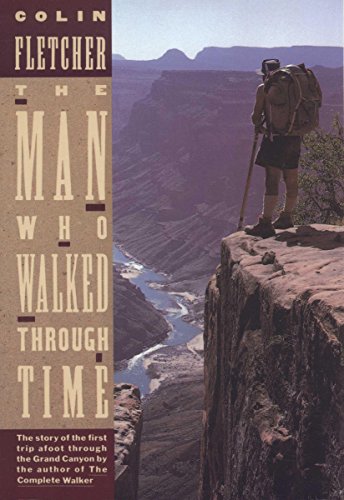
The Man Who Walked Through Time: The Story of the First Trip Afoot Through the Grand Canyon by Colin Fletcher

Written in 1967 and re-released in 1987, The Man Who Walked Through Time is about the last (and possibly only) person to walk through the entire expanse of the Grand Canyon. The book is more than a travel memoir of Fletcher’s journey, it is also a reflection on the concept of time and the interconnectedness of all living things. Fletcher describes everything from the rock colors, beaver dams to a small gnat-like creature fighting with its peer to protect a small parcel of land. Very interesting read.

Grade: B+

Science of the Magical: From the Holy Grail to Love Potions to Superpowers by Matt Kaplan

This is the second book I read while on vacation, Fletcher’s was the first. In this book, Kaplan takes a look at various common and not-so-common myths from early civilizations and puts them through the scientific process to see if there is an element of truth behind the myth. What he uncovers is, in some cases, there is.  Even though the early civilization may not have understood the why behind their action, they were often correct on the what. The science Kaplan reveals is intriguing and entertaining.

Grade: B+

Dark Money: The Hidden History of the Billionaires Behind the Rise of the Radical Right by Jane Mayer

If, like me, you are interested in how America’s political right became so unwilling to compromise, Dark Money offers some insight. Most of us, I presume, have accepted the reality that money influences our elections, but what Mayer does is painstakingly unravel the electronic money trail of donations largely hidden from public scrutiny. The book focuses on the Koch brothers and how their billions is pushing an agenda on an unsuspecting public.

Grade: A

How Long Are The Books?

The first book is a fairly short while Dark Money is long. The second book falls somewhere in between. Fletcher’s book is an excellent candidate for a weekend read.

Categories: Books I have read