I’ve always liked reading what Former Labor Secretary Robert Reich has to say about the economy. He is down to earth, practical and believes, quite simply, that people who work for a living — the Middle Class — has been getting the raw end of the deal for decades. In this 2013 documentary, he proves his point, by examining the data and explaining the government policies that created the stagnant wages workers have labored under since the early 1970s.
Family History
Family History: Bennie Lewis’ Locker Sheds Light On What Was Important To Him
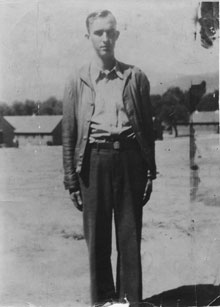
Bennie Lewis, a younger brother of my paternal grandmother. He died at the age of 25 in a logging accident.
I have previously posted about Bennie Lewis, my paternal grandmother’s brother, and wrote about how his life was tragically cut short while working in a Civilian Conservation Camp in Idaho. The post includes the letter Bennie wrote his mother one week before his death.
But to learn more about Bennie’s accident, I contacted the National Archives Records Administration in St. Louis and purchased a copy of his file. Contents of the file offer additional information about the accident because it contains the eyewitness accounts.
Bennie’s main duty in the camp at the time of his death was Kitchen Police — or KP duty as it’s often called, but he was also a truck driver. On the Friday when Bennie died, he was working with two other men, felling trees. They had been asked by their supervisor to cut dry lumber into four to eight foot sections — load the lumber into a truck and haul it back to the main camp a couple miles away.
The three men sawed in pairs. That is, two men would saw while the third man would mark the trees — rotating the roles so no one was stuck with only sawing. At the time of the accident — around 2:50 that Friday afternoon — it was Bennie’s turn to mark the trees. A witnesses who was sitting about 200 feet away — taking a break and talking with some other members of the camp — describes what he saw.
“…I happened to look up where the boys were cutting the last tree and just then the tree fell on Bennie. After it fell I could not move for about half a minute and then I ran up to see if I could do anything about it.”
Another witness reported hearing a man yell ‘look out’ as he saw the dead tree falling. The men sawing the tree were able to jump back out of the way, Bennie, unfortunately, was not.
In the follow-up reports that were filed after his death, the tree that killed Bennie was described as a dead 8-inch diameter Red Fir — about 40 foot long that uprooted as it fell.
Bennie’s Foot Locker:
In less than two hours of his death, all of Bennie’s personal effects were locked up and inventoried so the items could be sent to his family. This is what was found in his foot locker:
- 1 box of old letters
- 1 box containing two horned toads
- 1 box containing souvenirs and a New Testament
- A baseball cap
- 1 suit of blue clothes — 3 pieces
- 1 blue dress shirt with a neck tie
- 1 pair of black oxfords
- 1 briar pipe
Bennie, who had only been with the program about eight months when he died, received high marks for his work ethic and personality while in the CCC — being described by his supervisor in an earlier evaluation as ‘courteous and willing to work.’

Gravestone for Bennie Lewis, located in Cumberland County, Ky.
Red Tape
After Bennie death, his parents were awarded a monthly settlement of $8.40 to be paid for a period of eight years — or just a little over $800. For those who believe excessive red tape is a modern invention of the government — apparently not. In order to receive the monthly payment (which was actually sent in a bi-monthly $4.20 check), his parents were required to resubmit the claim four times a year (on the first day of January, April, July and October) and the claim had to be ‘acknowledged’ before the local postmaster and then forwarded to the Commission.
My Family Tree
Bennie was the second member of his family to die at a young age. When Bennie was around 12 or 13, his youngest brother, Earl, died about a week after his 10th birthday.
Children of Granville Hunter Lewis (1877-1962) and Delila Florence Surratt (1875-1948)
- Martin M. Lewis (1897 – 1974)
- Fannie Lola Lewis Cash (1900 – 1993)
- Mary D. Lewis Claywell (1903 – 1993) — my grandmother
- Claude L. Lewis (1905 – 1991)
- Clyde Lewis (1907 – 2003)
- James Logan Lewis (1909 – 1980)
- Bennie P. Lewis (1910 – 1935)
- Earl Lewis (1913 – 1923)
Categories: Cumberland Plateau, Family History
Larry Doby: The Second Player Across Baseball’s Color Line
Here is an interesting entry from theolballgame about MLB’s second player to cross the color line in the 1940s.

By Michael LeCompte
A sometimes unfortunate aspect of history is that the second person to do something is often forgotten. Eleven weeks after Jackie Robinson broke the color barrier in Major League baseball, Larry Doby joined the Cleveland Indians.
Although largely overlooked in 1947 as the national media followed the trials and feats of Robinson with the Dodgers in the National League, Doby was the first black player in the American League.
Larry Doby was born in Camden, South Carolina in 1923 and grew up in New Jersey. Like Robinson, Doby was also a three sport star in high school. According to teammates and coaches he had professional level talent in football and baseball.
However, Doby initially harbored professional aspirations of a different kind. Hoping to follow the example of an influential high school coach, he planned to go to college, with the ultimate goal of becoming a P.E. teacher.
View original post 306 more words
Categories: Family History
 Blue In The Red Zone
- Tea Party Speaker Touts ‘Schools Are Liberal And Evil’ Message In My Conservative, Rural Town
- ‘Appalachia’ By Catte Is A Perfect Antidote For ‘Hillbilly Elegy’
- ‘Evicted’ Describes What It’s Like To Be Poor, Vulnerable
- Heroin(e) Tells Story Of Three Outliers Making A Difference In Opioid Epidemic
- ‘Get A Job’ A Familiar Phrase Of The Politically Lazy
- So A Drop In Farm Land Values Nets 14 Percent Increase In My Property Tax Bill?
- ‘Godfather Of Modern Popular Gay Fiction’ Graduated From My Local, Rural High School
- America’s Political Dysfunction Called A Security Concern
- Is Ohio A Cesspool Of Hate, Fear And Ignorance?
- Posting, Sharing Facebook Memes Not Solving Any Problems
Old Newspapers
- Chronicling America: Historic American Newspapers: How to Facet Search Results
- Chronicling America: Historic American Newspapers: How to do a Proximity Search in Chronicling America
- News from the Library of Congress
- Chronicling America: Historic American Newspapers: How Do I Search Chronicling America?
- Chronicling America: Historic American Newspapers: Chronicling America Migration Announcement
- Chronicling America: Historic American Newspapers: Join the Library of Congress for Summer 2024--Junior Fellow
- Chronicling America: Historic American Newspapers: Recording Available--Chronicling America “Turning Points in History”
- Chronicling America: Historic American Newspapers: Announcing Webinar September 20, 2023, 4pm ET--Can Historical Newspapers be an Antidote to the Environmental Crisis?
- Chronicling America: Historic American Newspapers: Announcing Webinar--Chronicling America: "Turning Points in History"
- Chronicling America: Historic American Newspapers: Webinar Recording Now Available--Using Chronicling America for Historical Research
Top Posts & Pages


National Archives
- An error has occurred; the feed is probably down. Try again later.

 Charlie R. Claywell