
My America

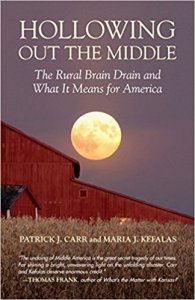
‘Hollowing Out The Middle’ A Vivid Description Of My Hometown

“It is dangerous and misguided to fund and operate rural high schools with the primary goal of getting the academically oriented student to college and assuming that the non-college bound will somehow get a job on their own.” — Hollowing Out the Middle: The Rural Brain Drain and What It Means for America

“…thank goodness for us Walmart came to town when the economy was down and sales tax (revenue) continues on the rise,” Preble County Commissioner during the recent State of the County address.

In Preble County, 50 percent of the county’s revenue comes from sales tax, another 22 percent comes from property tax, the commissioners recently told those in attendance for the annual State of the County address. This was apparently presented without cause for alarm even though economists have argued for years that both taxes unfairly target the poor and underemployed.

It is these antiquated beliefs that Hollowing Out the Middle: The Rural Brain Drain and What It Means for America by Patrick J. Carr and  Maria J. Kefalas explores. Published in 2009, the book is the result of a married couple moving to a small Iowa rural community and interviewing 100s of residents as they sought to understand the demise of the Heartland’s dying small towns.
Four Types Of Students

Even though the book is a ‘scholarly study’ it’s an enjoyable read because of the way the authors tell the story. They do this by segmenting the story into the following types of students at the local high school: Achievers, Stayers, Seekers and Returners. They conclude the book with a “What can be done to save small towns’ section.

As I read the book, their types rang true locally, in large part, because of my daughter’s recent high school graduation. So my memories are fresh concerning her experience. One problem small towns have created for themselves is their approach to education, which like the quote above points out, is bias.

In Eaton, just like in the Iowa study, there is an effort to educate the ‘best and brightest’ along a career path which includes college with an understanding that these students will leave the region — contributing to our brain drain. Conversely, there is also a drive to let those who remain in the community fend for themselves.

A Stayer in the book talks about his high school experience — one too typical in rural communities. According to the man, a teacher advised him to quit — and he did. Years later he reflected on that moment and said that his mother,

“didn’t try to keep me in school, and my dad was kind of a bit [concerned], but he didn’t really say much. I mean, nobody really tried very hard to keep me in school…”

This can leave a region, like Preble County, with an under-educated workforce, one that easier to manipulate, and cheaper to employ, but a workforce that also makes it difficult to attract higher-skilled positions to the region.

Besides the four student types heavily detailed in the book, the authors also look at disturbing trends that exist in rural areas. Here are a few:

  • A disproportional amount of military personnel are culled from rural regions. As the study points out, though, this is not due to a abnormally high level of patriotism, but rather many join the military based on economic need.
  • Drug use is rampant in rural towns as drug cartels target them as easy markets.
  • The lack of in-migration has intellectually and economically hampered rural regions.
  • Low educational levels have reduced the ability of the regions to attract the creative class, and with it, higher-skilled and higher-paying jobs.

The book, which highlights the mindsets destroying small towns, is a strong indictment against the status quo. It ends with a very compelling quote,

Why let small-town America die when, with a plan and a vision, it could be reborn and once again vital?

Rating 5 out of 5. The book offers plenty of ‘food for thought’ for individuals wishing to understand why small towns are dying. For community leaders wishing to reverse the trend, the book offers suggestions for revitalizing the towns.


Afterthought

Ohio has been one of the hardest hit states post-Great Recession, and locally our over-reliance on sales tax revenue is tenuous at best since it puts our destiny in the control of a state economy. But, one of the most interesting aspects, for me, concerning the State of the County address was learning the county has about $26 million (roughly two-year’s worth of expenditures) in reserves. This buildup occurred during the national economy recovery which began under Obama in 2010.

A wise investment, of 5-10 percent of that fund, would be to invest it in the people of Preble County. Instead, our board of commissioners tends to let the state dictate what projects we pursue. A recent example of this is the ‘no-brainer’ decision to build a $1.3 million structure on the county’s fairgrounds. Like extreme couponers who cannot resist hording ‘free’ toilet paper and toothpaste, the commissioners could not resist the ‘free’ $400,000 (an Ohio grant) that will cost us of $900,000 (to finish the building). The building benefits a minority of the county’s citizens and Preble County has significantly more pressing needs.

Categories: 8th congressional district, Books I have read, My America

‘Beautiful Boy’ Chronicles Teen’s Descent Into Meth Addiction

Two of the selling points for living in a small, rural town, is less crime and less drug use. Life is often portrayed, especially in farming communities like mine, as more natural — even holy. But, the myth has been destroyed in recent years as news spread about the opioid epidemic ravishing small towns.

But, before heroin, we were dealing with meth.

Meth (and heroin) tends to be more devastating in towns like mine because of limited mental health services, fewer economic opportunities and our entrenched reactive belief system. And, although how we got here has been heavily documented, how we escape has fallen prey to lazy thinking and a naïve belief that if ‘they just say no,’ the problem will solve itself.

This approach minimizes human frailty and dismisses the long-term impact that childhood decisions and upbringing have on drug use. It fails to address the myriad reasons people relapse.

Meth has made a resurgence in Preble County, and in an Eaton police report, one local resident, who was arrested after police say they found meth in his vehicle, gives one indication of why we are dealing with it again. Some of the chemically-addicted are no longer able to handle ‘normal’ life stressors. The suspect named in the report said he began using meth again ‘to help him handle his long work hours.’ This is one of the tragedies of the small-town, arrest-our-way-out of the drug dilemma approach  — it seeks out the arrest (since arrest ‘prove’ we are doing something) instead of what is best for the community (treatment for individuals trying to work and overcome addiction).

One thing is certain about meth — it is highly addicted, and once entrenched in a community — it is very difficult to eradicate.

Books, like Beautiful Boy: A Father’s Journey Through His Son’s Addiction by David Sheff, help explain why.

Painful Memoir

Like all parents, Sheff wants a great life for his son, instead though by his early 20s, the boy (Nic) is a hardcore meth user. The book offers a peak into the devastation that the boy’s addiction has on his parents and siblings. Since the story is told through the eyes of the father, readers get a better feel for the rollercoaster ride of hope and despair a family member endures when dealing with an addict.
Since it is a father’s story, after an opening hook of a college kid gone bad scene, Sheff quickly details his son’s childhood in the opening chapters. Included in this fairly quick sketch is the typical childhood — sports, events and outings. It is marred early on by his parents’ divorce, and the resulting long-distance parental sharing arrangement imposed by the court, but all-in-all his childhood feels very typical.

However, like many kids in the modern era (this was published in 2009), Nic was exposed to drugs at a young age. His first introduction into drugs are cigarettes, marijuana and alcohol — all before the eighth grade. What makes this more intriguing though is the author explains how he was gullible enough to believe it would not happen to his child. And, as the father learns he was too trusting. He relays an event to prove this — at a sleepover, when he thought his son and son’s friend had the flu — he later learned they were sick from being drunk.

This is one of the strengths of the book. It presents, in what feels like real time, the slow revelation of Nic’s illicit drug use, as the author realizes he’s failing to protect his son.

Understanding Addiction

Peppered throughout the book are significant sections about the drug itself. This is a testament to the father’s desire to understand why his son cannot shake the habit. Readers will walk away with a new appreciation for just how devastating the drug is to the brain — and how the drug destroys it to the point of creating a never-ending trap for users. This is one reason long-term rehab sessions are often required for meth addicts.

But, the father is not without fault –nor does he pretend to be. He openly admits to smoking marijuana with Nic when the boy was 17. Although, the father is empathetic — and open to some drug use — by the end of the book, he, like many others, reaches a point where he is no longer willing to solve Nic’s addiction.

Throughout this journey, the author does not hide his anger, fear, hate, and overwhelming love for his son. In the end, through all the drug-related disappearances and relapses, the father finally realizes he’s not the solution.

Nic must find his own way out.

Rating: 4.5 out of 5. The book effectively captures the emotional rollercoaster ride family members of addicts face. Many of us in Preble County have faced this. The book is filled with all the expected approaches to solving addiction: AA meetings, rehab, medication and therapy. But, mostly, the book is a story of hope.


Afterthought

Why Does Meth Appeal To Rural Counties?

This article from 2001 about Preble County gives three clues: inexpensive high, availability of raw materials, and the ability to turn a large profit from small investment. Our isolation also helps. Those wishing to learn more about the meth problem in rural towns can read Methland.

Categories: 8th congressional district, Books I have read, drug addiction, drug use, My America, Preble County

How To Build A Drug Town: Step 1 — Target The User, Ignore The Trafficker

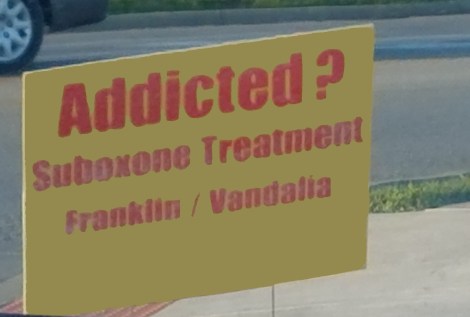
Company, from nearby county, offering heroin addiction treatment for Preble County residents.

“Boredom and a sense of uselessness and inadequacy—these are human failings that lead you to just want to withdraw. On heroin, you curl up in a corner and blank out the world. It’s an extremely seductive drug for dead-end towns, because it makes the world’s problems go away. Much more so than coke or meth, where you want to run around and do things—you get aggressive, razzed and jazzed.” — Judith Feinberg, West Virginia professor who studies drug addiction, as quoted in the The New Yorker.

In 2016, 18 Preble County residents died of accidental drug overdose. In 2017, there were 25.

One who did not die was a 40-year-old male who overdosed last Spring in a downtown Eaton, Ohio residence. When officers and paramedics arrived another male, presumably a fellow user, was administering CPR. In our local War on Drugs, the chemically-addicted have learned that CPR may be their best hope of survival — as they save each other from accidental death.

The victim was revived with Narcan, transported to a local hospital, and arrested for possession of a drug abuse instrument. The man’s next interaction with the police came two weeks later when, according to the police report, he was again arrested for possession of a drug abuse instrument. The incident began when an officer ‘on regular patrol of (same address where overdose occurred)’, noticed the man ‘skipping from under the carport into the alley and onto the roadway,’ at a ‘known drug house.’

This led to a pat-down, and the alleged discovery of a needle in the man’s pocket.

This individual would be arrested seven more times over eight months (nine arrests in nine months) — all for possession of a drug abuse instrument. Since the defendant’s address is listed as ‘at large’ he is presumably homeless.

And, now he owes ‘the system’ about $2,000.

Creating A Market

In today’s newspaper, a press release from the Preble County Prosecuting Attorney’s Office hints at the county’s role in the War on Drugs. Although, our role is a little overhyped in the release, the county played a part in a federal case that links a Mexican Drug Cartel to Middletown, Ohio. (You can read press release here). In the federal case, the Ohio State Highway Patrol Drug Interdiction team, which has been patrolling Interstate 70 inside Preble County for decades, arrested two of the indicted individuals.

A more realistic look at the traffickers we arrest can be seen in this story — where the traffickers feel more like drug users assisting other users.

Nonetheless, we definitely have a thriving drug culture inside Preble County. As I read and research newspaper clippings, police and court reports, I agree with the opinion of an individual associated with the Preble County court system, who recently said: We are in our third generation of drug abuse.

That, of course, begs the question: If we are three generations deep, why are we still arresting users, and not traffickers, and a follow-up question: Why are we not treating addiction like the mental health issue it is?

Ostracizing The User

One of the main reason we keep engaging in a decades-old approach is our iron-clad adherence to individualism. In a nutshell, this value system puts all the blame, and solutions, on the individual  — eradicating any complicity caused by systemic failure. In 2018, we know a lot more about drug addiction than we did in 1968 when Preble County first began dealing with illicit drugs. Yet, we have not significantly altered how we address this societal problem that played a role in economically gutting our community.

In a Ted Talk, Johann Hari explains what other country’s have done to successfully combat drug abuse — and one of the most successful concepts is embracing methods that help the chemically-addicted reestablish connections with their community.

Reestablishing the connection is a two-way street. The chemically-addicted have to do their work to stay clean, but the community has to do its work as well, which begins with recognizing drug addiction is a disease, and not a choice. In Preble County, we are not there yet, and it shows by the arrest records, the court records and the jail roster as we continue to criminalize a mental health issue. And, as we sink deeper into the abyss, we perpetuate the problem by dehumanizing the chemically-addicted. This makes it easier to engage in practices that offer short-term relief (jailing them) while creating long-term problems (creating a subculture that cannot be integrated into the community — road-blocking them from a productive life).

How It Has Shifted

Beginning in the mid-to-late 1970s, Preble County adopted the arrest the user approach to combat our growing drug problem. This became more pronounced as the drugs became more addictive. Part of this is, undoubtedly, an issue of pragmatism. It is infinitely easier to arrest a user than upend a business engaged in trafficking. It is significantly safer, too. By and large, when you read the arrest records of known users, there is no violence.

This approach has led to processing an escalating number of mental health care patients through the court system — which is not equipped to effectively resolve the problem (we have no drug court). Regardless which year you choose from 2009-2017, there is a disproportional number of user cases compared to trafficker cases. And, the ‘big traffickers’ that are caught in Preble County tend to be the ones passing through (like in the federal case mentioned above).

But, to examine a couple of years, here’s how the ratio plays out:

2009: Total cases – 207

  • Possession cases: 30
  • Trafficking cases (which includes manufacturing, trafficking, sale and cultivation cases): 21

2012: Total cases – 302

  • Possession cases: 62
  • Trafficking cases (which includes manufacturing, trafficking, sale and cultivation cases): 29

2015: Total cases – 215

  • Possession cases: 62
  • Trafficking cases (which includes manufacturing, trafficking, sale and cultivation cases): 20

2017: Total cases – 319

  • Possession cases: 146
  • Trafficking cases (which includes manufacturing, trafficking, sale and cultivation cases): 7

Records also indicate a significant rise in aggravated drug possession charges in the past couple of years.

There Is A Better Way

Not all communities are addressing the War on Drugs in the same manner. Police in a New England town of 16,000 have abandoned the user-arrest approach choosing instead to add a prevention, enforcement and treatment coordinator to their staff. The officer, a 20+ year veteran in the War on Drugs and former prison guard, came to the realization that the arrest them/jail them approach was not working. The New York Times reports on his transformation.

Those years spent guarding prisoners, and later kicking down doors, changed (Eric) Adams’s thinking. So many of the drug users he saw had made one bad decision and then became chained to it, Adams realized. Or they had begun on a valid prescription for pain medication, after an injury, and then grew addicted…. Arresting a person like this did no good, because there was always another to replace him or her — and regardless, any jail sentence had limits. Afterward, Adams saw, everyone landed right back where they started.

As Adams brainstormed ways to solve the dilemma, he realized there were three approaches to the drug problem: prevention, enforcement and treatment. He began seeing the chemically addicted beyond the lens of criminal to include their other identities  — as customers being targeted — and as victims needing treatment.

Now, when an individual overdoses in his New Hampshire town they can expect a much different approach. If the OD victim agrees to treatment, Adams will drive them to a rehab facility, and it does not end there. He keeps in touch with them — even if they relapse.

And, just as importantly, no accidental OD deaths have occurred since the program began.

Categories: 8th congressional district, How To Build A Drug Town, Life In A Red State, My America, Preble County