
Politics

Does GOP Presidential Candidate’s Porn Star Gaffe Hint At A Hidden Truth?

As the old saying goes, you just can’t make this stuff up.

With the race to the presidential primaries heading into the final lap, two GOP stars — intent on undermining each other — fumbled this week. The first was Marco Rubio. This rising GOP star, who does not have time to be bothered with his duly-elected day job, has spent years modeling the skills of the greatest GOP president, Ronald Reagan. Reagan knew the key to electability in the TV age is being able to read off a teleprompter skillfully, empathically and with conviction.

Rubio, though, has removed the need for the teleprompter.

But, in the recent GOP debate, his repetitive responses prompted Twitter users to conclude that maybe the robot glitched and needed to be repaired.

It’s not the first time the ‘I want to be president’ candidate has struggled with looking presidential on camera. But in Saturday’s debate, Rubio repeated lines so many times that GOP comrade, New Jersey Gov. Chris Christie, openly mocked the presidential contender.

More Than A Pretty Face

Not to be outdone by his nemesis, perennial outsider and Canadian-born Ted Cruz, bested Rubio for Gaffe of the Week.

Since Cruz’ team felt it was time to get the negative ads flowing more steadily, they launched a short online clip to undermine Rubio. Unfortunately for Cruz, his staff did not vet the actress who delivers the ad’s punchline.

The clip takes place in a fictional support group for voters dealing with an unnamed politician’s lies (Marco Rubio). One poor sap tell the support group that he voted for a Tea Party leader only to have that politician broker a deal in D.C. after being elected. The camera then zeroes in on a female member (Amy Lindsay) who sympathetically advises the man,

Maybe you should vote for more than just a pretty face next time.

Is Everyone Watching?

The clip, designed to exploit the belief that everyone is politics is a liar (except Cruz, of course), inadvertently gave a thumps-up to porn. This proved somewhat problematic for Cruz, who espouses Christian beliefs, so he pulled down the ad. As far as the actress, she originally stated that Cruz’ campaign team knew of her film history, but later recanted.

I have clearly talked to the filmmakers and stuff and just to be clear, I assumed that they knew but none of the filmmakers or the casting director knew about my complete filmography in the past that you’re talking about, so I was wrong in that statement, she was quoted as saying.

But the real mistake for Cruz may have been in not using a better-known adult film star.

Although many of Cruz’s followers vocally oppose the industry, the $10 billion porn industry has a significant numbers of viewers in conservative pockets of the country. In fact, online searches for porn in GOP-leaning states consistently outpace the number of searches in non-conservative areas.
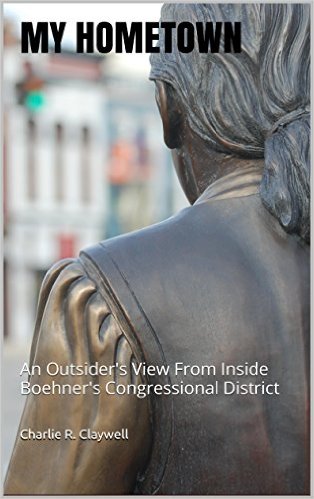

my-hometownMy Hometown: An Outsider’s View From Inside Boehner’s Congressional District

For 25 years one of the most powerful GOP leaders, former Speaker of the House John Boehner, was my Congressman. In My Hometown, I blend statistic evidence with personal stories as I seek to understand how my hometown descended from the thriving community of my childhood to an impoverished area dealing with a heroin epidemic. The eBook opens with the story of William Bruce, the man who founded Eaton, Ohio, and compares Bruce’s concepts of government and community to the methods believed and practiced today.

Categories: Funny Stories, Politics

Is GOP Frontrunner Trump A Reality-TV Version Of 1850s Know Nothings?

220px-Fillmore2One thing is certain for the 2016 GOP presidential ticket — what it has lacked in substance it has more than made up for in entertainment. At some point Trumpisms will almost certainly surpass Bushisms with regards to the ridiculousness of their nature. But part of the great marketer Donald Trump’s appeal (to one-fourth of the GOP electorate) is his ability to say something without really saying anything at all.

Although examples of this skill are seemingly endless, one of the most recent ones came on the wake of the tragic shooting in San Bernardino when Trump, speaking at a pep rally, was asked how he would deal with the situation.

“I would handle it so tough, you don’t want to hear,” Trump said, adding as he pointed to the cameras, “You don’t want to hear how I’d handle it. I would get myself in so much trouble with them, we are going to handle it so tough. And you know what we’re going to do? We’re going to get it stopped.”

Despite sounding more like a bragging co-worker who is always going to ‘show them,’ and offering no policy or solution — the cheering crowd lapped up his rhetoric. It begs so many questions, but one is — would people really elect such a demagogue?

Well, if history is an indicator, it could happen because, in many ways, Trump’s rhetoric, is just a throwback to the platform of the 1850s American Party.

The engine that propelled the American Party was fear and nativism. The party was afraid of so many things, but mostly non-white, non-Protestant citizens. They were especially afraid of the Irish Catholic immigrants. The Know-Nothings, as outsiders dubbed the group because of the secrecy associated with the organization, latched onto the naïve belief that “all Catholics were controlled by and took orders from the pope in Rome.” One of their goals was to remove from public office any Jew or Catholic.

As a History News Network writer notes,

The 2015 Republican playbook does look as if it is drawing on several themes and tactics from the 19th century movement, most notably anti-immigration and the rejection of traditional politics. The third pillar of the Know Nothings, anti-Catholicism, could easily be updated using the “replace all” function on a computer, substituting in the word Muslim for the earlier threat to Protestant values.

As the American Party pushed it politics of fear, it found early success and within a few years — 1855 —  43 members of the House of Representatives and five Senators were American Party members. But fear can only motivate voters so long especially when the priority of what to fear is called into question. Within a year, the Party split into factions over the issue of slavery. The party backed Millard Fillmore for president (he won Maryland) and by 1859, the Party opposed to so much and fearful of even more was finished — just a forgotten footnote in American history.

How about the modern marketer Trump and his nativism? Will Christians continue to flock to him, despite the fact that he took nearly a month to come up with his favorite Bible verse. Will the billionaire — whose abrasive, ‘speak my mind’ approach to politics has defied predictions — lead the country down a well-worn path of exclusivity?

Hopefully not, but it’s happened before.

Categories: American History, Politics | Tags: , , , , ,

Ohio Voters Reject Partisan Approach To Elections

Passage of Issue 1 should state the stage for dealing with the unethical manner in which the House of Representative Districts are drawn for Ohio.

The passage of Issue 1 should set the stage for creating more fairly drawn U.S. House of Representative Districts in Ohio.

Although marijuana legalization was the big news nationally for Ohio, the most important issue on the Tuesday, Nov. 3 ballot was one dealing with how districts are drawn throughout the state.

Voters overwhelming approved a measure that will remove much of the partisanship which shapes Ohio’s legislative districts. Although the approved measure only deals with state offices, it sets the stage for dealing with federal districts (shown in map).

What Issue 1 Will Do

Under the new process, an independent body — with representatives from both major parties — will have a say in how a district is drawn after each Census. In the past, both the Democrat and Republican parties abused the system by carving out districts designed to keep them in power. But, voters send a strong message rejecting this approach.

Why It Matters

A two-party system works only when both parties have an fair chance at winning an election or office. Whenever a political party bypasses that process, voters-at-large lose because large segments of voters have no voice.

This is painfully obvious for U.S. House of Representative districts in Ohio.

Even though in the last four presidential elections Ohioans have voted for a Republican twice (George W. Bush) and a Democrat twice (Barack Obama) — which suggests a fairly evenly divided state politically — 12 of the 16 U.S. House of Representatives are GOP due to the unethical manner in which the state is carved up. In Ohio’s 8th, where I live, former Congressman John Boehner was re-elected last November with 126,000 votes (out of 500,000 registered voters) despite the fact that southwest Ohio is home to several non-GOP sections — sections bypassed through gerrymandering.

This means, in a district like Ohio’s 8th, besides non-GOP voters having no voice in the political process of selecting their U.S. Congressman — voter apathy is a significant problem.

Ridding The Country Of Ultra-Radicalism

Another, often overlooked problem with gerrymandering, is it — as the Columbus Dispatch points out — “creates a system where incumbents have more fear of being challenged from the far flanks of their parties, causing them to govern in a more partisan manner.”

Former GOP House Speaker Tom DeLay was well aware of this issue and would threaten to ‘primary’ a congressman (endorse a new candidate to challenge the incumbent during the GOP primary) when a member of the House did not vote along party lines. In an odd twist, it is the gerrymandering endorsed and indirectly created by Boehner that pushed him out of office. This approach to elections gave the more conservative elements of the GOP a voice — a voice which would not have existed if the playing field between the two parties was level.

Original Intent

The Founding Fathers understood that opposing viewpoints were the backbone of the American political system and also knew that opposing parties must have an equal chance at running the country. Without a fair playing field, gridlock ensues, ultra-radical groups have a disproportionate amount of power, and the votes of too many average Americans are nullified.

Which is what we have today.


The Marijuana Question

  • The overwhelming rejection of legalizing marijuana calls into question the validity of polls. Although 65 percent of Ohio voters rejected Issue 3, in the weeks leading up to Election Day several polls suggested the legislation would pass.
  • Its failure to pass may be more an issue of protocol and not necessarily a repudiation of marijuana. As a 62-year-old supporter of legalized marijuana noted,
    • “I can’t believe I voted ‘no’ when it was finally on the ballot,” said Marty Dvorchak of the northern Cincinnati suburb of Fairfield. “I think it’s ridiculous that marijuana is illegal. The war on drugs has been a failure. But I don’t think 10 people (growers) should have a monopoly.” 
  • Supporters of legalization promise they’ll be back with a revised plan.
Categories: Current Events, Ohio History, Politics