

8th congressional district

That Time A Jury In My Rural County Set A Rapist Free

29754290914_0dfaba0176_zWhen a tape emerged during the presidential campaign of Donald Trump joking about sexually assaulting women my teenage daughter posted a status update saying,

I am disgusted and offended by ANYONE who defends Donald Trump after he bragged about sexual assault.

We live in a Trump County so people responded and my daughter was advised to get ‘thicker skin’ because in the ‘real world,’ she was told, that’s how men talk.

Crimes Against Women

Obviously, my daughter doesn’t need ‘thicker skin’ because outrage is an appropriate response to Trump’s comments. We already live in a country, and in my family’s case a state (Ohio), where crimes against woman are under-reported, under-investigated and quite often not prosecuted.

This is especially true with rape.

Rape: Ohio In Top Third Of U.S.

Ohio ranks 17th (2014 data) in the nation with 32 rapes per 100,000 people — a rate nearly 20 percent higher than the national average. Ohio has also been the source for some of the most notorious rape cases garnering national attention, like Brock Turner and Steubenville and our legislators struggle with something as basic as creating commonsense laws. As a nation, spousal rape has been illegal since 1993 (Really? It took that long.), but Ohio is still dealing with loopholes in our legislation.

Rape Culture

People do not educate themselves about rape — because it’s easier to believe the myths and pretend it does not happen to people we know. Or, to deny the reality that people we know rape. But as Kate Harding explains in her book Asking for It: The Alarming Rise of Rape Culture–and What We Can Do about It we have a rape culture. She accurately points out that, as a society, we have placed the burden of rape prevention on the victim (learn self-defense, dress appropriately, don’t get drunk if males are present, etc.). It’s a peculiar approach — one we do not use for other crimes. How ludicrous would it be to examine the actions and reactions of a robbery victim?

Yet, we have no qualms doing it to rape victims. I know, I watched it happen in a Preble County courtroom.

You Know A Rape Victim

In the United States one in five women are the victim of rape or attempted rape, an astounding number that speaks volumes about our mores and values. This statistic means you and I know rape victims. Even in small rural cities like Eaton, Ohio where I live (pop. 8,400) — reported incidents of rape are high. Between 2009 and 2015, according to data submitted to the FBI, 53 incidents of rape were reported in Preble County (pop. 41,000) with 21 of those incidents being reported in my hometown of Eaton.

This means my hometown is on par with Ohio’s 32 incidents per 100,000 average.

It’s one thing for an incident to be reported, though, the real issue is how many charges are filed and how many convictions are secured. Nationally, and locally, the number of cases that make it inside a courtroom is significantly lower than the number of reports.

In Preble County, about one-third of the 53 incidents were prosecuted.

Inability to Convict

The number of rape convictions in Preble County from those years is even lower: nine. National statistics suggest that two to eight percent of all reported rape incidents are false (i.e. the victim is lying). Rounding that percent up to 10 percent would mean five Preble Countians lied in their report, leaving the county with 48 potential rapes. With only 17 processed through the court system, this suggests that the remaining 31 incidents were cleared, dismissed, not investigated or inadequately investigated since the prosecuting attorney’s office did not seek charges in those cases.

Real World Example: Rapist Set Free

Two decades ago, I listened as a 20-year-old Preble County woman testified in Preble County Common Pleas Court about a male co-worker who placed ‘what appeared to be a knife’ to her neck, forced her to drive them to his home, where she testified she was raped.

The defendant sat 20 or 30 feet away from the woman and never testified, and, quite frankly, he was never on trial. The victim was. Every action she took that fateful day was scrutinized — from the timing of her phone calls to why she didn’t try to escape. During the cross examination, and in his closing arguments, the defense attorney paraded out all the myths prevalent in our culture. He suggested that maybe the newlywed woman was lying to cover up the ‘mark on her neck,’ and the attorney went so far as to say that the gun — visible on a table during the incident — was simply a ‘conversation piece.’ (In a 2002 article, though, the assistant prosecuting attorney that argued the case said the defendant ‘brandished’ the gun.)

In the defense attorney’s closing arguments he also implied the victim ‘wanted it.’ During the trial considerable time was spent detailing the various sexual assaults that unfolded. In the closing arguments the defense implied all the acts were consensual.

The tactics worked. The jury deliberated six hours and returned a not guilty verdict to eight counts of rape and one count of kidnapping.

When I asked the detective what went wrong with the case he said, “I guess they didn’t believe her.”

Our inability to believe can perpetuate crime.

The Rest Of The Story

But it was not the end of the story for the defendant, Stephen Quinn. Five years later he plead guilty to rape, kidnapping and felonious assault just across the county line in Darke County. His victim — a female co-worker — testified that Quinn placed a knife to her throat and forced her into his vehicle and raped her.

Quinn is currently serving a 28-year sentence in an Ohio penitentiary.

Preble County’s Track Record On Rape Convictions

Between 2009 and 2016, 18 cases with rape indictments were processed through the Preble County Common Pleas Court. One of those cases was dismissed by the Prosecuting Attorney.

Of the 17 remaining cases:

  • Nine yielded a rape conviction
  • Three jury trials ended in acquittal
  • Five cases ended in plea bargains where the rape charge was dismissed or reduced.
Categories: 8th congressional district, My America, Small Town Politics, Understanding Trump Counties

(Almost) Everyone Is Doing Great In My Trump County

24809370421_807e410de0_zOther than that how was the play Mrs. Lincoln?

Framing is the age-old ploy of controlling perception.

In the modern era, it has become the logistics behind molding public opinion. Word choice and image are often carefully choreographed to evoke specific feelings and beliefs. As many of us learned last November, the approach works. And to the chagrin of the many I’ve heard say ‘I thought all this would end with the election,’ the chaos and misdirection seems to be the new norm for American politics.

But, beyond the misdirection and the 3 a.m. excretion of angry, irrational Tweets, is the larger problem with the Pr*sident’s micro-targeting approach to communication: The lack of a noble vision or a higher purpose.

We’re Doing Great?

I pondered the national political chaos as I read about the ‘state of the county,’ an annual presentation given by local political leaders. Since I live in a Trump county the slant here is obvious. So are our problems. They mirror the problems other Trump Counties face: which, in general, is a lack of adequate funds. And one of our larger, newer problems, is our population is declining. As a local business leader wrote in 2012,

“…the number of workers in Preble County age 18 to 29 is decreasing…Young people are leaving Preble County for one simple reason: there is not enough opportunities to keep them here.”

Those who do stay must cope with the hopelessness that exists in economies where upward mobility is stunted by the lack of livable wage jobs.

Mechanics of Governing

The list of local accomplishments detailed in the speech reads like a new home construction project punch list (something that has fallen precipitously here since 2000). It is about installing heating/cooling systems, a ‘really nice’ restroom facility at the county fairgrounds and an improved phone system.

As I read, I questioned if residents find it inspiring or, if like new home owners, they simply want the checklist completed so they can have a nice place to live.

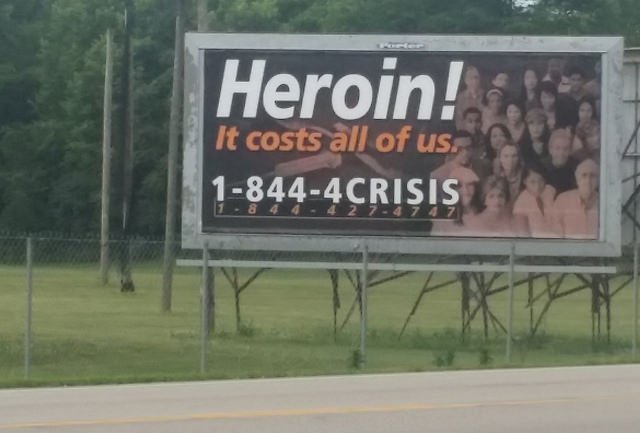
The speech comes just weeks after a spokesman for my Congressman (Warren Davidson) advised the county commissioners that the challenge of this generation is the ‘heroin problem.’

Talk about an uninspiring goal especially for a region with a rich history of inventions and inventors.

Public Policy

Solving the heroin problem requires original thought, public policy shifts — and, quite frankly, money. But money is lacking. Despite the spin that, due to an increase in sale tax income, ‘most businesses are doing well,’ many locals are financially strapped.

How Well Are You Paid?

In Preble County two economies seem to exist. Oddly enough, even with our Trump-leanings, the separation falls along government lines. Workers supported by taxpayer dollars — county-level politicians and staff, public safety officials, city government or school district employees — fare much better economically than fellow citizens.

About half of our 20,000 or so workers exit the county for employment while many who remain work retail or fast food. Around five percent of ‘prime-aged’ workers in the county (1,000 people) have simply quit looking for gainful employment. Roughly 6-8 locals compete for every manufacturing job opening. Besides wreaking havoc on family incomes, inadequate work opportunities also mean a lack of tax revenue for the county — inside a state that has intentionally cut off funds to local governments.

Investing in People, Attracting Jobs

Locally, this lack of money is seen in the small details like choosing to attach a paper note (in 2009) detailing a reduction in business hours — instead of updating the county courthouse door. It’s heard in the prayers where the ‘less fortunate’ are mildly scolded for their societal failure and God is implored to

…help them see their circumstances aren’t as bad as they could be.

in a tone that feels like the Pharisees, who prayed,

God, I thank You that I am not like the other men—swindlers, evildoers, adulterers—or even like this tax collector (or druggie in the modern era).

It’s also heard by listening to what is not said.

‘Suffer The Children’

In the state of the county address, care was taken on which stats to push out into the public arena. One of the stats mentioned was the roughly half-million dollars spent by Jobs and Family Services in 2015 — the agency that is mandated (among other tasks) to house children that are, in essence, wards of the state. This stat alone — which rose from a $162,000 General Fund expenditure in 2010 to $517,000 in 2015 suggests all is not well here, but it also speaks to the level of irritation felt by officials that the expenditure exists. The county’s engineer’s office also recently spent (in one month, not one year) about the same amount — on ditch maintenance equipment, a 2017 7-passenger van and a 2017 Jeep Cherokee — but those unmentioned expenditures do not seem to elicit the same level of angst.

(Missing from the comment, of course, is the larger, more troubling story of how much profit these children generate as they are shuffled away from family members and out of the county — and in some cases out of the state — in a modern-day version of Orphan Trains.)

Good Ol’ Days

It was in the Reagan years when the ‘roller coaster ride’ of government spending came to an end. The dismantling of government and deregulation of industry also marks the beginning of our decline. In an outgoing message from a GOP Preble County Commissioner in the mid-1980s, he admitted it was probably good for us that the subsidies had ended. But our best years were the 1950s to the late-1970s.

He also said,

“Because people are employed and do much of their shopping outside the county, tax revenue is poor. More and better employment opportunities are the only answers to this problem.”

It Rolls Downhill

Except for a handful of expansions here and there, the good jobs did not come. Instead a slow, steady increase in local taxes unfolded — as villages and the city started skimming one to two percent off the top of workers’ paychecks. This was in addition to the one to two percent paid for school taxes. Then our local sales tax rose, outpacing the state, eventually landing at 7.25 percent which, of course, is a heavier burden for lower income workers — like those working minimum wage — or those on a fixed income. Then residents began shelling out an additional $20 for a local tax when they purchased their license plates.

As local taxes stripped them of hard earned money people grew angry, not at the local decision makers, but rather at the federal government.

Precious Stones

In Walden, Henry David Thoreau astutely points out that, in America, we worship polished stone. Although he was alluding to our national obsession with monuments, it speaks to our belief that capital or property is more valuable than people.

Of course, the mindset that values property over people is as old as the country (read the history of the Virginia Colony). Two small monetary expenditures — one for $5,000 the other for $10,000 — approved by the commissioners late last year exemplify our local, underlying bias.

The lesser amount, which raised the county’s overall annual obligation to $10,000, satisfied a state mandate that required mental health services be offered to inmates at the county jail. Ohio, like much of the country, is plagued with overcrowded prisons and jails (as state legislators criminalize more behavior). Although, compared to the overall budget, the $5,000 increase is miniscule, it generated considerable discussion and one commissioner said, ‘how do we get them off our dime.’

The second decision altered a county insurance policy so our courthouse would be replaced, as opposed to repaired, in the event of a disaster — such as a fire. Discussion was virtually non-existent as the board rubberstamped the $10,000 annual increase to replace polished stone.

Of course, the appraised value of buildings tend to fall when people abandon a community.

They began leaving seven years ago.

Categories: 8th congressional district, Life In A Red State, My America, Personal Essays, Understanding Trump Counties

10 Things I Learned This Week

new-orleansSince this has to be the making of one of the most asinine eras of American history, from time to time I’m going to list what I learned over the course of seven to 10 business days.

  1. Risk-based screening. I was reminded that word choice is integral to shifting public opinion when I read an update from my Congressman Warren Davidson (OH-8th). Davidson, who noted he had been on Fox & Friends to discuss national security, advised in his newsletter that,

    “It is time for Congress and the President to work together to pass legislation reforming risk-based screening for refugee and other immigration programs.”

    It reminded me of the words by 20th century journalist and satirist H.L. Mencken,

    “The whole aim of practical politics is to keep the populace alarmed by an endless series of hobgloblins, most of them imaginary.”

  2. Fast-Track ILC (In Lieu of Conviction). Although an individual who utilizes medication-based therapy to kick a heroin habit has a 70-90 percent chance of relapse — and those who try ‘willpower’ alone tend to relapse with 30 days — my local prosecuting attorney’s office has created a plan to fast track heroin cases so defendants can get treatment instead of jail time. I’ll be following the results of these cases because it feels more like fast-tracking defendants through the system and creating a new crop of felons. (See 13th)
  3. Americans are (still) angry — My Senator from Ohio, Rob Portman, is denying allegations that he refused to allow Democrat constituents to attend a Presidents Day event.
  4. Farmers who supported Trump, may get the shaft. Since I live in a rural, farming region, I found these stories interesting. Some farmers who use immigrant labor were hoping for a status quo approach to deportation since it affects their bottom line. That, of course, is not happening. Farmers who export crops to China or Mexico may also be negatively impacted if relationships between the countries continues to be strained.
  5. The GOP ‘mavericks’ are voting in line with Trump. Talk is cheap and despite the maverick image of GOP heavyweights like John McCain and Rand Paul or even my governor — John Kasich, the image appears to be more hype than reality since they are voting (or in the case of Kasich — meeting) in line with Trump’s agenda.
  6. Boehner says Repeal and Replace won’t happen. Whether you like him or not, former House Speaker John Boehner, at times, can be very direct. With regards to repealing Obamacare he says the GOP is just blowing smoke. It’s not going to happen.
  7. Deportation is fueling private prison profits. Follow the money is the old journalism adage. Big actions often mean big profits for some and such is the case with the drive to rid of the country of the ‘bad dudes.’
  8. Trump travel costs outweigh Obama’s — by a lot. The GOP loved to moan about Obama’s vacations, golfing, etc. Turns out Trump is outperforming the former president in money spent on getaway trips.
  9. Losers go home. Mitch McConnell, the Senator from the state where I was born, Kentucky, is apparently tired of all the protests and demonstrations. He said he is not opposed to obstructionism, but the losers in this election need to get over it, because winners enact the policies and losers go home.
  10. Americans still have a sense of humor. Apparently Alec Baldwin’s portrayal of the president is gaining popularity.
Categories: 8th congressional district, My America, Politics