
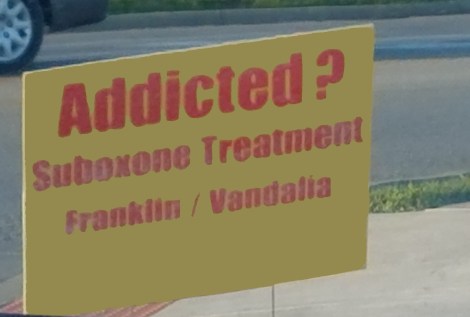
Company, from nearby county, offering heroin addiction treatment for Preble County residents.
“Boredom and a sense of uselessness and inadequacy—these are human failings that lead you to just want to withdraw. On heroin, you curl up in a corner and blank out the world. It’s an extremely seductive drug for dead-end towns, because it makes the world’s problems go away. Much more so than coke or meth, where you want to run around and do things—you get aggressive, razzed and jazzed.” — Judith Feinberg, West Virginia professor who studies drug addiction, as quoted in the The New Yorker.
In 2016, 18 Preble County residents died of accidental drug overdose. In 2017, there were 25.
One who did not die was a 40-year-old male who overdosed last Spring in a downtown Eaton, Ohio residence. When officers and paramedics arrived another male, presumably a fellow user, was administering CPR. In our local War on Drugs, the chemically-addicted have learned that CPR may be their best hope of survival — as they save each other from accidental death.
The victim was revived with Narcan, transported to a local hospital, and arrested for possession of a drug abuse instrument. The man’s next interaction with the police came two weeks later when, according to the police report, he was again arrested for possession of a drug abuse instrument. The incident began when an officer ‘on regular patrol of (same address where overdose occurred)’, noticed the man ‘skipping from under the carport into the alley and onto the roadway,’ at a ‘known drug house.’
This led to a pat-down, and the alleged discovery of a needle in the man’s pocket.
This individual would be arrested seven more times over eight months (nine arrests in nine months) — all for possession of a drug abuse instrument. Since the defendant’s address is listed as ‘at large’ he is presumably homeless.
And, now he owes ‘the system’ about $2,000.
Creating A Market
In today’s newspaper, a press release from the Preble County Prosecuting Attorney’s Office hints at the county’s role in the War on Drugs. Although, our role is a little overhyped in the release, the county played a part in a federal case that links a Mexican Drug Cartel to Middletown, Ohio. (You can read press release here). In the federal case, the Ohio State Highway Patrol Drug Interdiction team, which has been patrolling Interstate 70 inside Preble County for decades, arrested two of the indicted individuals.
A more realistic look at the traffickers we arrest can be seen in this story — where the traffickers feel more like drug users assisting other users.
Nonetheless, we definitely have a thriving drug culture inside Preble County. As I read and research newspaper clippings, police and court reports, I agree with the opinion of an individual associated with the Preble County court system, who recently said: We are in our third generation of drug abuse.
That, of course, begs the question: If we are three generations deep, why are we still arresting users, and not traffickers, and a follow-up question: Why are we not treating addiction like the mental health issue it is?
Ostracizing The User
One of the main reason we keep engaging in a decades-old approach is our iron-clad adherence to individualism. In a nutshell, this value system puts all the blame, and solutions, on the individual — eradicating any complicity caused by systemic failure. In 2018, we know a lot more about drug addiction than we did in 1968 when Preble County first began dealing with illicit drugs. Yet, we have not significantly altered how we address this societal problem that played a role in economically gutting our community.
In a Ted Talk, Johann Hari explains what other country’s have done to successfully combat drug abuse — and one of the most successful concepts is embracing methods that help the chemically-addicted reestablish connections with their community.
Reestablishing the connection is a two-way street. The chemically-addicted have to do their work to stay clean, but the community has to do its work as well, which begins with recognizing drug addiction is a disease, and not a choice. In Preble County, we are not there yet, and it shows by the arrest records, the court records and the jail roster as we continue to criminalize a mental health issue. And, as we sink deeper into the abyss, we perpetuate the problem by dehumanizing the chemically-addicted. This makes it easier to engage in practices that offer short-term relief (jailing them) while creating long-term problems (creating a subculture that cannot be integrated into the community — road-blocking them from a productive life).
How It Has Shifted
Beginning in the mid-to-late 1970s, Preble County adopted the arrest the user approach to combat our growing drug problem. This became more pronounced as the drugs became more addictive. Part of this is, undoubtedly, an issue of pragmatism. It is infinitely easier to arrest a user than upend a business engaged in trafficking. It is significantly safer, too. By and large, when you read the arrest records of known users, there is no violence.
This approach has led to processing an escalating number of mental health care patients through the court system — which is not equipped to effectively resolve the problem (we have no drug court). Regardless which year you choose from 2009-2017, there is a disproportional number of user cases compared to trafficker cases. And, the ‘big traffickers’ that are caught in Preble County tend to be the ones passing through (like in the federal case mentioned above).
But, to examine a couple of years, here’s how the ratio plays out:
2009: Total cases – 207
- Possession cases: 30
- Trafficking cases (which includes manufacturing, trafficking, sale and cultivation cases): 21
2012: Total cases – 302
- Possession cases: 62
- Trafficking cases (which includes manufacturing, trafficking, sale and cultivation cases): 29
2015: Total cases – 215
- Possession cases: 62
- Trafficking cases (which includes manufacturing, trafficking, sale and cultivation cases): 20
2017: Total cases – 319
- Possession cases: 146
- Trafficking cases (which includes manufacturing, trafficking, sale and cultivation cases): 7
Records also indicate a significant rise in aggravated drug possession charges in the past couple of years.
There Is A Better Way
Not all communities are addressing the War on Drugs in the same manner. Police in a New England town of 16,000 have abandoned the user-arrest approach choosing instead to add a prevention, enforcement and treatment coordinator to their staff. The officer, a 20+ year veteran in the War on Drugs and former prison guard, came to the realization that the arrest them/jail them approach was not working. The New York Times reports on his transformation.
Those years spent guarding prisoners, and later kicking down doors, changed (Eric) Adams’s thinking. So many of the drug users he saw had made one bad decision and then became chained to it, Adams realized. Or they had begun on a valid prescription for pain medication, after an injury, and then grew addicted…. Arresting a person like this did no good, because there was always another to replace him or her — and regardless, any jail sentence had limits. Afterward, Adams saw, everyone landed right back where they started.
As Adams brainstormed ways to solve the dilemma, he realized there were three approaches to the drug problem: prevention, enforcement and treatment. He began seeing the chemically addicted beyond the lens of criminal to include their other identities — as customers being targeted — and as victims needing treatment.
Now, when an individual overdoses in his New Hampshire town they can expect a much different approach. If the OD victim agrees to treatment, Adams will drive them to a rehab facility, and it does not end there. He keeps in touch with them — even if they relapse.
And, just as importantly, no accidental OD deaths have occurred since the program began.
 As an Ohioan whose U.S. Congressional vote has been disenfranchised, I am well aware of the downside that the unethical redistricting maps has caused. For starters, it created an environment that gave rise to the Freedom Caucus, which has at least two Ohio members (including Warren Davidson who presides over Ohio’s 8th Congressional District where I live). The Freedom Caucus does not have a reason to compromise (which the book does discuss). This unwillingness to compromise adds to the partisanship destroying Congress — at the expense of small towns like mine which are economically deprived and filled with a tainted labor pool due to our overly-aggressive approach to drug addiction. No solutions exist at the local level and no help is offered from the state or federal level. So small communities, like Eaton, Ohio, falter while Davidson and Freedom Caucus members push an anti-safety net agenda in line with what groups like Club for Growth want instead of what constituents need.
 Krakauer offers some commentary at the end of the book on why he chose to tackle the subject. When he decided to research the topic he was embedded with some U.S. soldiers for another book he was finishing up. As he explains he attended some therapy sessions with the soldiers who were dealing with Post Traumatic Stress Disorder, and the individual leading the session made the observation that two groups are most affected by the disorder: soldiers and rape victims.



 Charlie R. Claywell